
How much does Google Ads cost?

Ask "how much does Google Ads cost?" and you'll get the same answer everywhere: "it depends," followed by an average cost per click pulled from some industry benchmark. The number exists. It's also completely useless for making a decision.
Google Ads has no list price: you set a budget, Google spends it. The real question lies elsewhere, in what that budget costs you once you add up three layers: what you pay Google, what you pay to manage it, and what goes out the door without bringing anything back.
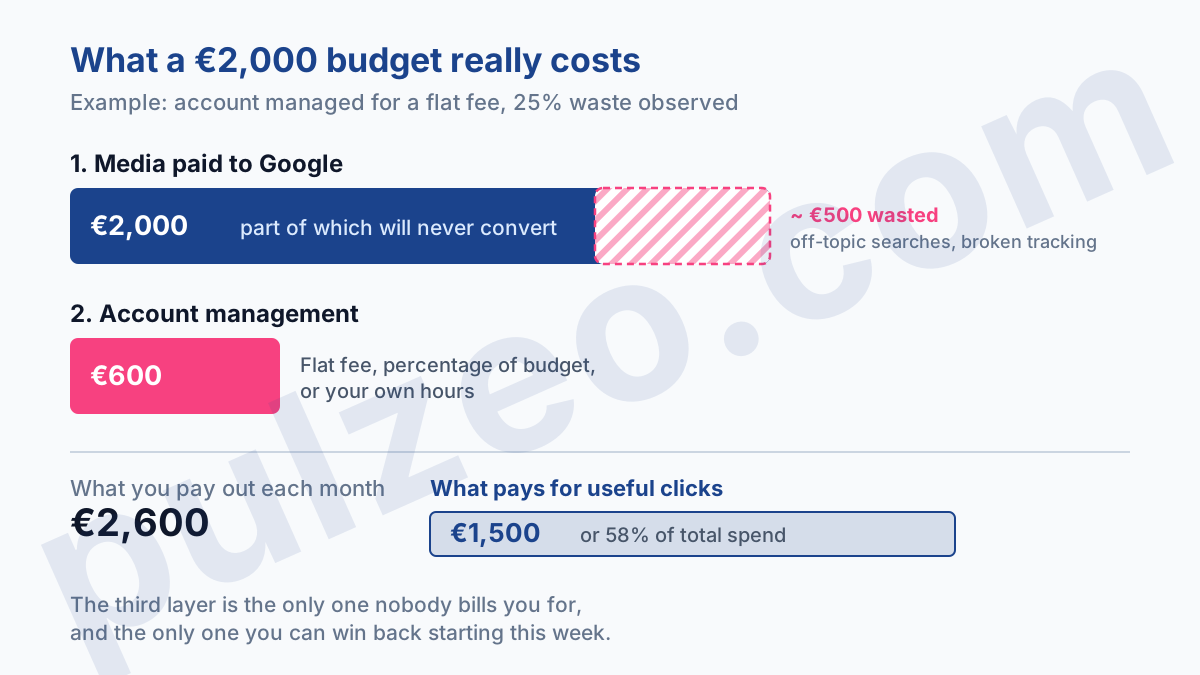
That third line is missing from every price list I read. You're quoted a €1,500 budget and 15% for management, and nobody tells you that a serious chunk of that €1,500 will pay for clicks that never had a chance of becoming customers. Here's the honest breakdown, layer by layer. The worked examples are French, since that's where I work, so the amounts are in euros; the reasoning holds in any market.
Does Google Ads have a fixed price?
Let's start with the good news, the kind that reassures anyone on a first budget: getting on Google Ads costs nothing in itself. No subscription, no account setup fee, no platform commission skimmed off along the way. You only pay when someone clicks your ad, and you decide the daily cap yourself.
What trips people up is confusing two very different things. The budget is what you choose to put in: a number you type into a box. The cost is what you have to live with: the real price of a click, set by the auction at that moment and by the competition on your query. You have full control over the first and none at all over the second.
One subtlety that many people discover on their first bill: your daily budget isn't a hard cap. Google can spend up to twice that amount on a given day, when the traffic is there, and make up for it on slow days.
Google caps spending at "two times your average daily budget" on a single day, and at "30.4 times your average daily budget" over a month.
That factor of 30.4 is simply the average number of days in a month. So the safeguard is monthly, not daily: seeing €38 go out on a Tuesday with a budget set at €20 is nothing unusual; it's the behavior described in the official documentation on average daily budgets. What counts is the total at the end of the month.
What is the average cost per click in France?
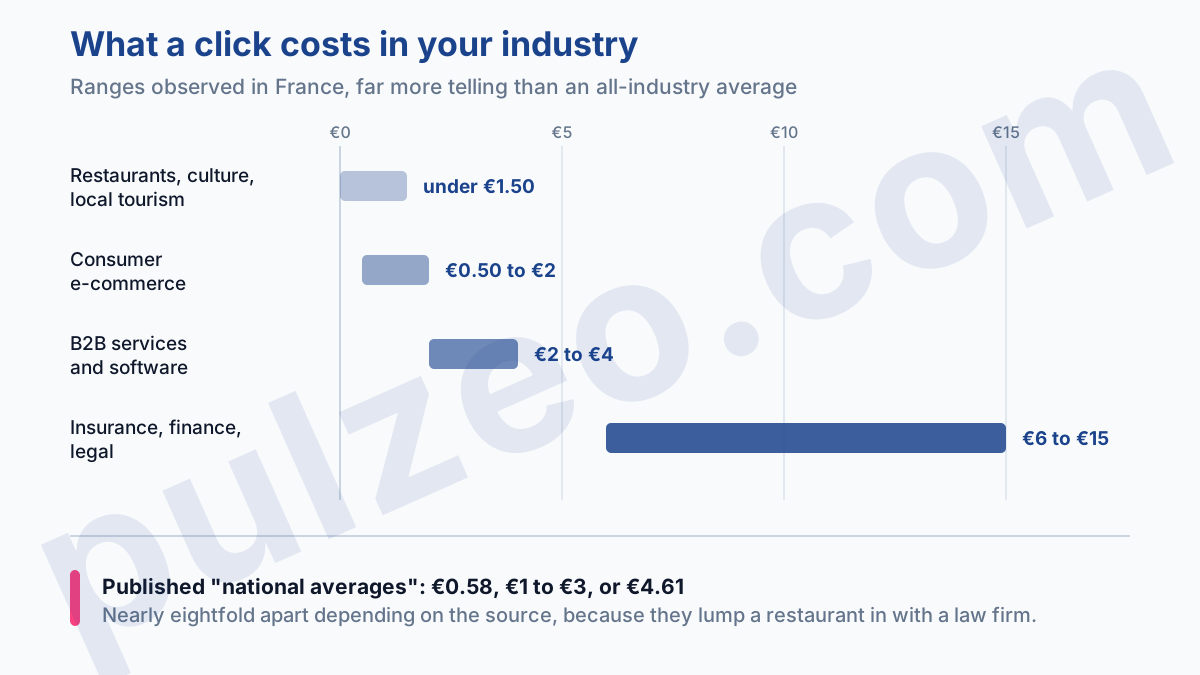
Here's the first layer, and the only one everyone talks about. Look up the average cost per click in France for 2026 and, depending on the publication, you'll get a median of around €0.58 from an ad-pricing observatory, €1 to €3 from most agencies, or €4.61 in the most widely cited roundups.
These figures don't really contradict each other: they're based on different samples. But how far apart they are is itself the answer to your question. An average that varies nearly eightfold depending on who calculates it can't tell you anything about your account, because it lumps a neighborhood restaurant in with a law firm.
The gaps between industries, on the other hand, are stable and far more useful. The Google Ads pricing tables published by French agencies and the ranges you see in the field line up fairly well:
- restaurants, culture, local tourism: often under €1.50 a click;
- consumer e-commerce: between €0.50 and €2;
- B2B services and software: €2 to €4;
- insurance, finance, legal: €6 to €15, with spikes well beyond that on the most competitive queries.
Two factors move your CPC within these ranges, and only one of them is up to you. First, competition: the higher your competitors bid on a query, the higher the price of entry, and there's nothing you can do about it.
Then there's the quality of your ad, measured by Quality Score: at the same position, an ad judged relevant pays less per click than an average one. It's the only lever that brings the price down without sacrificing anything else.
A point I make over and over in audits: a high CPC isn't bad news in itself. In an industry where a signed customer is worth €3,000 in margin, paying €12 a click is a bargain. For an online store with a €25 average order, €2 a click can be unsustainable. You never judge a CPC on its own.
These industry ranges are still ballpark figures. When a trade deserves its own numbers, I pull its searches one by one from Keyword Planner and take the math all the way to the cost per customer: that's what the episodes on a lawyer, a plumber and real estate do, where the gap between two searches in the same trade often exceeds the gap between two industries.
The cost of managing the account
Someone has to manage that budget. It's the layer that articles on Google Ads pricing almost always leave out, even though it often accounts for 15 to 40% of the total. A campaign left alone doesn't stay in shape: bids shift, searches change, ads wear out.
Agency prices: a percentage of the budget or a flat monthly fee
Two models split the French market. A percentage of the ad budget, usually between 10 and 20%, and a flat monthly fee, which runs roughly from €500 to €3,000 depending on the size of the account. Both are defensible, but they cost you dearly in opposite situations.
The percentage has the advantage of being proportional: it follows your budget. Its flaw is more of a problem than it looks, since it aligns incentives the wrong way. Your provider earns more when you spend more, never when you spend better.
The flat fee, on the other hand, crushes small budgets. At a €600 fee on €1,500 of media spend, you pay 40% of your ad budget in management fees, money that doesn't buy a single click. That's the math I ask everyone to do before signing, and I break it down in the article on when an agency is worth it. With a freelancer, the pricing works differently: here are a consultant's rates in detail.
Doing it yourself: the cost of your time
The free option isn't free. Managing an account properly easily takes two to four hours a week: reading search terms, excluding what doesn't convert, keeping an eye on CPA by campaign, rewriting ads. Put a value on those hours at what your time is worth, and you often land right back at the price of a flat fee.
The real cost of managing it yourself isn't even the time you spend, it's the time you don't. The accounts I take over are almost never badly managed out of incompetence: they're badly managed because nobody has opened the interface in six weeks.
Between the flat fee and the Sunday-night spreadsheet, there's a third way: Pulzeo analyzes your accounts and gives you an action plan ranked by impact, for a few dozen dollars a month.
The budget that brings nothing back
Third layer, the one nobody bills you for and nobody shows you. On an account nobody watches, a significant share of the budget pays for clicks that never had a chance of becoming customers. On the accounts I audit, that share that could never pay off most often sits between 20 and 40% of spend.
Take a moment to think about what that means. On a €2,000 monthly budget, 25% waste is €500 a month, €6,000 a year, handed to Google for worthless traffic. That's very often more than it would have cost to manage the account and prevent it.
Where does the leak come from? Almost always from the same places:
- off-topic searches picked up by broad match, with no safeguards;
- keywords that spend regularly without ever converting;
- broken conversion tracking, which skews every decision downstream.
The good news is that this third cost is the easiest of the three to recover. You won't negotiate the CPC of the legal industry, but you can cut a useless search this afternoon. The path runs through the Search terms report, then excluding useless searches as negative keywords. It's tedious, you do it once a week, and it's what separates a budget that works from a budget that evaporates.
What a customer costs you
Now forget everything above for a minute. Cost per click, hourly rate, waste percentage: those are components. The deciding number is your cost per acquisition, in other words what you pay to get a customer, compared with what a customer brings you.
The same reasoning applied to other acquisition channels, from word of mouth to buying leads, is in the article on what a customer costs depending on how you find them.
Two accounts to illustrate. The first pays €8 a click and converts one visitor in ten: each customer costs it €80. The second pays €0.50 a click but converts one visitor in five hundred: each customer costs it €250. The one with the more flattering CPC pays three times as much for its customers.
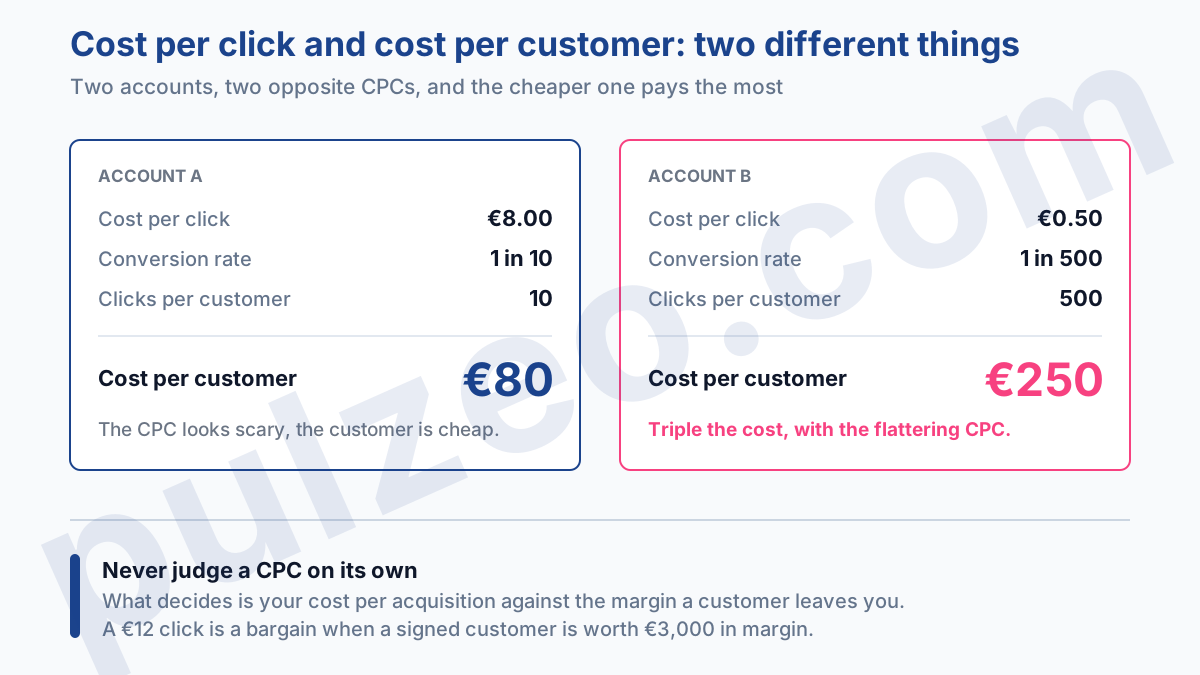
That's why I never start an audit with the CPC. I start from the CPA, compare it with the margin a customer generates, and everything else follows. If a customer leaves you €200 in margin and costs you €60, the account is healthy, even with a high CPC. If they cost you €190, you're working for Google.
And when the math never works out on a query, whatever you optimize, that's the sign it belongs in organic search rather than paid.
The calculation gets trickier when you're no longer buying clicks: on a video campaign, you pay per view or per thousand impressions, and it takes three conversion stages to get back to a cost per customer, as the article on the price of a YouTube ad explains in detail.
Our CPA calculator gives you the threshold beyond which you lose money, and the article on a rising CPA explains how to spot the decline before the end of the month.
So what budget should you plan to get started?
Honest answer: Google doesn't impose any minimum; you can launch a campaign at €5 a day. But a budget that's too small doesn't produce enough conversions to base a decision on, and you end up paying for data you can't use. Below €800 to €1,000 a month, most accounts operate in that fog.
That range is only a ballpark, not a rule: the real floor is calculated from your own CPA, and that's what the article on the minimum budget threshold covers in detail.
The ballpark figures I give depend mostly on the CPC in your industry. A local business on €1 searches can learn a lot with €600 to €800 a month. A general online store starts closer to €1,500.
A B2B company on €8 keywords barely reaches ten or so clicks a day with €2,500 to €3,000, or roughly 350 clicks in the month. That's not much to make decisions from, and it explains why these industries rarely start any lower. The ad budget calculator runs that calculation from your CPC and your goal.
One thing these ranges don't tell you, and it makes a lot of people give up too early: getting started costs more than running at cruising speed. Until automated bidding has built up enough signal, your cost per acquisition is inevitably higher, and there's nothing abnormal about that extra cost.
How long it lasts depends on your buying cycle, not on a fixed counter, as I explain in the article on the learning phase. Hence the real rule for a starting budget: plan enough to last beyond that phase, or you'll judge Google Ads on the very weeks when it was working at its worst.
One last piece of advice, the one I always give in a first meeting: build management into the budget from day one, not afterward. A €2,000 budget handed entirely to Google, without a single hour or euro spent watching over it, almost always produces less than a €1,500 budget that's actually managed.
That's exactly what Pulzeo sets out to make affordable: continuous monitoring of your accounts that warns you when a CPA spirals or a campaign spends without converting, without an agency's flat fee.
Google Ads is neither expensive nor cheap. It costs exactly what you're willing to let it spend without looking.
Common questions
What's the minimum budget to get started on Google Ads?
Google doesn't impose any minimum: you can launch a campaign at €5 a day. But below €800 to €1,000 a month, most accounts don't generate enough conversions to decide anything from the numbers. The real floor isn't set by Google, it's set by the amount of data you need to manage the account.
Does Google Ads charge fees on top of the ad budget?
No. There's no subscription, no setup fee and no platform commission: you only pay for clicks (or impressions, depending on the format). The extra costs you'll see come from elsewhere: agency or freelancer fees, a tool subscription, building landing pages.
How much does it cost to have a Google Ads campaign managed?
Two models dominate in France, where I work: a percentage of the ad budget, usually 10 to 20%, or a flat monthly fee ranging from €500 to €3,000 depending on the size of the account. On small budgets, the flat fee is proportionally very expensive: a €600 fee on €1,500 of media spend means 40% of your ad budget paid out in management fees, money that doesn't buy a single click.
Is cost per click the right metric for judging the price?
No, it's the most misleading one. An €8 click that converts one time in ten gets you a customer for €80; a €0.50 click that converts one time in five hundred gets you a customer for €250. The only number that matters is the cost per acquisition compared with what a customer actually brings you.
