

You look at your acquisition budget, and the question always comes up the same way: SEO vs PPC, which channel will work better for you? You search, and you read the same answer nine times over: the two are complementary. That's true. And it doesn't help anyone decide anything on a Monday morning.
Here's the answer I give, and it comes down to a single division. The choice isn't made at the channel level, it's made keyword by keyword. On the same site, some queries are profitable in ads and others are lost causes from the start, and you can tell which ones before you've spent a dollar.
What's the difference between SEO and PPC?
SEO earns you a position; PPC rents it to you.
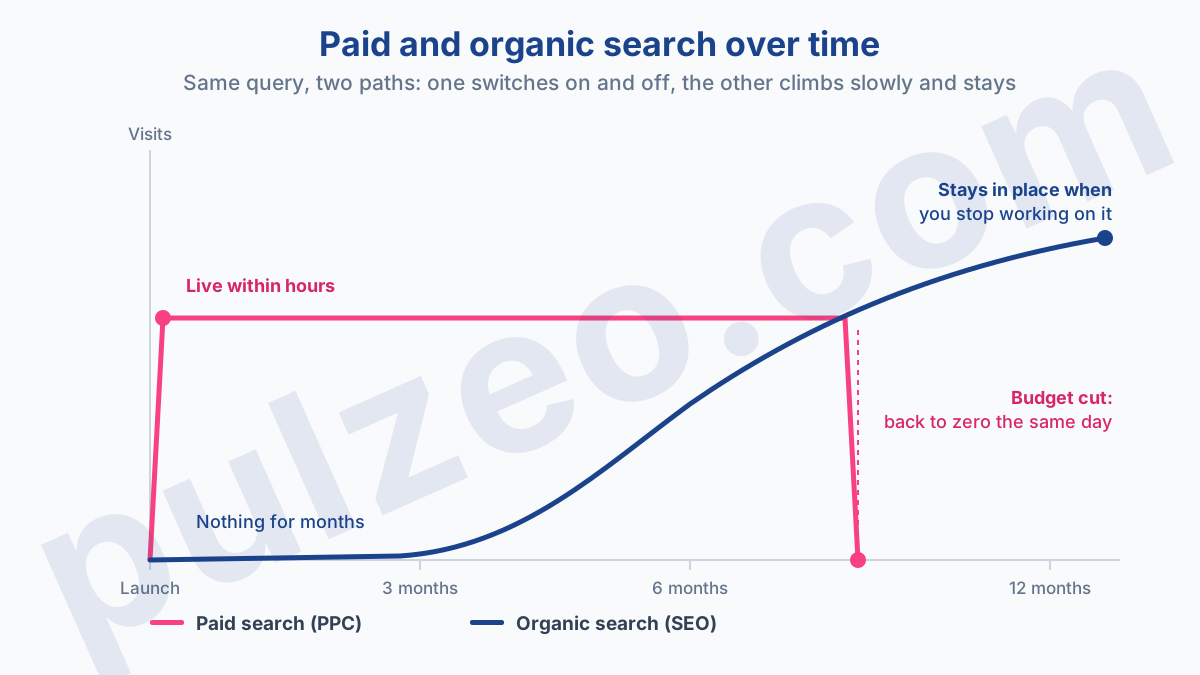
With SEO, you earn your place with content, technical work and links. The click costs you nothing, and the position stays when you stop working on it, wearing away slowly. With PPC, which you'll also hear called paid search or SEM, you buy the click at auction. Your ad shows up within hours, and it disappears the day you cut the budget.
On screen, the only visible difference is the "Sponsored" label. For your decision, what matters lies elsewhere: lead time and reversibility. Ads switch on and off within the day. SEO takes months to climb, and months to come back down.
There's a third asymmetry, less well known and yet decisive for the rest of this article. Ads tell you which query triggered the click, query by query. Organic doesn't: Google shows only some of those queries in Search Console and folds the rest into the totals.
Is SEO really free?
No. The click is free; the position isn't.
The word "free" spoils the whole comparison, because it sets a blank column, which is anything but blank, against an ad budget with a number on it. SEO that produces anything is paid for in production, and that production has four line items:
- the site audit and the technical fixes;
- writing and updating content;
- acquiring inbound links;
- maintenance, once the positions are won.
Figures on this item are scarce, and they need a careful read. On the French market, where I work, a paid link goes for €100 to €1,000 a month on average. Links that come from your suppliers, your partners or professional directories, on the other hand, are usually free.
For everything else (the audit, the content, the upkeep), the published ranges are too scattered for any single figure to mean anything.
And if you do it yourself, the cost still exists; it just changes columns. Three articles a month at four or five hours apiece comes to two working days. Multiply that by your day rate. That amount never appears on an invoice, which explains why so many comparisons leave it at zero.
The ad side comes with a bill too, and the comparison is telling: on the same French market, expect to pay €200 to €1,000 to have a campaign built, then €200 to €2,500 a month to have it managed, on top of the ad budget itself. Neither channel is the cheap one.
How long does SEO take to work?
Nobody can tell you, not even Google.
Agencies converge on three to six months, a figure repeated so widely it passes for data. Google's own documentation explicitly declines to commit. Its official SEO Starter Guide says that some changes take effect within a few hours while others take several months, and recommends waiting a few weeks before even judging whether a change did any good.
When the company that runs the search engine won't give a timeline, it's because the timeline depends on things it doesn't control either: your domain, your industry, and what everyone else is doing.
In practice, on a young domain in a competitive industry, the clock runs longer than six months, and nothing guarantees page one at the end of it. That uncertainty is what really sets SEO apart from advertising, far more than price: an ad starts tomorrow, at a cost known in advance, and within three weeks you know whether it pays.
The math that tells you if a keyword is worth it in PPC
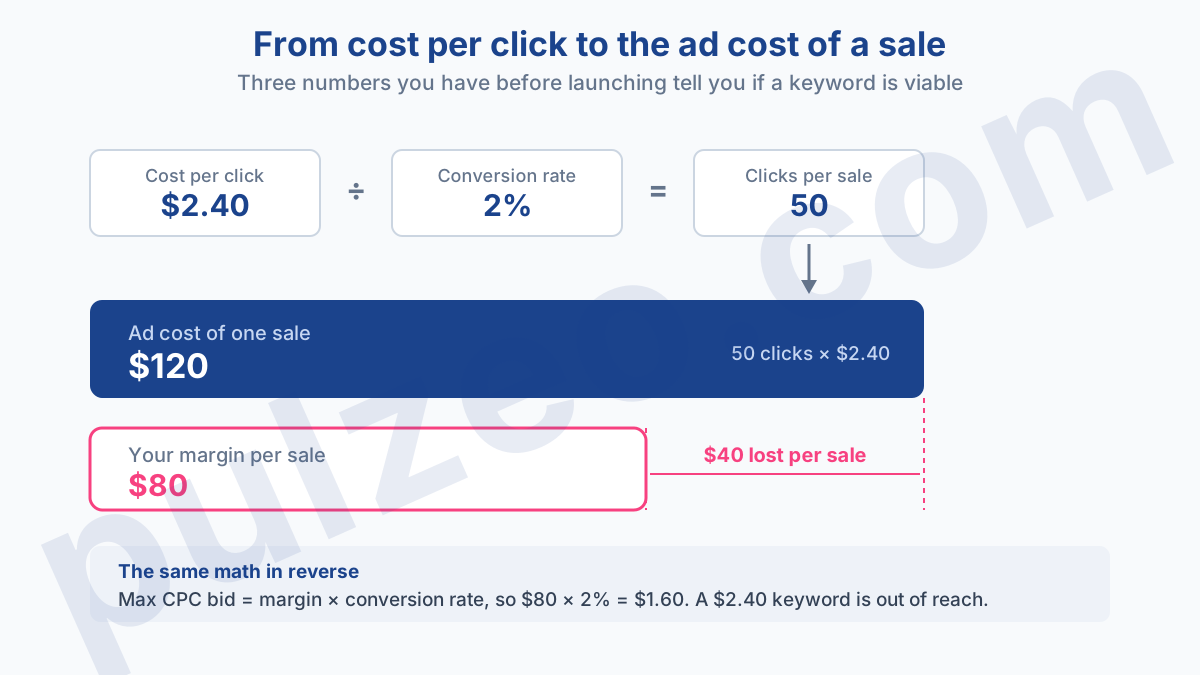
The ad cost of a sale is the price of the click divided by your conversion rate. The whole decision comes down to that.
You need three numbers, and you have all three before launching anything:
- the keyword's top-of-page bid range in Google's Keyword Planner, which stands in for the cost per click;
- your conversion rate, read off your site or estimated;
- your margin per sale.
Take a keyword at $2.40 a click and a site that converts at 2%. That means fifty clicks for one sale, or $120 of advertising per sale. If your margin is $80, that keyword loses you $40 on every order, and no amount of ad optimization will close that gap. If your margin is $300, you'd be wrong to pass it up.
The same math works in reverse, and that's where it becomes useful. Your maximum CPC bid is your margin multiplied by your conversion rate. With an $80 margin and a 2% conversion rate, you can't pay more than $1.60 for a click. A keyword showing $2.40 is out of reach, and you know it without having spent a cent.
Our max bid calculator does the calculation for you. And Pulzeo gives you the cost per click of your keywords without your having to build a campaign to get at it.
A word of caution about these figures: the cost per click you're shown is a range, not a promise, and average CPC doesn't mean much on its own. The math isn't there to predict to the cent; it's there to rule out, from the start, the keywords that don't stand a chance.
Why the answer changes from one keyword to the next on the same site
Because the two numbers that decide it, the cost of the click and the conversion rate, vary enormously from one query to the next on your own site.
On your brand name
The click costs next to nothing there, nobody else is seriously fighting for it, and whoever types your name already knows you: they convert much better than your site average. The math almost always works. The real debate lies elsewhere, and it's a simple one: are you paying for a position you already hold for free? The answer depends on whether or not a competitor is bidding on your name.
On a generic query
The click is expensive there, because everyone is after it, and it converts less well, because the searcher is still comparing. The math often doesn't add up. That's exactly where SEO pays off: the same query, with no cost per click, and a mediocre conversion rate that no longer costs you anything to absorb.
Hence the conclusion the comparison articles never draw. Asking SEO or PPC for a whole site has no answer, because the same site answers "ads" on thirty queries and "content" on three hundred others.
What PPC teaches you about your SEO
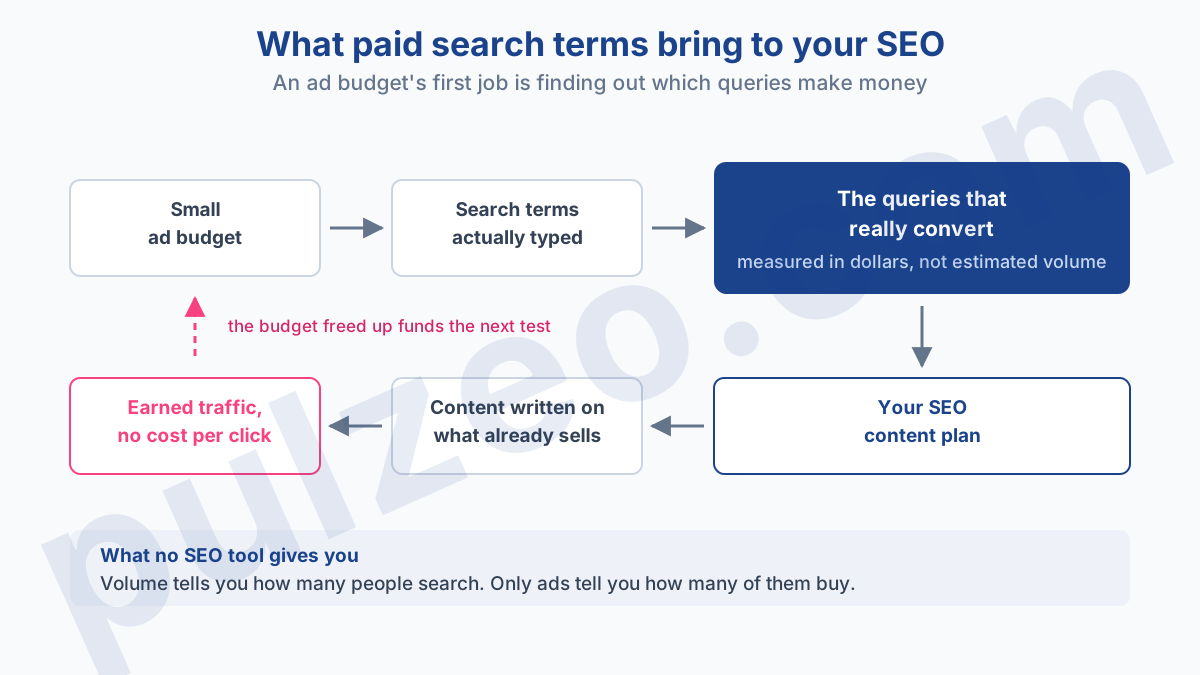
Advertising tells you which queries actually make money. No SEO tool tells you that.
SEO tools give you volume and an estimated difficulty. Neither one tells you whether the query brings in customers: a keyword with 2,000 searches a month can sell nothing at all, and a keyword with 40 searches can drive your revenue. You only find out after writing the article, which is to say too late.
Advertising settles that question in a few weeks, with real money. The search terms report shows you the queries people actually typed and what each one produced, as long as you know that Google hides some of them. Zeo can analyze that data for you and point out the queries that spend without bringing anything in.
Now flip the logic. A small ad budget becomes a paid measuring instrument for your content plan: the queries that convert in ads are the ones that deserve an article. You're no longer writing blind; you're writing about what has already proven it sells.
SEO or PPC on a tight budget?
Start with ads, on a handful of keywords that pass the math test.
Three reasons, in order. You get data in weeks instead of months. You can stop overnight if it isn't working, which isn't true of an investment in content. And above all, SEO built without data is a string of bets: you pick your topics on instinct, you wait six months, and only then do you discover you went after the wrong queries.
Two honest caveats, because this advice doesn't hold everywhere. If your margin doesn't cover the ad cost of a sale on your queries, advertising isn't an option at all, and you'll have to accept the slow pace of organic or look elsewhere. And you need enough budget to reach a measurement threshold: below a certain number of conversions, you aren't buying information, you're buying noise.
The rest of the work is monitoring, and that's the part that wears people down. You have to track the cost per click as it climbs, the conversion rate as it shifts, the margin as it tightens, and redo the division regularly for each group of keywords. Nobody has time to do that by hand every week.
That's what Pulzeo does for you. The dashboard keeps your cost per conversion up to date against the previous period, drills down to the keyword, and warns you when a campaign spends without bringing anything in. Our plans start below the price of half a day of consulting.
So the question you started with never called for a channel; it called for a list. Pull up your top twenty queries, put each one's cost per click and your margin beside it, and you'll see the answer take shape line by line, without having to pick a side.
Common questions
How much does SEO cost compared with PPC?
SEO costs nothing per click, but it costs in production: audit, content, links, maintenance. On the French market, where I work, a paid link goes for €100 to €1,000 a month on average. For the rest, the published ranges are too scattered to mean much. If you do it yourself, the cost is in hours: count them and multiply by your day rate, or the comparison with PPC is skewed from the start.
How long should you wait before judging an SEO change?
Google's documentation refuses to give a firm timeline: some changes take effect within a few hours, others take several months. It advises waiting a few weeks before assessing a change. In practice, on a young domain in a competitive industry, think in months, with no guarantee of reaching page one.
Should you do SEO and PPC at the same time?
When the budget allows, yes, but not on the same queries. Keep ads for the keywords whose margin covers the cost per sale, and content for the ones too expensive per click to be profitable. Doing both everywhere means paying twice for the same position.
What's the minimum budget to test a keyword with PPC?
It isn't measured in dollars but in expected conversions. Until the test produces enough conversions to tell a result from chance, you're buying noise. The useful benchmark: multiply the estimated cost per sale by about thirty conversions, and see whether that budget is within your reach over the test period.
