
What is the minimum Google Ads budget?

"How much should I put into Google Ads?" Everyone answers with a range. $300 to $500 a month to get started, $800 to $2,500 for a small business, $20 a day to test. Those figures have one thing in common: they're pulled out of thin air by whoever quotes them. Yet your minimum Google Ads budget can be calculated, and it comes down to a single multiplication: thirty times your cost per acquisition.
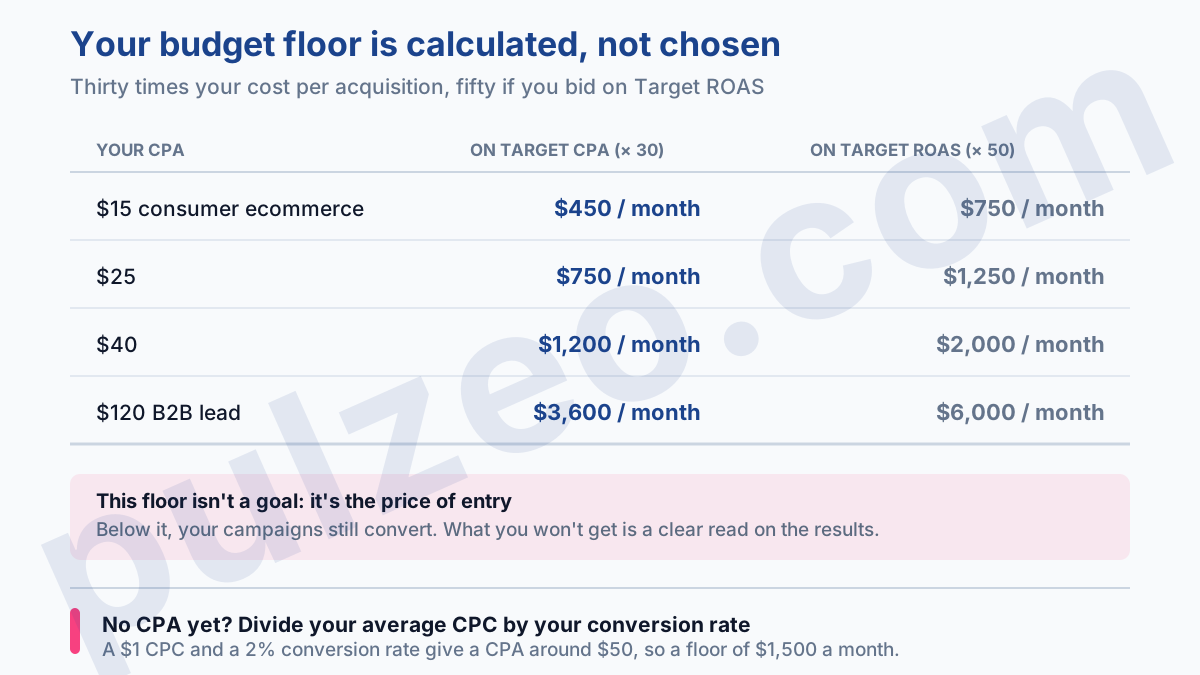
So a $25 CPA calls for $750 a month, and a $120 B2B lead calls for $3,600. That floor only covers the share paid to Google: for what Google Ads really costs, all in, you have to add account management and wasted spend.
Let's be clear about where this comes from, because that's the whole point. The thirty comes from Google, which sets it down in black and white in its documentation. Turning it into a budget floor, on the other hand, is my own deduction, and I stand by it.
Here's why that reasoning holds, how to set your number, and why the most common advice online doesn't survive three lines of math.
How much should you spend on Google Ads at a minimum?
Enough to produce thirty conversions a month: that's the threshold Google uses to evaluate a bid strategy, and I derive a budget floor from it.
That comes as a surprise, because the budget is always presented as an amount you decide, based on what you can afford. In reality, it's dictated to you. Your cost per acquisition sets it, and the volume of data the algorithm needs locks it in. Your market sets the price of a click, your site sets the conversion rate, and those two set your CPA. Everything else follows from there.
That's why "$500 a month" means nothing until you know what a conversion costs you. For an online store at a $15 CPA, $500 keeps an account running. For a B2B firm at $120 a lead, $500 buys four leads in the month. Enough to pay the bill, without learning a thing.
If you haven't launched a campaign yet, this calculation happens before you even open the interface: I've laid out where to start when you create your first campaign, and the budget comes last there, not first.
Why Google doesn't set a minimum budget
Go looking for an official Google Ads minimum budget: you won't find one. You can open an account and run ads at $1 a day, and nobody will stop you. The only guidance on amounts that Google gives in its guide to choosing your bid and budget is to start small and watch what happens.
That missing guardrail costs you dearly. No message will ever tell you "this budget is too low for the campaign to work." The ads will run, the clicks will come in, the bill will arrive. Everything will look normal. And after three months, you'll conclude that "Google Ads doesn't work for us," when you never reached the threshold where it starts to work.
It's the trap I see most often with advertisers who come to me discouraged. Their campaigns didn't fail: they were never put in a position to succeed.
The 30-conversion threshold Google publishes
The figure exists, and it's public. In its documentation on Smart Bidding, Google recommends measuring performance over a period of a month or longer that has at least thirty conversions. Its page on Target CPA is stricter: the last thirty days, at least thirty conversions.
Read it for what it is, no more, no less. Google recommends; it doesn't forbid anything. Your campaigns will run at ten conversions a month, they'll convert, and no eligibility threshold will stand in your way on Target CPA. What it's telling you is that below thirty, it won't vouch for what the results mean.
One detail that matters, and that Google leaves open: its page doesn't say whether those thirty conversions are counted per account, per campaign or per bid strategy.
Since the sentence is about evaluating a strategy, and a strategy is set at the campaign level, that's the level I use throughout this article. Keep it in mind, because it changes your trade-offs: thirty conversions spread across five campaigns aren't worth thirty conversions in a single one.
This is where I take over, and you can judge the reasoning for yourself. If the very company selling the ad space thinks you need thirty conversions to judge a strategy, then a budget that can't produce thirty buys you a number that nobody, not even Google, guarantees means anything.
The budget isn't too small to convert, then. It's too small to give you a verdict.
Why thirty, and not ten or a hundred
Google doesn't justify it anywhere, so here's my take, for what it's worth. Smart Bidding is a statistical engine, and a statistical engine needs data. With eight conversions in a month, it's hard to tell a signal from chance: three more or three fewer, and your read on the account flips.
One thing is certain, though: you're in the same boat. On ten conversions a month, a CPA going from $25 to $31 proves absolutely nothing: two fewer conversions, one bad month, are enough to produce that gap on the same budget.
You won't know whether your change worked. Thirty simply marks the point where the swings start to mean something.
Fifty conversions if you're aiming for Target ROAS
Google's page on Smart Bidding sets a higher threshold for Target ROAS: fifty conversions. The logic holds up. Target CPA has only one thing to predict, the probability that a click converts.
Target ROAS also has to predict the value of each conversion, and a value varies far more than a simple yes or no. A $40 order and a $900 order each count as one conversion.
A practical consequence that often gets ignored: switching to Target ROAS raises your budget floor by 67%. Plenty of online retailers switch to it because it sounds more grown-up, with volume that was barely enough for Target CPA. Then they wonder why delivery collapses.
How do you calculate your Google Ads budget?
The formula fits on one line: Google Ads budget floor = 30 × your CPA. And if you bid on Target ROAS, 50 × your CPA.
A $25 CPA requires $750 a month. A $40 CPA requires $1,200. A $120 B2B lead requires $3,600, and there's no trick to get around it. Careful, though: this floor is still only a price of entry, the amount below which you're buying noise.
Your actual budget then follows from your business goal, by multiplying the number of sales or leads you're aiming for by your CPA. Our ad budget calculator does that math in one click if you'd rather skip the spreadsheet.
What if you don't know your CPA yet?
The classic starting-out case: no history, so no CPA. Estimate it from two figures you can get before spending a single dollar. Your average CPC, which Keyword Planner's forecasts give you for your keywords.
And your conversion rate, which you know if you already have a site, or which you set cautiously at 2% if you have nothing. The estimated CPA is the CPC divided by the conversion rate.
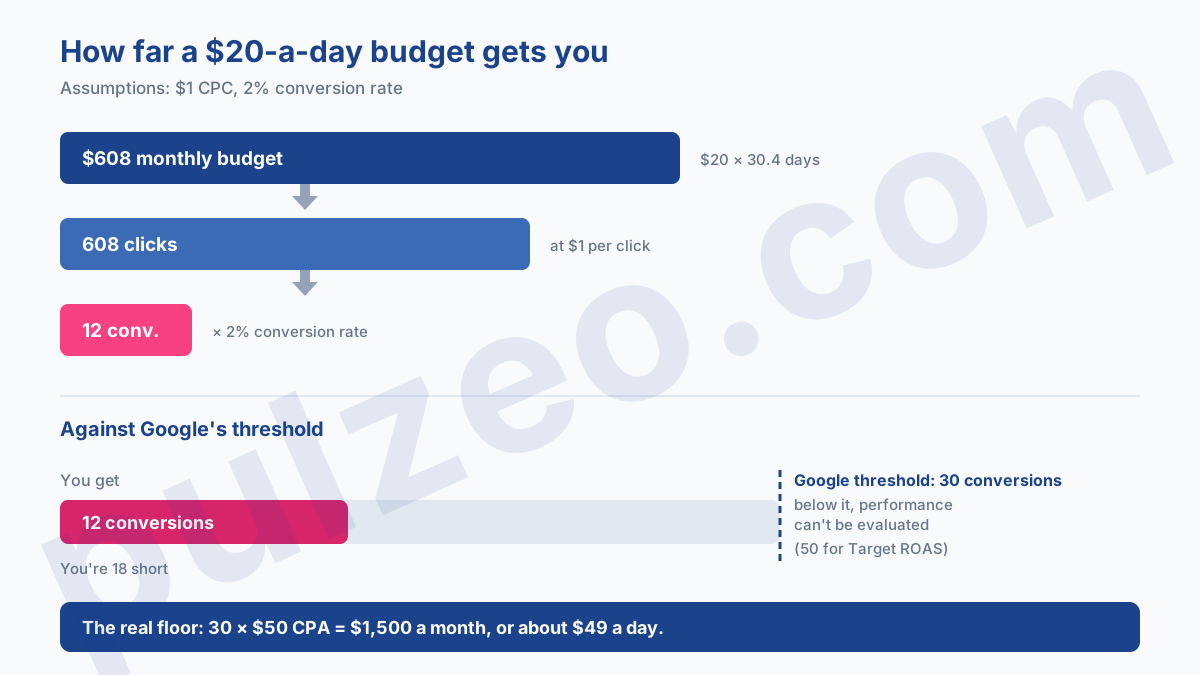
A concrete example. A $1 CPC, a 2% conversion rate: your CPA will land around $50. Thirty conversions at $50 is $1,500 a month, or about $49 a day. That puts you at more than double the "$20 a day to test," and you knew it before spending your first dollar.
Can Google spend more than my daily budget?
Yes, on a given day. No, over the month. It's the most common source of confusion about the Google Ads daily budget, and both rules are written down in the documentation on average daily budgets.
First rule: on any given day, Google can spend up to two times your average daily budget, for most campaigns. Set $30 and you may see $60 on a Tuesday when traffic is good. That's by design: Google overdelivers on the strong days and makes up for it on the slow ones.
Second rule, the reassuring one: over the month, you'll never pay more than 30.4 times your average daily budget.
The 30.4 is the average number of days in a month, 365 divided by 12. So a $30 daily budget can't cost you more than $912 over the month, whatever the spikes. Remember this multiplier rather than 30: it's the one that turns a daily budget into a monthly budget.
Why "$20 a day to start" almost never works
This advice is everywhere, and it rests on click-based reasoning: at $1 a click, $20 a day buys 20 clicks, and twenty clicks a day give you data. The reasoning is appealing. It's also wrong, because Smart Bidding doesn't learn from clicks. It learns from conversions.
Run the numbers. $20 a day is $608 over the month. At $1 a click, that's 608 clicks. At a 2% conversion rate, that gives you twelve conversions. Twelve, when Google recommends thirty before its own bid strategy can be evaluated. You're at 40% of the threshold, and you'll never know it, because no alert will tell you.
That's where the advice becomes harmful, because it reassures you. It makes you believe you're testing, when you're funding an experiment whose result will be unreadable no matter what. Three months later, you'll have spent $1,824 to learn nothing.
One caveat from the field, though: this reasoning assumes accurate conversion tracking. If your conversions are miscounted, your CPA is wrong, and the whole calculation above collapses with it. Before sizing a budget on your CPA, check that the CPA means something, which I've covered in the guide on badly configured conversions.
Why a small budget doesn't catch up over time
This is the distinction that changes everything, and it's counterintuitive. It's tempting to imagine that a small budget gives the same results, only slower: fewer conversions a month, so more months to get there.
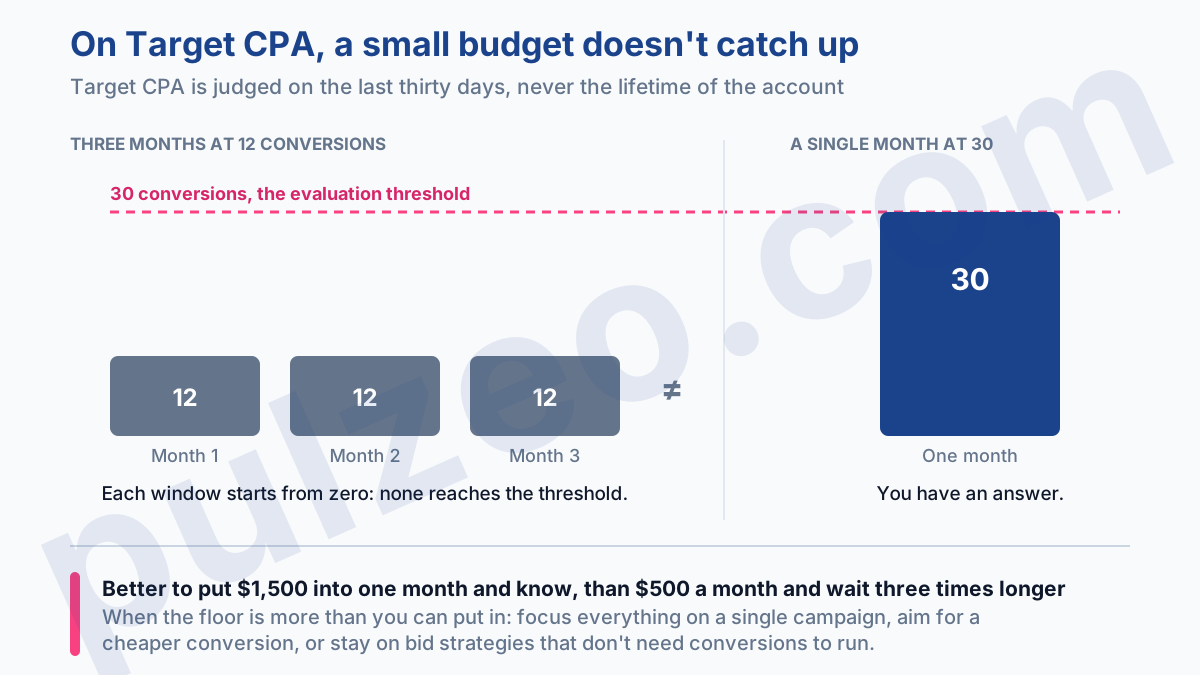
It's true for judging, not for bidding. To read your results, Google accepts a longer period as long as it has thirty conversions: three months at twelve give you a trend, two months late.
To bid on Target CPA, though, the threshold isn't cumulative. Google evaluates that strategy over the last thirty days, and calculates its recommended target over the same window. Three months at twelve conversions will never make one month at thirty: each window starts from zero.
So when the floor is more than you can put in, there are only three honest ways out, and none of them is hoping:
- concentrate the whole budget on a single campaign, instead of spreading it thin across five that will all miss the threshold;
- aim for a cheaper, more frequent conversion (a quote request rather than a purchase, a call rather than a signed contract) to bring the CPA down;
- stay on bid strategies that don't need conversions to work, such as Manual CPC or "Maximize clicks" with a maximum CPC bid limit.
The fourth option, the one nobody owns up to, is not running Google Ads this quarter. There's no shame in that. Better to put $1,500 into one month and know, than $500 a month for three months and wait three times as long to find out. On those searches, SEO is often the best use of your time until you have the budget to buy the clicks.
And if you're planning to hand all this over to someone, remember that management fees come out of that same pot. It's actually what decides at what budget an agency starts to pay for itself.
That leaves the real issue once the budget is set: holding it. A floor can be crossed in both directions, and an account that drops below its thirty conversions rarely does it with a bang. That's what Pulzeo watches for you: Zeo tracks the conversion volume and CPA of every account, and alerts you when the account slips, before three weeks of budget have gone into unreadable data.
Thirty times your CPA is the price of entry for getting an answer. Below that, you're buying silence.
Common questions
What is the minimum budget for Google Ads?
Google doesn't impose any minimum: technically, you can run ads at $1 a day. But the useful minimum can be calculated: you need enough budget to produce at least 30 conversions in 30 days, the threshold Google itself uses to evaluate Target CPA. In practice, your floor is 30 times your CPA. With a $25 CPA, plan on $750 a month; with an $80 CPA, plan on $2,400.
Should you multiply your CPA by 30 or by 50?
By 30 if you bid on Target CPA, by 50 on Target ROAS, which also has to predict the value of each conversion, which takes more data. The floor you get is still a price of entry, not a goal: above it, your budget follows from your business goal, meaning the number of sales or leads you're aiming for multiplied by your CPA. If you don't know that CPA yet, estimate it by dividing your average CPC by your conversion rate.
Can Google Ads go over my daily budget?
Yes, on any given day. Google states that the daily spending limit is two times your average daily budget for most campaigns. Over the month, however, you'll never pay more than 30.4 times your average daily budget. The days when Google spends more are offset by days when it spends less.
What happens if my Google Ads budget is too low?
Your campaigns run and you get conversions, since Google imposes no minimum. What you're missing is an answer. Under 30 conversions a month, you don't have enough to judge whether it's working, and Google itself recommends not drawing conclusions below that threshold. So you're paying for a result you can't read. Better to concentrate a small budget on a single campaign than to spread it thin across five that will all miss the threshold.
