
Google Ads account structure: how many campaigns

I take over an account, open the Campaigns tab, and I know almost immediately who I'm dealing with. Not by looking at the results, by looking at how it's carved up. Because Google Ads account structure isn't the housekeeping exercise you get sold everywhere: it's what decides whether Smart Bidding has anything to learn from.
An account with fifteen campaigns doing three conversions each is a "well-organized" account that will never learn a thing.
It's the misconception I see most often. People segment to "stay in control", multiply campaigns by product, by keyword, by location, and end up with a campaign hierarchy that's beautiful on paper and anemic in practice. Here's how to build a structure that helps the algorithm instead of starving it, and the only three real reasons to add a campaign.
The three levels of a Google Ads account
A Google Ads account has three nested levels: the account, the campaigns, the ad groups. The account sits above everything. Each campaign has its own budget and targeting. Each ad group brings together closely related keywords and the ads that go with them. That's the hierarchy described in Google's official documentation, and so far everyone agrees.
Knowing the levels is useless unless you know what gets decided at each one. Because every boundary you draw has a price.
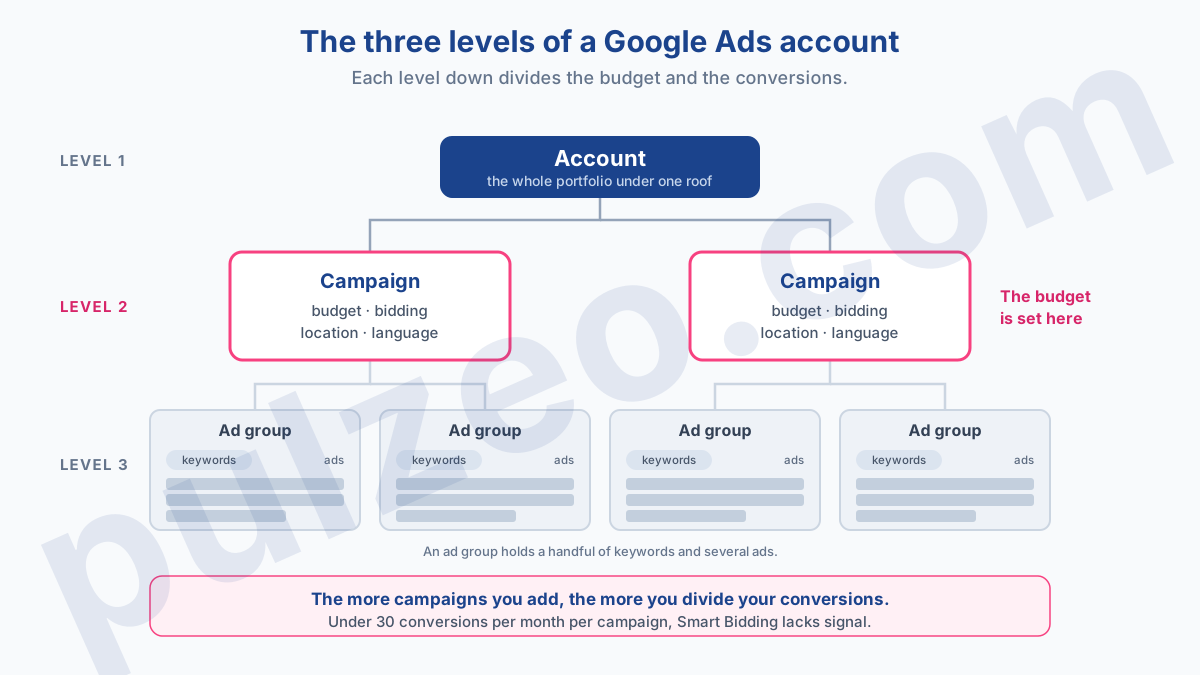
Budget and targeting are set at the campaign level
This is the point with the biggest consequences. Daily budget, bid strategy, locations, languages, ad schedule: all of it is set per campaign. Two campaigns means two separate budgets, two bidding algorithms each learning on its own.
Remember that, because everything else follows from it. When you add a campaign, you're not tidying up, you're cutting your budget and your conversions in two.
Keywords and ads live at the ad group level
The ad group, on the other hand, is all about consistency. It brings together a handful of keywords that mean the same thing, and two or three ads that speak to them. This is where relevance between the query and the message is decided, and with it a good part of your Quality Score.
A well-built ad group is a set of keywords so close that one ad suits them all. The moment you need to write a different message, that's the sign you need another ad group, not one more keyword thrown into the mix.
That consistency plays a second, lesser-known role. When several of your keywords could match the same search, the most relevant ad group wins the tiebreak, landing pages included.
Why splitting campaigns changes performance
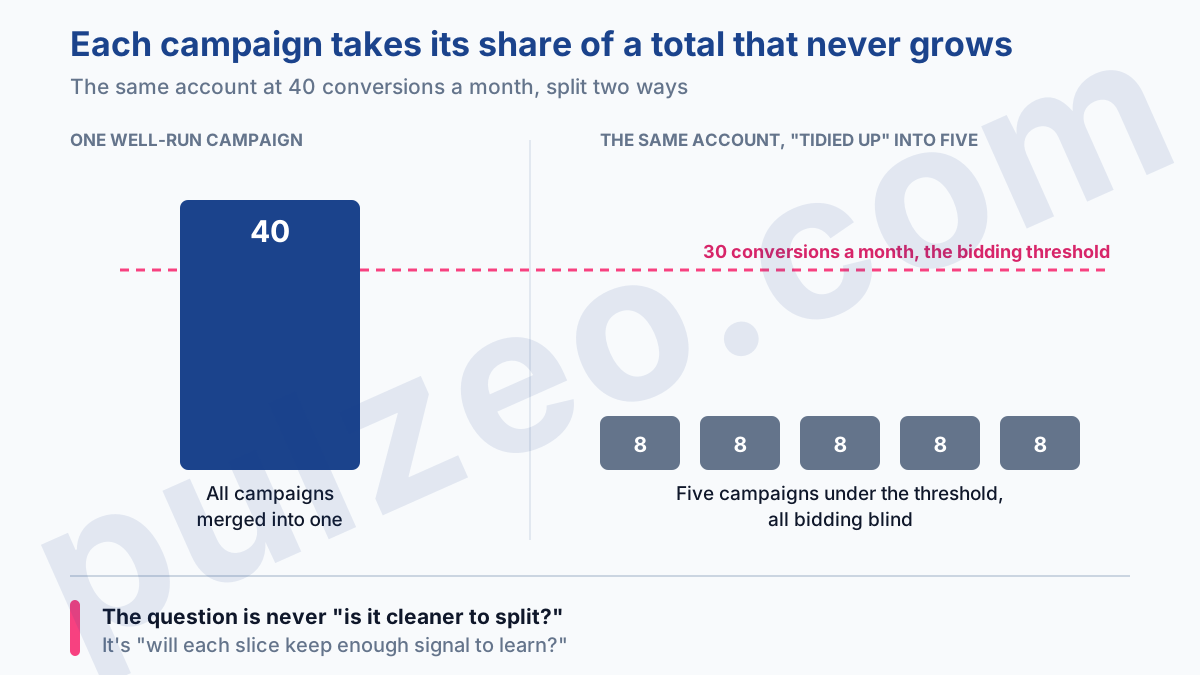
Here's the figure that should drive all your splitting decisions: Google recommends evaluating a campaign over a window that contains at least 30 conversions, a benchmark set out in its Target CPA documentation. I draw my own working rule from it: under 30 conversions a month, I don't think a campaign has enough to bid seriously. Below that, the algorithm doesn't have enough examples to learn who to show your ads to.
Now do the math nobody does. An account generates 40 conversions a month. Put it all through one well-run campaign, and the algorithm has something to work with. Break the same account into five "well-organized" campaigns, and each one drops to 8 conversions a month. What you gain in clarity, you lose in performance: the five underfed campaigns are bidding blind.
A case that comes up often. I took over an e-commerce account: eighteen campaigns, one per product family, a model of tidiness on paper. In practice, fourteen of them were running under five conversions a month, and their CPA never managed to settle on target: it jumped around from one week to the next.
We regrouped the families by margin and by audience: four campaigns instead of eighteen. Once the learning period had run its course, two to three weeks, the overall CPA started holding steady again, quite simply because each campaign finally had something to learn from.
That's what's really at stake with structure. Every campaign you create takes its share of a conversion pie that doesn't get any bigger. The question is never "is it cleaner to split?" It's "will each slice keep enough signal to learn?" Most of the accounts I take over are over-segmented, and that's precisely what drags them down.
Hence the principle I apply everywhere: as few campaigns as possible, as many as necessary. Consolidate by default, and split only when you have no choice.
Should you have one campaign per product?
No, and it's the number one idea that sounds good but isn't. Splitting campaigns by product or by category seems logical: it looks like a well-organized website. But a catalog of twenty products doesn't make twenty campaigns: it makes twenty tiny budgets and twenty starving algorithms.
The habit comes from the old days, when bids were managed by hand, keyword by keyword. In that world, the more you split, the more control you had. Smart Bidding flipped the rule: now, the more you split, the less you feed the machine that makes the decisions for you.
The right unit is the intent theme, not the product. Products sold to the same audience, with the same bidding logic and comparable profitability, fit perfectly well in a single campaign. It's the difference between setting out to organize a Google Ads account around the way the algorithm learns, and blindly copying the layout of your internal catalog.
The only three reasons to create a new campaign
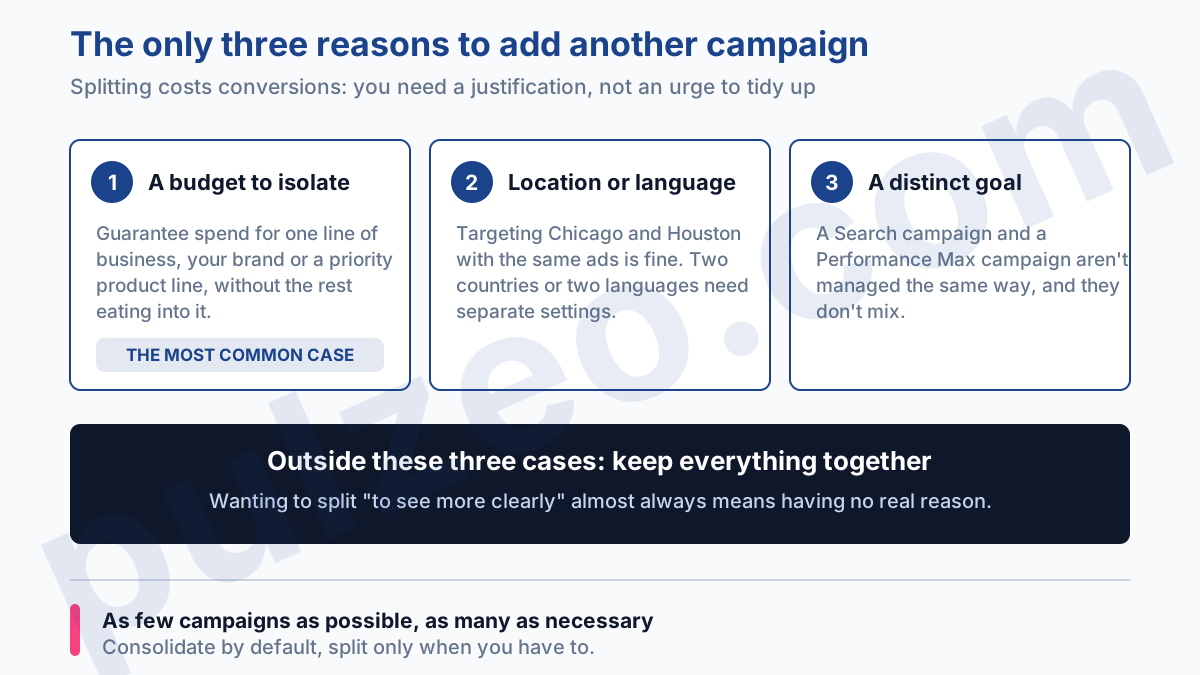
Since splitting has a cost, you need a real justification. In my experience, you can count the valid ones on one hand. A new campaign is justified when, and only when, one of these three cases is true:
- A budget to isolate: you want to guarantee spend for one part of the business (your brand, a priority product line) without the rest eating into it.
- A different location or language: targeting Chicago and Houston with the same ads is fine, but two countries or two languages need separate settings.
- A distinct goal or campaign type: a Search campaign and a Performance Max campaign aren't managed the same way and don't mix.
Of those three cases, isolating your brand is the most common, and the most profitable. Searches for your name convert at a completely different level from generic searches, often at a laughably low CPA, and mixing them in with the rest lets expensive generic traffic eat the budget of cheap brand traffic. A separate brand campaign is the one split I almost never argue about.
Outside those cases, the default answer is: keep everything together. If you're tempted to split "to see things more clearly", it almost always means you have no real reason, just an urge to tidy up, and that's not enough to split.
One caveat on language since September 2026: on Search, the campaign's language setting no longer applies, and the language of your ads decides instead (details in the September 2026 Google Ads news). Two languages still justify two campaigns if their budgets need to stay separate, but no longer for the setting itself.
How many keywords per ad group?
Between 5 and 15 keywords that share the same intent, never just one per group. There was a time when everyone swore by SKAGs, single keyword ad groups, for maximum control over the message. That era is over: since match types broadened and responsive search ads took over, isolating each keyword only multiplies ad groups without adding anything.
The right criterion comes down to one word: consistency. Every keyword in a group has to fit the same ads. "Men's running shoes" and "running sneakers for men" mean the same thing, so they go together. "Running shoes" and "hiking shoes" don't call for the same message, so not the same group.
An ad group that's too broad gives itself away when you write the ad: if you can't write one that genuinely speaks to every keyword in the batch, there are too many of them.
How to name campaigns when you have thirty of them
Here's the topic nobody talks about, and it makes life miserable for anyone who takes over an account. Google doesn't enforce any naming convention, so accounts fill up with "Campaign 1", "Test", "New campaign (2)", and six months later nobody knows what does what anymore.
A campaign's name has no effect on delivery. It has a huge one on your ability to filter, to read a report and to hand the account over to someone else. That's management, not decoration.
The convention I use comes down to four segments separated by vertical bars, from the most general to the most specific:
- the campaign type: Search, Shopping, PMax or Display;
- the business theme, the one that matches a line of your offering;
- the location, when it's what separates campaigns;
- a test or season tag, only if there is one.
That gives you Search | Hiking Shoes | US | - or PMax | Winter Sale | US | Q1. Nothing sophisticated, but with twenty campaigns, a filter on "Search |" instantly isolates everything you run on the Search Network, and a report sorted by name groups the rows that belong together.
Two survival rules go with it. Never put a creation date in the name, because a campaign that runs for three years ends up labeled "2023" and looks dead. And keep exactly the same convention across every account you manage, which saves you from relearning each client's hierarchy every time you open it.
Apply the same logic to ad groups, in a shorter form, with the theme and the match type: Men's Hiking | Exact. You'll know at a glance what you're looking at, without opening the keyword list.
What does restructuring an existing account cost?
A learning period, and you need to know that before you turn everything upside down. When you recreate a campaign or copy it elsewhere, Smart Bidding goes back into learning on the new campaign, and Google warns that reorganizing wipes out the data you've accumulated. In other words: restructuring is never free.
That doesn't mean you should freeze an account that got off to a bad start. A structure that starves the algorithm deserves to be consolidated, even at the cost of a learning period. But it rules out the big cosmetic cleanup, the "I'm reorganizing everything so it looks nicer" that resets every counter to zero for no gain at all.
My rule: you only restructure to fix a real signal or management problem, never for looks. And when you do it, you do it in one go, cleanly, not through a string of small tweaks that restart the learning period again and again. A campaign structure gets overhauled rarely, and for good reasons.
How to tell if your structure is starving the algorithm
The symptom is easy to name and harder to spot by eye: campaigns running under the conversion threshold, month after month, without anyone connecting it to the way the account is split. You look at each campaign on its own, find it "a bit sluggish", and don't see that it's the whole account that's broken into too many pieces. The budget gets diluted exactly as it does when it goes to campaigns too small to tell you anything.
The check takes two minutes and needs no tool. Open the Campaigns tab, set the date range to Last 30 days, show the Conversions column and sort it in ascending order. Every active campaign showing fewer than 30 conversions is a candidate for consolidation. If they make up half your list, the problem is no longer any one campaign: it's the split itself.
Run this check every month, because an account fragments through a series of small decisions, never all at once. It's exactly the kind of monitoring Pulzeo does for you, flagging the campaigns that no longer reach the volume they need and the ones you'd be better off merging. The bid strategy you chose then finally has something to work with.
A good account structure isn't the most detailed one. It's the tightest one that stays manageable, the one where every campaign still has enough to learn from.
Common questions
How many campaigns should a Google Ads account have?
As few as possible, as long as each one stays manageable. A campaign is only justified if it needs a separate budget, a different location or language, or a distinct campaign type. The real safeguard is conversion volume: under 30 conversions per month per campaign, Smart Bidding lacks the signal to bid well. A small account often fits in two or three campaigns, not fifteen.
Are SKAGs still worth it?
No. Isolating each keyword in its own ad group multiplies ad groups without adding anything, now that match types have broadened and responsive search ads have taken over. Group 5 to 15 keywords that share the same search intent instead. The right criterion isn't the number but consistency: every keyword in a group has to fit the same ads.
Do you lose data when you restructure a Google Ads account?
Recreating or moving campaigns and ad groups restarts Smart Bidding's learning period from scratch, without the old campaign's conversion history. Google itself warns that reorganizing after the fact can wipe out the performance data you've accumulated. That's no reason never to touch your structure, but it is a reason to do it only for a real gain, not to tidy up.
Should you structure campaigns by product or by theme?
By intent theme, not mechanically by product. Splitting campaigns by product looks clean but scatters your budget and conversions into slices too small for the algorithm. Group products that share the same bidding logic and the same audience into a single campaign, and only split when budget, location or goal genuinely demands it.
