

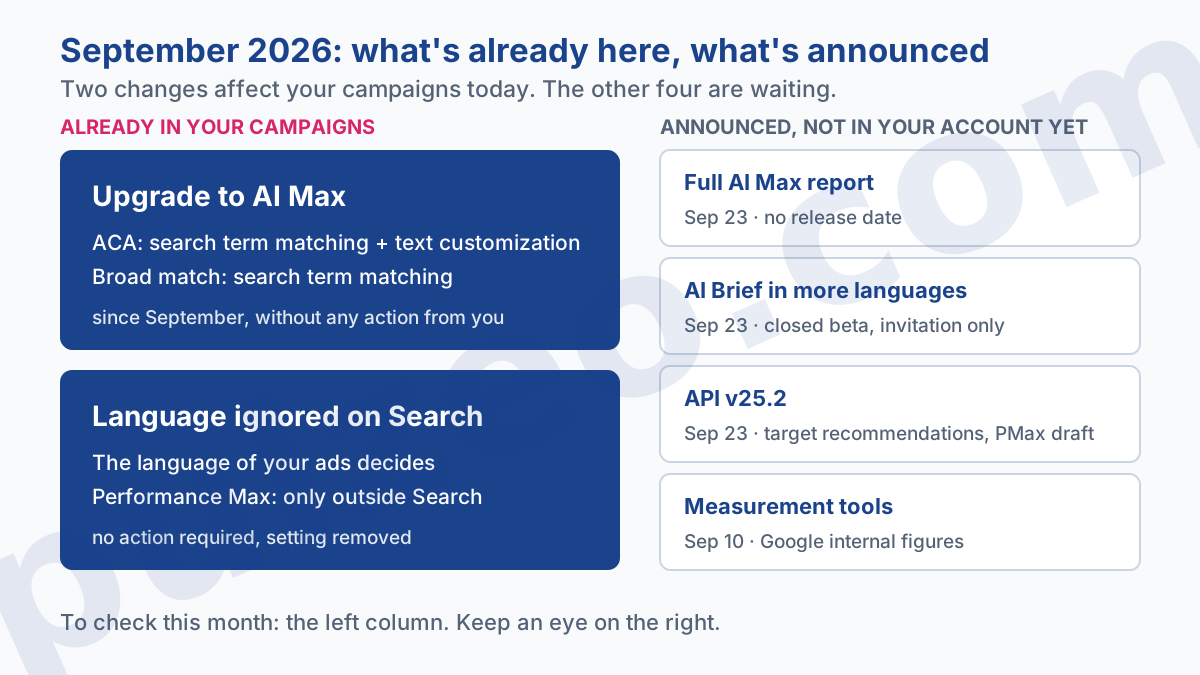
Five pieces of news in September, and two of them changed your Search campaigns without asking for your opinion. The rest is announced, in beta or limited to the API: useful to know what's coming, with no rush.
Here's the month, from most pressing to most distant:
- AI Max automatically replaces automatically created assets and campaign-level broad match;
- language targeting no longer plays any role on the Search Network;
- AI Max promises a full journey report, and its brief comes to more languages, in closed beta;
- version 25.2 of the Google Ads API reveals three projects in the pipeline;
- Google pushes its first-party data tools, with in-house figures to back them.
AI Max moves into campaigns using ACA and campaign-level broad match
It was announced in April, and now it's here. As Google's post on the AI Max upgrade explains, campaigns that used automatically created assets (ACA) or the campaign-level broad match setting are being upgraded to AI Max automatically from September 2026. The email Google sent me in early August set the start date at September 1.
What gets switched on depends on where you started. A campaign that used ACA moves to AI Max with search term matching AND text customization. A campaign on campaign-level broad match only gets search term matching.
The second case is the sneakier one. Your ads don't change a single comma, so nothing shows on screen, but the system will now go after queries that none of your keywords cover. Your bill will tell you, not your interface.
Open every Search campaign, check whether AI Max is listed, and decide feature by feature. Text customization can be turned off in campaign settings, and search term matching can be switched off ad group by ad group.
Then read through your search terms for the last four weeks, looking for what cost money without bringing anything back. That's the task Pulzeo automates by isolating the searches that spend without converting, with the exclusion applied from the same screen.
Dynamic Search Ads, for their part, still aren't moving: their upgrade remains scheduled for February 2027, as I explained in what AI Max really changes for DSA.
Language targeting leaves the Search Network
Since September, a Search campaign's language setting no longer does anything. Google Ads Help puts it plainly:
"The campaign-level language targeting setting will be removed. Search ads will automatically match based on the language of your ads."
To work out which languages a user speaks, Google now reads the language of their query, their language settings and their preferences. Google states that no action is required on your side: the setting is removed at the campaign level.
In Performance Max, the rule splits in two. The chosen language no longer counts for ads shown on Google Search, but it still filters YouTube, Display, Discover and Gmail. One setting, two behaviors inside a single campaign.
Who needs to act? Mostly bilingual accounts: a Belgian, Swiss or Canadian advertiser who split French and Dutch, or English, campaigns for this setting alone.
The split still holds if the budgets differ, but it no longer guarantees anything about language. From now on, the language of your ads does the sorting: a French ad in the wrong campaign will go after French queries.
I was still writing this summer that language justified a separate campaign, in the guide on structuring an account without fragmenting it; on Search, that's no longer true.
AI Max promises a full report, and its brief comes to more languages
On September 23, Google announced two new AI Max features. The first is a report that brings together, for each Search ad, the search term that triggered it, the assets the user saw and the page they landed on. If text customization and final URL expansion are active in your account, that's exactly the missing link for understanding what the system did with your budget.
The catch: no date. Google promises "additional details and availability later this year."
The second, AI Brief, lets you describe your business, your audience and your key messages in your own words to guide AI Max. It now covers seven more languages, French among them, but the feature remains in closed beta: you have to be invited. Nothing to do on your side this month.
What version 25.2 of the Google Ads API reveals
The API gets new features before the interface does, and the release notes for v25.2, published on September 23, reveal three that will interest an advertiser.
Two new recommendations target Search campaigns with a target: raise the target CPA, or lower the target ROAS, when the bid is too low to hold the intended performance. It's the logical follow-up to the August 17 change, when an unrealistic target stopped correcting itself; the details are in the article on target bidding since August 17.
If they show up in your Recommendations tab, read them before applying: raising a target CPA means agreeing to pay more for every conversion.
Google is also adding the ability to generate a Performance Max draft from an existing Smart campaign. Small accounts still running Smart campaigns can see the path being prepared for them.
Finally, tracking templates, custom parameters and the final URL suffix move down to the asset group level in Performance Max. Useful if you tag your URLs by group to find them in Analytics.
Measurement: Google pushes your first-party data
On September 10, Google presented a set of measurement tools built around one idea: handing it more data from your side. A new metric, the Data Strength Uplift, is meant to quantify in Google Ads the conversions recovered thanks to your first-party data setup.
Enhanced conversions are coming to Google Analytics, and Data Manager is being integrated into it directly.
The figures put forward are flattering: 11% more Search conversions with enhanced conversions compared to standard conversion imports, 14% more conversions with Google tag gateway. These are Google's internal data, measured by the ad platform on its own advertisers. I read them as an order of magnitude, not as a promise for your account.
The advice itself is sound. A conversion the tag doesn't see is a conversion automated bidding ignores. If you've never checked what your tag reports, start with conversion tracking with Tag Manager before looking for one more tool.
