
Google Ads for dentists in France: cost per patient in 2026

The cheapest click I've measured since I started this series is the one for Google Ads for dentists: €1.47 on the French query for "dentist," for 201,000 searches a month in France, according to French Keyword Planner data.
Put that figure next to the other trades I've measured and the anomaly jumps out. An emergency electrician pays €19 a click. A vet open on Sundays pays up to €61. A dentist pays less than the price of a coffee, in a market fifty times bigger.
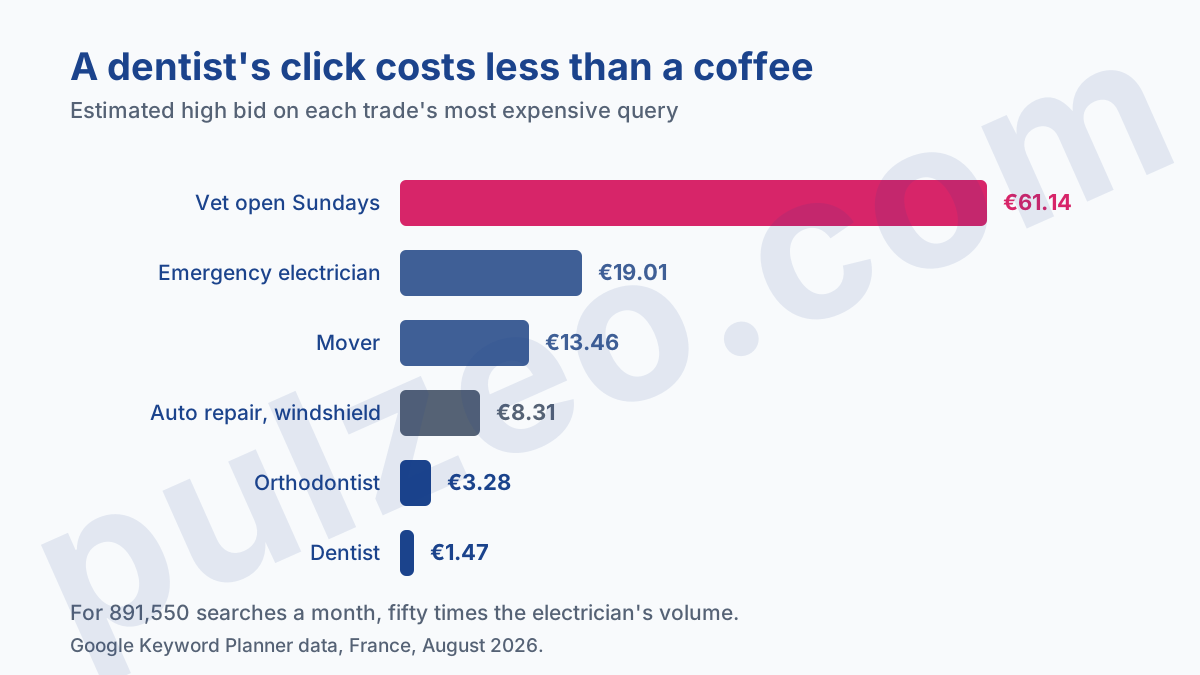
There's a reason for it, a legal one, and it stopped applying five years and nine months ago. Here's what a patient really costs, procedure by procedure, and what the code of professional conduct still forbids you to write in an ad.
What a click costs when you treat teeth
Pulled on August 21, 2026 from Keyword Planner, location France, across the trade's 78 queries excluding suppliers and jobs, for a total of 891,550 searches a month. The queries are French, translated here, and the bid is the high end of the Top of page bid range.
| Keyword (translated) | Searches / month | High bid |
|---|---|---|
| dentist | 201,000 | €1.47 |
| orthodontist | 90,500 | €3.28 |
| dental implant | 49,500 | €1.63 |
| dental office | 40,500 | €1.66 |
| emergency dentist | 40,500 | €1.44 |
| dental crown | 40,500 | €1.02 |
| teeth whitening | 33,100 | €1.58 |
| dental prosthesis | 27,100 | €1.26 |
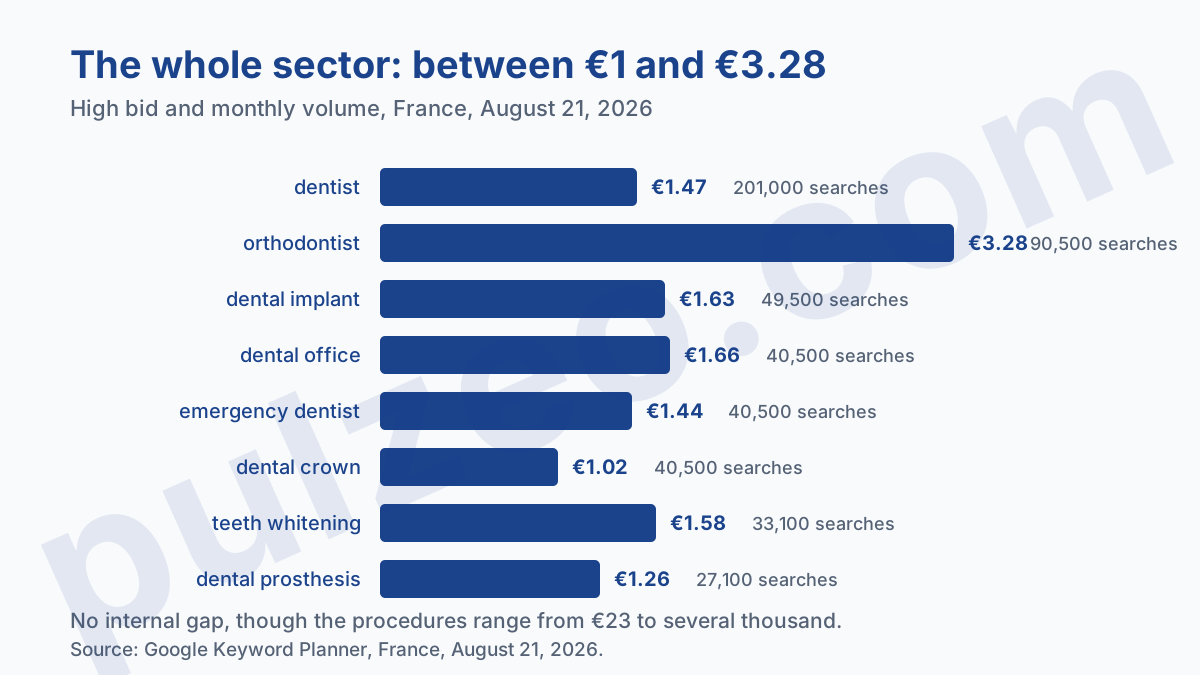
What's striking isn't the level, it's how flat it is. In the other trades, the most expensive query can cost up to fifteen times the cheapest one. Here, everything fits between €1 and €3.28, emergencies included, four-figure procedures included.
One reminder before going further. The estimated bid isn't what you'll pay: it's what you'd bid to aim for the top of the page, and your actual cost will come in lower, often by half. I went through how to read it in the article on how to read Keyword Planner volumes.
Why is a dental click so cheap?
Because for decades, your fellow dentists weren't allowed to bid.
The French code of professional conduct for dentists banned "all direct or indirect means of advertising." That ban was lifted by Decree No. 2020-1658 of December 22, 2020, which rewrote the profession's rules on professional communication.
Nearly six years later, the market still hasn't filled up. The bids prove it: when a profession starts buying clicks, prices go up, as we saw with veterinary clinics after their own rules were relaxed. Here, nothing has moved.
A €1.47 click in a market of 891,550 searches a month isn't a market bargain: it's a spot nobody has taken.
That window will close. It stays open as long as the profession hasn't caught on to the change, so the section on what the rules really allow matters as much as the section on the numbers.
What you still aren't allowed to write
The decree lifted the general ban, but it didn't open the floodgates. Article R4127-215-1 of the French Public Health Code allows you to share "information likely to contribute to the patient's free choice of practitioner" (my translation), about your skills and your practice conditions, and sets six limits in its paragraph I alone.
Communication must be fair and honest, must not use third-party testimonials, must not rest on comparisons with other practitioners, must not encourage unnecessary use of care, must not undermine the dignity of the profession and must not mislead the public.
Three of them translate directly into a Google Ads account.
The three that show up in an account
- No third-party testimonials. The thing to check in the account is now called store ratings, which took over from the old review extensions retired in 2018. It's an automated asset, so it's active without you asking for it as soon as your business gathers around a hundred eligible reviews and 3.5 stars: you have to go turn it off in account-level automated assets.
- No comparison with other practitioners. So out go "the best dentist in," "the number one practice" and every superlative that implies a ranking.
- No encouraging unnecessary use of preventive care or treatment. That's the limit aimed at cosmetic work: a promotion on teeth whitening falls right into it.
The fee trap in the ad
Article R4127-240 adds that information on fees must be "clear, honest, precise and non-comparative." A dentist who shows "implant from €990" in an ad risks failing the "precise" test if the final price depends on the technique and materials. The word "comparative" in the text, on the other hand, targets comparison with other practitioners, not a gap between your own fees.
These rules aren't recommendations. A breach goes before the disciplinary chamber of the Order of Dental Surgeons, and an ad stays on record. If you're getting close to the line, have your departmental council of the Order review your copy before it runs.
Sixteen cents separate a €23 consultation from a €2,000 quote
Here's the point that decides everything, and it comes down to comparing two rows of the table.
"Dentist" costs €1.47 a click. "Dental implant" costs €1.63. Sixteen cents apart. But a consultation at the regulated French rate is billed at €23, while a full implant costs €1,500 to €2,500 according to price surveys published this year. The implant and its abutment remain off the national fee schedule and freely priced; only the crown on top has been covered since October 2023, on a €107.50 base.
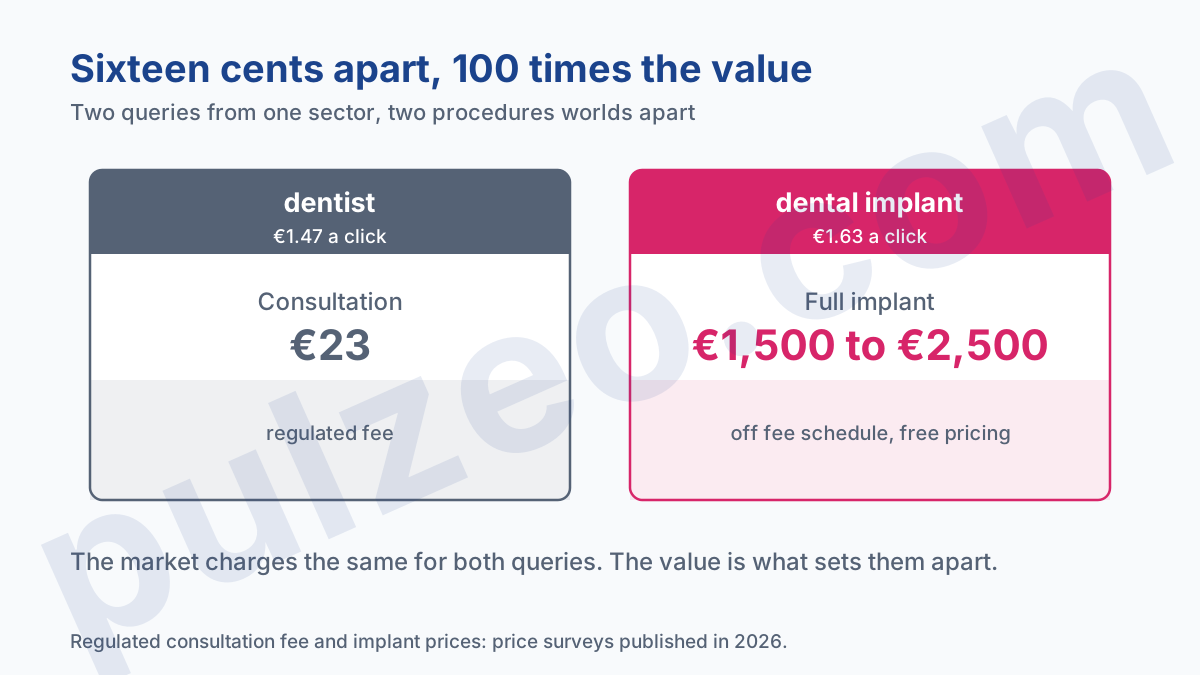
In other words, you pay the same price to attract someone coming in to get a tooth checked and someone weighing several thousand euros of work. The market doesn't tell them apart yet, even though their value couldn't be more different.
That's why I advise starting a dental practice's campaigns on procedure queries rather than queries naming the profession. "Dental implant," "dental prosthesis" and "dental crown" add up to 117,100 searches a month, cost around one and a half euros, and bring in quotes, not checkups.
The only trade in the series where urgency doesn't set the price
Here's the anomaly within the anomaly, and I haven't seen it in any other sector of this series.
Everywhere else, urgency is what costs the most. The click on "vet open on Sunday" climbs to €61, the one on "emergency electrician" to €19, precisely because the person searching at that hour doesn't shop around and accepts the premium rate.
Not so in dentistry. "Emergency dentist" gets 40,500 searches a month at €1.44, "on-call dentist" 8,100 at €1.30, "dentist open on Saturday" 2,900 at €1.40. That's 51,500 searches, all below the price of the ordinary query at €1.47.
The explanation lies in how the profession is organized in France. Out-of-hours dental care covers Sundays and public holidays; the Order's departmental councils organize it under a regional health agency order, and patients reach it through a departmental number or through 15, the French emergency medical number, depending on the region. So the on-call practice has no reason to bid for a spot it's assigned in rotation.
Saturday, by the way, falls outside this system, which only covers Sundays and public holidays: if your practice opens on Saturdays, those 2,900 searches a month at €1.40 are yours and cost you next to nothing.
In practice, the other emergency queries bring in one-off treatments and patients who then go back to their usual dentist. They fill slots, they don't build a patient base.
The 36,800 searches that lead to Doctolib
This sector's trap, and it's a big one.
Four queries pair Doctolib, the French medical appointment booking platform, with dentistry, for a total of 36,800 searches a month: "doctolib dentist" and "dentist doctolib" at 18,100 each, plus the orthodontics variants. These people are looking for the booking platform, not your practice.
Without negative keywords, broad match picks them up. You pay to send patients to a middleman, which then assigns them according to its own criteria. Pulzeo spots these search terms in your campaigns and suggests the negatives, which saves you from digging through a Search terms report nobody opens of their own accord.
Two other, less obvious groups to exclude from day one:
- equipment suppliers, whose names circulate among practitioners. "DPI dental" climbs to €267 a click and "GACD dental" to €13.46: these are practices ordering their supplies, and the high bid gives away a professional market, not patients;
- jobs and training. Dental assistant, dental technician, dental school, entrance exams: people who want to work in dentistry, not get treated there.
What a patient costs, and when it starts paying off
Let's run the numbers with an actual cost at half the bid, so about €0.75 a click on local queries.
At that rate, four hundred euros buys more than 500 visits a month. At a 4% booking rate, which is realistic for a practice with a simple form or a visible phone number, that's about twenty new patients a month. Roughly €20 to acquire each patient.
Twenty euros, when the first consultation alone brings in €23. Acquisition is paid back at the first visit, in revenue, before we even get to what comes next.
And what comes next is what matters most. Oral health guidelines call for at least one checkup a year, and some patients will go through a crown, a prosthesis or orthodontic treatment in the years that follow.
That's what sets this trade apart from the others in the series: a mover has to land the move; an electrician, win the job; here, the patient just has to come back the following year.
The real constraint isn't financial, it's logistical: your schedule. Twenty new patients a month means an extra chair to fill, and there's no point buying appointments you can't honor.
What budget to start with
€300 to €500 a month, and I'd lean toward the top of the range rather than the bottom for a counterintuitive reason: at this click price, the risk isn't spending too much, it's not reaching enough volume to judge.
Focus that budget on two or three high-value procedures rather than on the generic query, which will put you up against every practice in town for checkups. And let it run for at least six weeks: the time between the search and the first appointment is measured in days for emergencies, but in weeks for an implant.
One last benchmark to see where you stand. If your cost per new patient goes over €60, something is off upstream, and it's almost always the targeting: either you're buying the generic query, or you haven't excluded Doctolib and the suppliers. The same reasoning applied to another health profession is in what a client costs a vet, where the ethics rules are similar but the bids are another story entirely.
Common questions
Is a dentist allowed to advertise in France?
Yes, since Decree No. 2020-1658 of December 22, 2020, which removed from the dentists' code of professional conduct the ban on “all direct or indirect means of advertising.” Article R4127-215-1 of the French Public Health Code allows dentists to share information about their skills and practice conditions, subject to six conditions: fair and honest communication, no third-party testimonials, no comparison with other practitioners, no encouraging unnecessary care, no harm to the dignity of the profession and nothing that misleads the public.
How much does a Google Ads click cost for a dental practice?
From €1.02 to €3.28 depending on the query, measured in France in August 2026. “Dentist” tops out at €1.47, “dental implant” at €1.63, “orthodontist” at €3.28. It's the cheapest trade I've measured, thirteen times cheaper than an emergency electrician, even though its search volume is fifty times higher.
Can a dental ad show patient reviews?
Article R4127-215-1 rules out third-party testimonials, and store ratings, which took over from review extensions in 2018, fall under that. The catch is that they're an AUTOMATED asset: they switch on by themselves as soon as a business gathers around a hundred eligible reviews and 3.5 stars. Go turn them off in account-level automated assets rather than assuming they're off.
What budget should a dental practice plan for when starting out?
€300 to €500 a month is enough. At an actual cost of €0.75 a click on local queries, €400 buys more than 500 visits a month. At a 4% booking rate, that's about twenty new patients a month, at around €20 each to acquire.
