
How much do YouTube ads cost in 2026?

You want to know what an ad costs before you jump in: that's the first question, and it's the right one. Except that what YouTube ads cost is the worst-explained topic I know of in marketing. Someone quotes you a cost per view of two cents, you conclude that $500 will do, and three weeks later you have a hundred thousand impressions, zero quote requests, and no idea what went wrong.
The problem isn't that the published figures are wrong. They're accurate. They just answer a different question from yours. You're asking what a customer costs, and you're told what a second of attention costs.
I'll give you both answers, with the real rates and how to translate them into acquisition cost. Plus one fact most online guides haven't caught up with: since spring 2026, the campaign type they talk about no longer exists.
On YouTube, you're not buying a click
That's the misunderstanding at the root of everything else. On Google Search, the rule is simple: someone clicks, you pay. Nobody clicks, you pay nothing. The link between spend and interest is direct, almost reassuring.
On YouTube, that link is broken. You're buying exposure, and Google measures it in two ways depending on the format you choose. The official documentation on video ad formats spells out how each one is billed, and it's worth two minutes of your time.
What Google calls a view
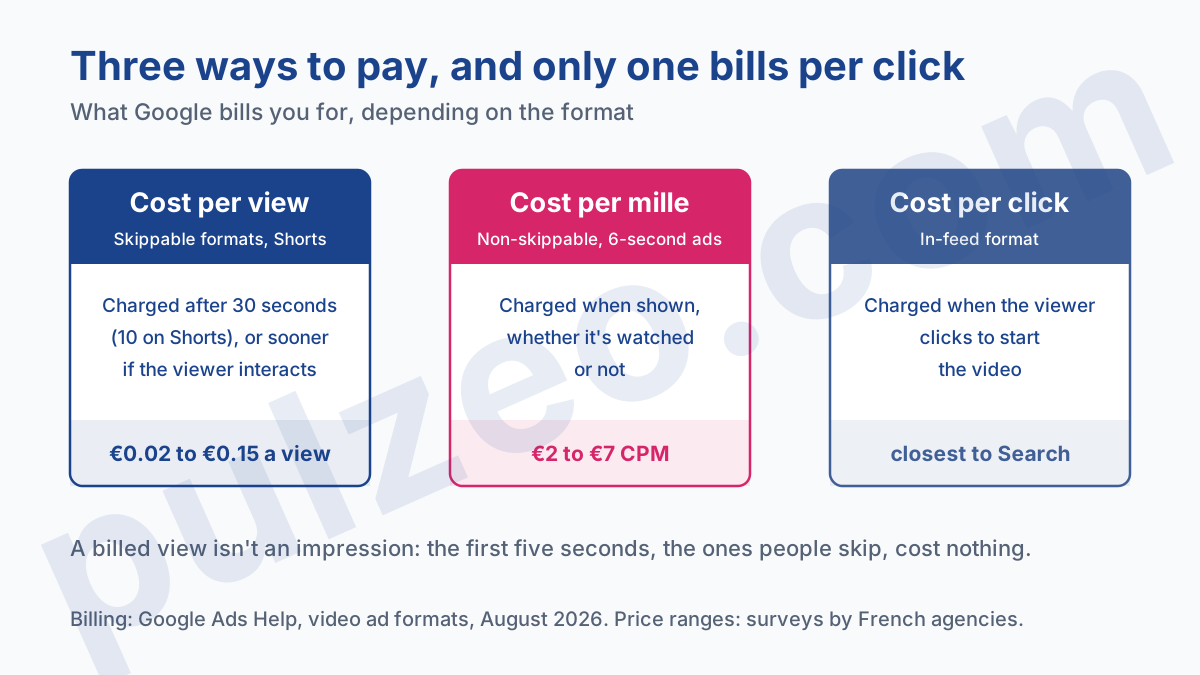
A view isn't an impression. On a skippable ad, you're charged when the person watches thirty seconds, or the whole video if it's shorter, or when they interact with the ad. In other words, an ad everyone reflexively skips after five seconds costs you nothing at all.
It's a real filter, and it's actually good news. You just need to know about it before you run the numbers: your ad can start fifty thousand times and you only pay for three thousand.
Google adds a useful detail about cost-per-view bidding: the amount you're really billed, called the actual CPV, is almost always lower than the bid you set.
The tCPV bid is optimized to charge you with the lowest amount available…
What Google calls a thousand impressions
The other currency is CPM: you pay per thousand impressions, whether the person watches or not. That's how non-skippable formats are billed, along with six-second bumper ads and the YouTube Masthead.
One variant is worth knowing, viewable CPM, where only impressions actually visible on screen are counted. On placements where your ad can play at the bottom of a page nobody scrolls down to, it's the only one of the two that reflects what someone actually had in front of their eyes.
How much does a view cost, and how much for a thousand impressions?
Here are the ranges for the French market, in euros. Google publishes no rates, so they come from the figures that specialist French agencies publish, and they line up closely enough to serve as a benchmark.
The cost per view on a skippable format falls between €0.02 and €0.15. CPM runs between €2 and €7 in France, with peaks at €12 on non-skippable formats and high-demand inventory. Six-second ads go for around €3 to €8 per thousand impressions, Shorts placements for €2 to €5, which makes Shorts the cheapest inventory on the platform today.
These gaps aren't random. Between a €2 CPM and a €7 CPM, the same money buys an audience three times wider or three times more qualified. Targeting, time of year, industry and video quality make the difference, exactly as they do on Search.
One trap before going further, because I've seen it fool serious people. If you open Keyword Planner for France and type the French for "YouTube advertising", you'll see a bid well above €10.
That figure is the price of a click on Google Search for that query, meaning what agencies pay to catch people like you. It has nothing to do with the price of an ad served on YouTube.
Why that price tells you nothing about the cost of a customer
This is the real subject, and it's where nearly every article I've read on it stops. I read the top-ranking ones before writing this one: they give the ranges, list the formats, and leave you there. None of them takes the next step, which is the only one you actually care about.
A cost per view only becomes a cost per customer after going through three stages of the funnel, and each one swallows most of what goes in.
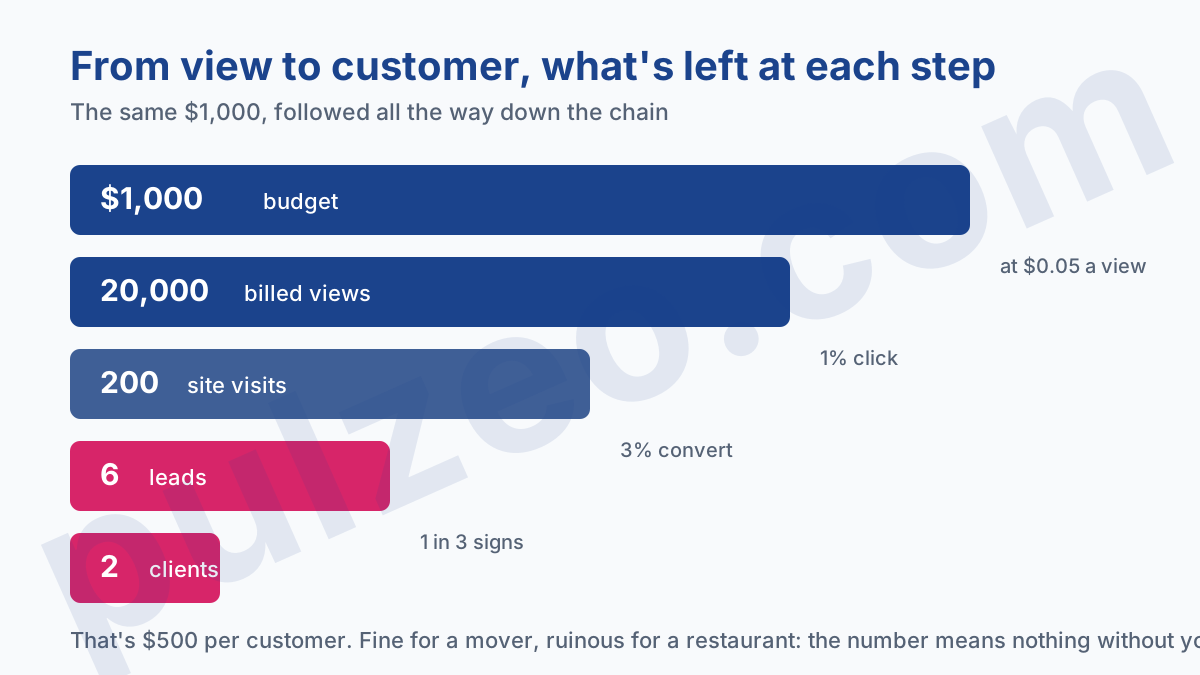
Let's take a worked example, with deliberately optimistic assumptions. A $1,000 budget and a cost per view of $0.05 buy you twenty thousand views. Of those twenty thousand people who watched at least thirty seconds, say 1% click through to your site: two hundred visits. Of those two hundred visits, a 3% conversion rate, which is decent: six leads.
$1,000 for six leads, or $167 per lead. If one lead in three becomes a customer, your acquisition cost is $500.
That figure is neither good nor bad in itself. For a moving company or an accounting firm, where one customer is worth several thousand dollars, it can work just fine. For a restaurant where each diner spends about $30, it's a disaster. It's the same reasoning as the real cost of a Google Ads campaign, applied to a different currency.
Run this calculation with your own numbers before you spend the first dollar. You need three figures: your estimated click-through rate, your conversion rate and your lead-to-customer rate. You'll know in 5 minutes whether the format stands a chance.
Video action campaigns no longer exist
Here's the fact that makes half of what you still read on the subject obsolete. For years, the standard way to drive conversions with video was called a Video action campaign. It no longer exists, and Google dismantled it in three stages, documented in the official migration announcement.
Three dates, and the last one has passed:
- April 2025: the option to create one disappears from the interface;
- July 2025: Google starts automatically upgrading existing campaigns to Demand Gen;
- April 2026: the date announced for the final upgrades, completed in May according to the product page.
In practice, if your goal is to generate sales or leads with video, you no longer create a video campaign: you create a Demand Gen campaign, which serves on YouTube but also on Discover, Gmail and the Display Network, and whose metrics don't read like those of a classic video campaign.
What's left under the video campaign label are the reach, views and engagement goals. Awareness, in other words. An excellent tool, but not one you judge on cost per customer, and that's exactly the misunderstanding plenty of advertisers have been stuck with since the switch.
A counterintuitive detail while we're at it, and it's in the documentation: on a video campaign set to Maximize conversions, you're still billed per thousand impressions. Optimizing for conversions doesn't mean paying per conversion.
You may already be paying for it without knowing
A question I ask on every account I take over, and it surprises people every time: do you know what share of your budget already goes to YouTube?
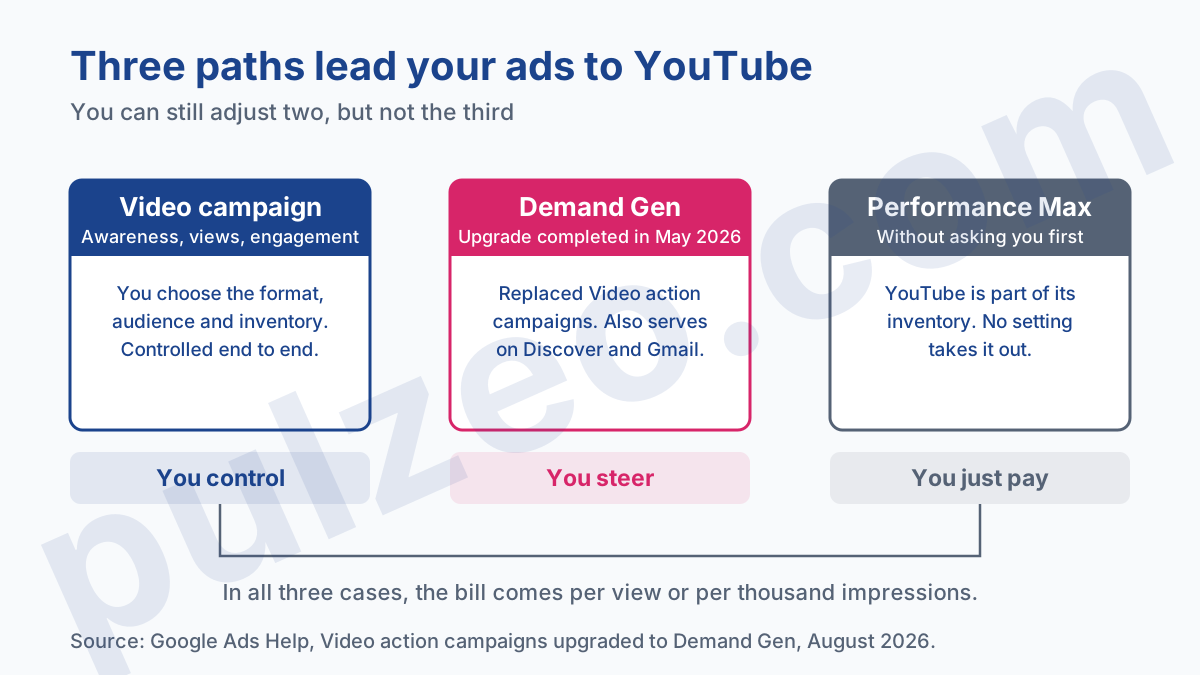
Performance Max serves on YouTube, and so does Demand Gen. The difference between the two is worth knowing, because it decides what you can still take back control of.
Demand Gen lets you choose: in the Channels panel, a "Let me choose" option lets you pick for yourself where your ads show, YouTube included. Google recommends leaving everything on, via "All Google channels", the default setting, but the decision stays with you. Performance Max gives you no such choice: YouTube is part of its inventory and nothing takes it out.
So plenty of advertisers wondering whether they should test video are already running it, without knowing and without ever having decided to.
The report that answers this question is called "Where ads showed", and you'll find it under Campaigns, then Insights and reports. Performance Max has its own, kept separate, under the "Performance Max campaigns placement" template in the Report editor: check the first report without the second and you'll wrongly conclude that nothing goes to YouTube.
These reports show the channels and videos where your ads ran, and they sometimes hold surprises: kids' channels, content unrelated to your market, videos watched by people who will never buy anything.
Excluding them happens at the account level, and it needs revisiting regularly. Pulzeo tracks these placements alongside the rest of your campaigns and flags the ones that spend without bringing anything in.
Who shouldn't advertise on YouTube
A strong opinion, because staying quiet on this point costs small budgets dearly.
Video is a bad choice in three situations:
- you need results within two weeks;
- your monthly budget is under $1,000;
- you don't have a decent video to run.
The last point is the most underestimated. Producing a decent video often costs more than the first month's media budget, and a sloppy video pushes the cost per view up instead of down, since nobody watches it to the end.
On the other hand, the format gets interesting when your product is easier to understand by showing it than by describing it, when your sales cycle is long, or when your Search market is saturated and a click already costs $15 there.
Here's the rule I apply, and it fits in one sentence.
As long as your Search campaign hasn't hit its volume ceiling, every dollar you put into YouTube is a dollar taken from a channel that converts better.
How much should you spend to test YouTube ads?
There's no minimum amount to launch a video campaign: you can start at $5 a day, and the platform won't stop you. But Google does publish a floor, with a number attached, and almost nobody passes it on.
It's tied to your goal, not to an absolute amount. On the page about optimizing video campaigns for conversions, Google recommends a daily budget of at least fifteen times your target CPA, and at least ten times the expected CPA if you're on Maximize conversions.
Translation: if you're aiming for a $50 lead, Google asks you for $750 a day for its machinery to work as designed. It's a sobering number, and better to know it before than after.
The real constraint is statistical, and it sets your test budget far better than a round number. You need enough volume for your numbers to stop being noise, and on a format where click-through rate is measured in tenths of a percent, that takes a lot of impressions.
This is what skews a lot of people's judgment: a 0.3% click-through rate is normal on a video campaign, when it would be catastrophic on Search. Comparing the two is like judging a boat's speed by highway standards.
It's also one of the few places where a tool does you a real favor. Pulzeo expects a 0.1% click-through rate on a video campaign, versus 2% on Search, and won't raise an alert below five thousand impressions, because under that the math means nothing.
In practice, plan for enough to buy several thousand impressions a day for three to four weeks, and decide in advance what you'll look at when it's over. Not the cost per view, which will look good no matter what. The number of visits to your site, and what those visitors did there.
What YouTube ads cost is therefore not a range to memorize but a calculation to run with your own numbers. The two cents per view are real. They only become a good or a bad deal once multiplied by everything that stands between them and a paying customer.
Common questions
How much does a YouTube view cost?
French agencies that publish their figures put the cost per view between €0.02 and €0.15 on a skippable format. Watch out for what counts as a view, and for the format: on a skippable in-stream ad, Google only charges once someone has watched thirty seconds, or the whole video if it's shorter, or interacted with it. On a Shorts placement, the threshold drops to ten seconds. Either way, the first few seconds everyone skips cost you nothing.
What's the minimum budget for a Google Ads video campaign?
Google doesn't impose any minimum budget on video campaigns, contrary to what you often read. The real constraint is statistical: you need enough volume for the numbers to mean something. Plan for enough to buy several thousand impressions a day for at least three weeks before you judge anything.
Is YouTube CPM cheaper than Google Search?
The two aren't bought in the same currency, so a direct comparison makes no sense. On Search you pay for the click of someone who's already looking for your product. On YouTube you pay to reach someone who was watching something else. A thousand impressions at $4 look like a bargain until you count how many it takes to land one customer.
Can you still create a Video action campaign?
No. Google removed that option in April 2025, then automatically upgraded existing campaigns to Demand Gen, the last ones in spring 2026. If you want to drive conversions with video today, you go through Demand Gen or Performance Max, not through a classic video campaign.
