
Is a Google Ads agency worth it?

A Google Ads agency charges either 10 to 20% of your ad budget or a flat monthly fee of €500 to €3,000, depending on how complex the account is. Those are the going rates on the French market, where I work, and they're quoted everywhere. What nobody works out is the math that goes with them: at what budget can those fees actually be earned back?
The short answer comes with a number. With the market's floor fee, you need about €3,300 in monthly budget for management fees to drop to around 15%. Below €2,000, you're paying more than a quarter of your budget in fees, and the agency has to pull off a small miracle just for you to break even.
You won't find that calculation on the pages that rank first for this topic, almost all of them written by agencies. So here are the numbers, the formula, and the cases where an agency is still the right call anyway.
First, a word on vocabulary. A PPC agency and an AdWords agency sell the same service: PPC, short for pay-per-click, is simply the common name for paid search, and AdWords is what Google's ad platform was called until 2018. The term is still a clue, though, since a website that still talks about AdWords hasn't been touched in eight years.
How much does a Google Ads agency cost?
First, a distinction plenty of quotes leave blurry: the ad budget goes to Google, the management fees go to the agency. When someone quotes you "€2,000 a month," always ask which of the two they're pricing.
A percentage of the budget
The original model. The agency takes 10 to 20% of what you spend on advertising. On a €3,000 budget, that's €300 to €600 in monthly fees.
The upside is real: interests are aligned at the start, since the agency earns more when you invest more. The downside is just as real, and it's rarely spelled out: the agency has an interest in you spending more, not in you spending better. An optimized account that gets the same conversions on 30% less budget automatically lowers its pay.
The flat monthly fee
The model that dominates today, and the rate cards published by French agencies are fairly consistent from one to the next:
- €300 to €700 for a simple campaign with a single goal;
- €800 to €1,500 for an account with several campaigns;
- €1,500 to €3,000 for full strategic support;
- more for large accounts.
A flat fee is easy to understand, but it hides an arithmetic trap. Public rate cards show an entry price of €300, while in practice ongoing support for a small business tends to start at €500 a month, whatever your budget. It's that floor, not the listed price, that drives everything that follows.
Performance-based pay
The third model, less common but growing: the agency gets paid on results. In e-commerce, expect 2 to 5% of the revenue attributed to the campaigns. In lead generation, €10 to €25 per qualified contact.
On paper, it's the best aligned of all: the agency only wins if you win. In practice, it shifts the problem to measurement. Who decides that a lead is qualified? What happens if your conversions are being counted twice?
This model only holds up if your tracking is flawless, which is far from the norm. Before you accept pay tied to your conversions, first check that your conversions are telling the truth: otherwise, you'll be paying for results that don't exist.
Setup fees, the ones nobody remembers to count
Whatever model you pick, one line almost always gets added, and it's almost always missing from comparisons: onboarding fees. Expect €500 to €2,500 depending on complexity, sometimes more for a multi-country account.
They cover creating the account, setting up billing, the first ads and configuring conversion tracking. It's real work, and done well, it's worth the price.
The problem is that it skews the first year's math. A €500 monthly fee with €800 of setup isn't €6,000 over the first year but €6,800. On an ad budget of €2,000 a month, or €24,000 over the year, the fee share then climbs from 25 to 28%. And if you switch agencies after a year, you pay that entry fee all over again.
At what budget does an agency pay off?
What matters isn't your industry or how much time you have. It's one simple ratio: your management fees divided by your ad budget. That share is the gap the agency has to close before it makes you a single cent.
Take the floor fee, €500 a month, and run the numbers:
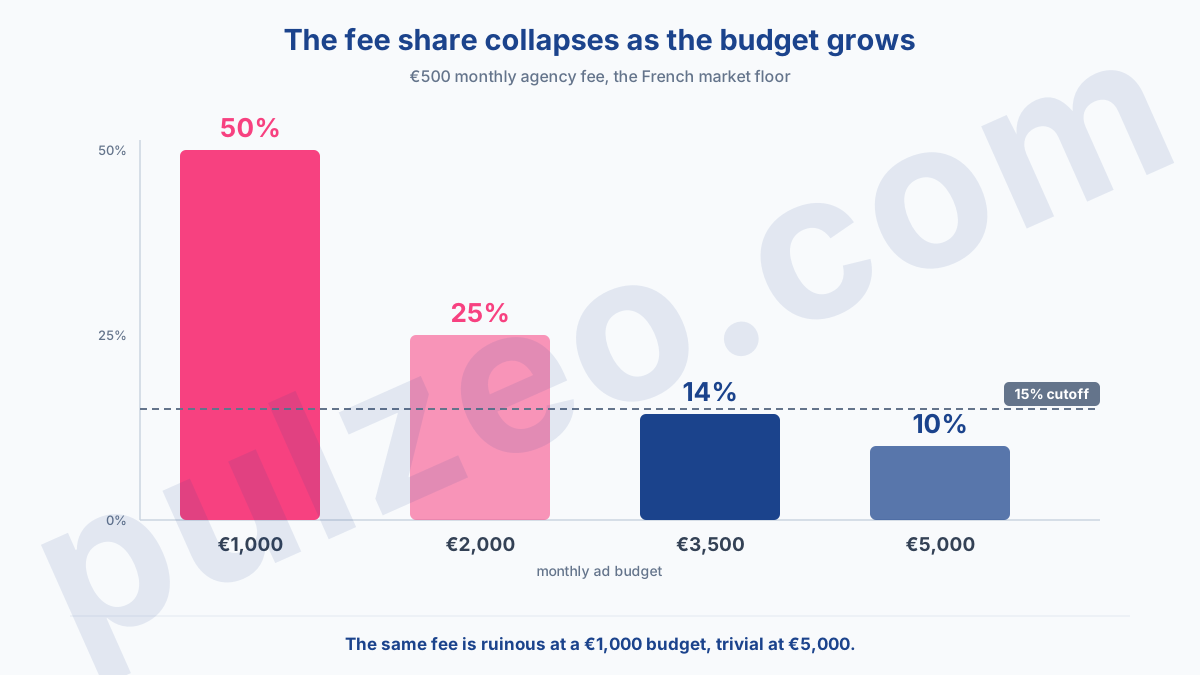
At a €1,000 budget, you pay 50% in fees. At €2,000, 25%. At €3,500, 14%. At €5,000, 10%. The curve collapses, and that's the whole story: the same fee is ruinous for one advertiser and trivial for another.
If you take 15% as an acceptable level, which is the middle of the range agencies themselves charge on a percentage basis, the threshold follows on its own.
You need about €3,300 in monthly budget to justify a €500 fee, and €5,300 for an €800 fee. Below that, you're funding overhead, not performance.
How much an agency has to improve your results to pay for itself
This is where the math gets brutal, because most advertisers work with a fixed budget. You don't have "€2,000 of budget plus fees." You have €2,000, period.
Let's run it again. A €2,000 budget, a €500 agency: you have €1,500 left that actually goes into advertising. To get from €1,500 what you used to get from €2,000 on your own, the agency has to improve your return by 33%. Not maintain it. Improve it by a third, just to break even.
And with a €1,000 budget and the same fee, you have €500 of advertising left: you'd need to double your return. No serious agency will promise you that on an account that's already properly set up.
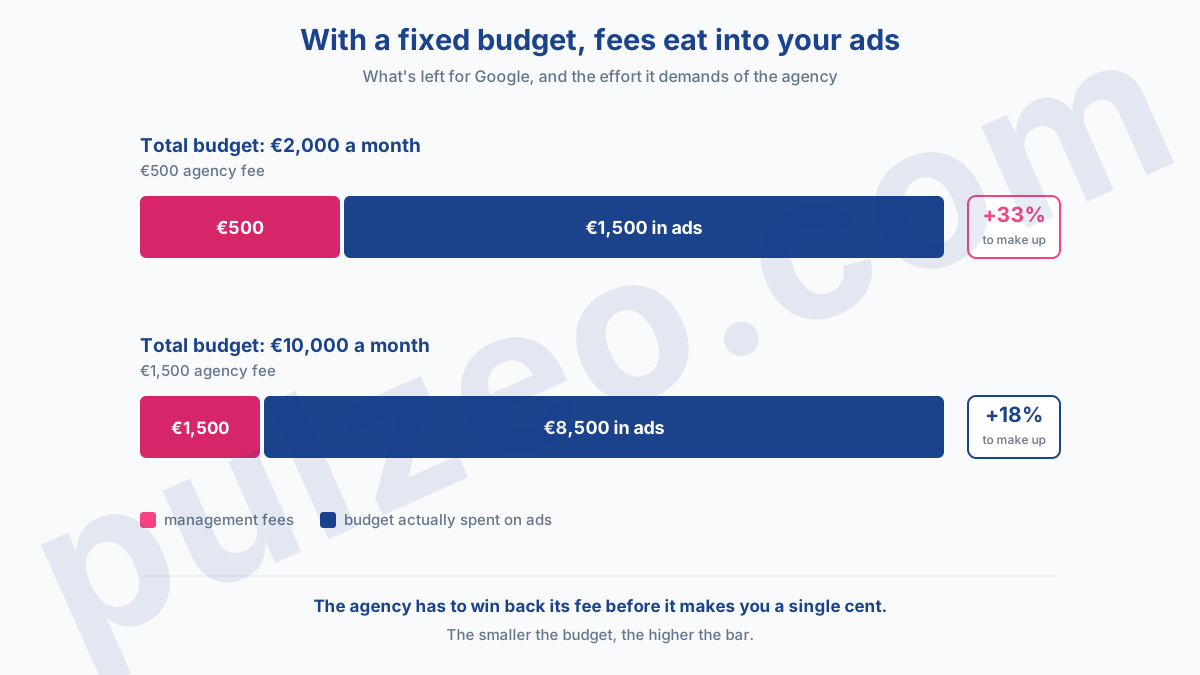
The good news is that the math flips fast. With a €10,000 budget and a €1,500 fee, the required improvement drops to 18%, which is perfectly achievable on a neglected account.
What this calculation mostly tells you is that the bar you have to clear depends on what you pay. A management tool like Pulzeo costs $49 to $299 a month: on the same budget, it leaves nearly everything for ads, where a flat fee takes a quarter.
How many hours does your monthly fee buy?
A flat fee isn't really bought by the month, it's bought by the hour, even if nobody presents it that way. Which leads to the most useful question to ask in a meeting, and the one that makes people squirm the most: how many accounts does the person who'll handle yours manage?
The gaps are huge. Agencies that work in depth cap the portfolio at 8 to 12 accounts per specialist, and beyond twenty or so accounts per consultant, fine-tuned management becomes physically impossible.
Do the math. In France, a full-time job comes to about 150 hours a month. Spread over 10 accounts, that's 15 hours per account. Over 25 accounts, 6 hours, or an hour and a half a week, calls and reporting included.
Now set those hours against your fee. At €500 a month, the first case works out to €33 an hour, below what an experienced consultant costs the agency. The second works out to €83 an hour, which holds up.
A floor fee only pays off for the agency with a heavy portfolio, which means few hours spent on your account. It isn't dishonest, it's just math.
Better to know that before you sign than to find out in month three, when the calls get further apart and each monthly report looks more and more like the last.
When an agency is clearly still the right choice
It would be dishonest to conclude "never hire an agency." There are situations where it's the best investment in the account, and they don't depend on budget alone.
First, when you're launching an account. The first few months are when the most expensive mistakes happen: a shaky structure, badly set up conversion tracking, targeting that's too broad. Paying someone to pour clean foundations costs less than redoing them a year later.
Next, when your account is genuinely complex. Several countries, several languages, a product feed with ten thousand items, Shopping and Performance Max running side by side. That's a real craft, and it doesn't fit in a dashboard.
Finally, when you need what a tool doesn't do: ad creative, a brand strategy, someone who pushes back on your offers. A paid search agency doesn't just sell bid tweaking, and that's precisely the part no software replaces.
What to check in a Google Ads agency contract
Three contract points decide how much room you have to maneuver, and none of them appears on agencies' sales pages:
- who owns the Google Ads account;
- how long you're locked in;
- what the monthly report actually contains.
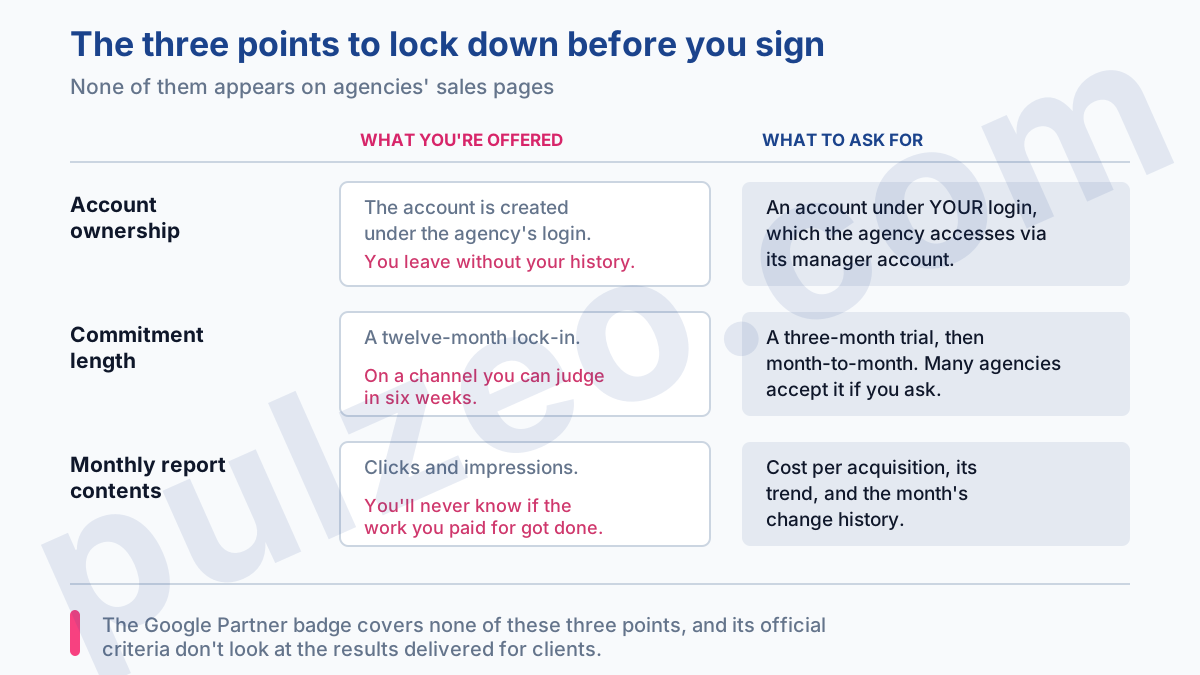
First, account ownership: it's the point I see neglected most often on the accounts I take over. If the agency creates the account under its own login, you'll leave without your history the day you go, and your next provider, or you yourself, will start from zero on bid learning.
So insist on an account created under your login, which the agency accesses through its manager account. That's also what lets you stay in control and keep an eye on your accounts on your end, in your own tool, without depending on the agency's reporting schedule.
If it is already too late and the agency alone holds the rights, there is a way to get your Google Ads account back, from asking for Admin access to the form Google provides.
Next, commitment length. Twelve locked-in months on a channel you can judge in six weeks is a lopsided deal. A three-month trial followed by month-to-month is a reasonable compromise, and many agencies accept it if you ask.
Finally, the report contents. A report that only shows clicks and impressions hides what matters. What counts is the cost per acquisition, how it's trending, and what was changed in the account this month. Without a change history, you'll never know whether the work you were billed for actually happened.
One last word on the badge many agencies show off to cut these questions short: it covers none of these three points, and its official criteria don't look at the results delivered for clients either.
And if you're down to choosing between several candidates, the checks to run before signing, from the audit done on your own account to the promises Google forbids agencies to make, are covered in the article on how to choose a PPC agency.
What if your budget doesn't justify an agency?
It's the most common case, and the one nobody talks about: between €500 and €2,500 in monthly budget, you're too small to make an agency pay off, and often too busy to open Google Ads every morning. Managing it yourself requires a grasp of the basics, but you can learn them without paying for a course; the real gap lies elsewhere.
What's missing at this stage isn't strategy, it's monitoring. A CPA that climbs for three weeks, a conversion that stops reporting, a search term that swallows the budget: these problems get spotted in minutes when someone's looking, and cost a month of budget when nobody is.
The good news is that this monitoring comes down to three weekly checks, a quarter of an hour in all:
- compare the week's cost per acquisition with the previous four, to read a trend rather than an isolated number;
- check that the Conversions column is still reporting data, for every important action;
- open the search terms report and exclude whatever has spent without ever converting.
Do those three things every Monday and you'll already have most of what an agency bills for monitoring. It's also exactly the part a tool can take over, for a fraction of the lowest fee on the market: Zeo reviews your accounts continuously, flags anomalies and turns the diagnosis into an action plan ranked by impact, instead of leaving you to hunt for what to fix.
You keep the strategy and the decisions, and hand off the monitoring. And if your budget grows to the point where an agency makes sense, you show up with a clean account, an intact history and numbers to set against theirs, which is the best position to negotiate from.
In between, there's also the freelance route, with its own rules of the game: what a freelance consultant costs, and the availability question that comes with it.
That leaves how much to invest before you get there. It's a different question, and it comes even earlier: the minimum budget for Google Ads to have something to learn from. The management fees discussed here are also just one cost item out of three, and the three layers of cost add up together. Delegating is just one way to find customers: the other nine, with the price of each, are reviewed here.
Common questions
How much does a Google Ads agency cost per month?
There are three pricing models, and the figures below are French market rates, where I work. On a percentage basis, expect 10 to 20% of your monthly ad budget. On a flat fee, expect €300 to €700 for a simple campaign, €800 to €1,500 for an account with several campaigns, and €1,500 to €3,000 for strategic support. On performance, expect 2 to 5% of revenue in e-commerce, or €10 to €25 per qualified lead in B2B. Add setup fees of €500 to €2,500 in the first year, and keep in mind that most agencies won't go below €500 a month.
At what budget should you hire a Google Ads agency?
What matters is the share of your budget that goes to fees. With the market's floor fee (€500 a month in France), you need about €3,300 in monthly ad budget for fees to drop to 15%, a level where a good agency can make them back. Below €2,000, fees exceed 25% and the agency starts at a disadvantage that's hard to overcome.
Who owns a Google Ads account created by an agency?
Whoever created the account, unless agreed otherwise. It's the point most often overlooked and the most expensive one: if the agency creates the account under its own login, you leave without your conversion history the day you switch, and the new provider starts from scratch. Insist on an account created under your own login, not the agency's, with the agency accessing it through its manager account.
Google Ads agency, AdWords agency, PPC agency: are they the same thing?
Yes, they're three names for the same job. PPC, short for pay-per-click, is the usual name for buying ads on search engines, and AdWords is the old name of Google Ads, which Google dropped in 2018. The vocabulary on an agency's website is still a useful clue: an agency that still calls itself an AdWords agency in 2026 hasn't updated its site in eight years.
Does the Google Partner badge guarantee an agency's quality?
No. The badge certifies a volume of ad spend managed, a minimum optimization score and certifications passed by the team. Those are activity criteria, not results achieved on your own campaigns. A certified agency may well be excellent, but the badge alone says nothing about what it will do with your account.
