
What does it mean to be a Google Partner agency?

You're comparing providers. One shows off a Google Partner agency badge on its homepage, the other doesn't. Your first instinct: that one has been vetted by Google, so it must do better work.
The badge is real enough. It's no decorative sticker, and Google checks its requirements every day. But it vouches for three very specific things, and none of the three is the results delivered for clients.
None of this is confidential: Google publishes its criteria in black and white. It's just that nearly every page explaining this label is published by an agency that displays it, and they rarely dwell on what it doesn't say.
What is a Google Partner agency?
A Google Partner agency is a company enrolled in the Google Partners program whose manager account meets three requirements that Google checks daily: an optimization score of at least 70%, at least $10,000 in ad spend over 90 days across all managed accounts, and at least half of its account managers certified on Skillshop.
The status comes with a badge the company can display on its website, a profile page in the official Partners directory, and Google Ads promotional offers. Support, on the other hand, is open to every company enrolled in the program, badge or not.
Above that sits a second tier, Premier Partner status, reserved for the top 3% of participants in each country and reassessed once a year.
So much for the definition. The rest of this article is about what these requirements actually measure, because that's where the misunderstanding hides.
The three criteria, as Google publishes them
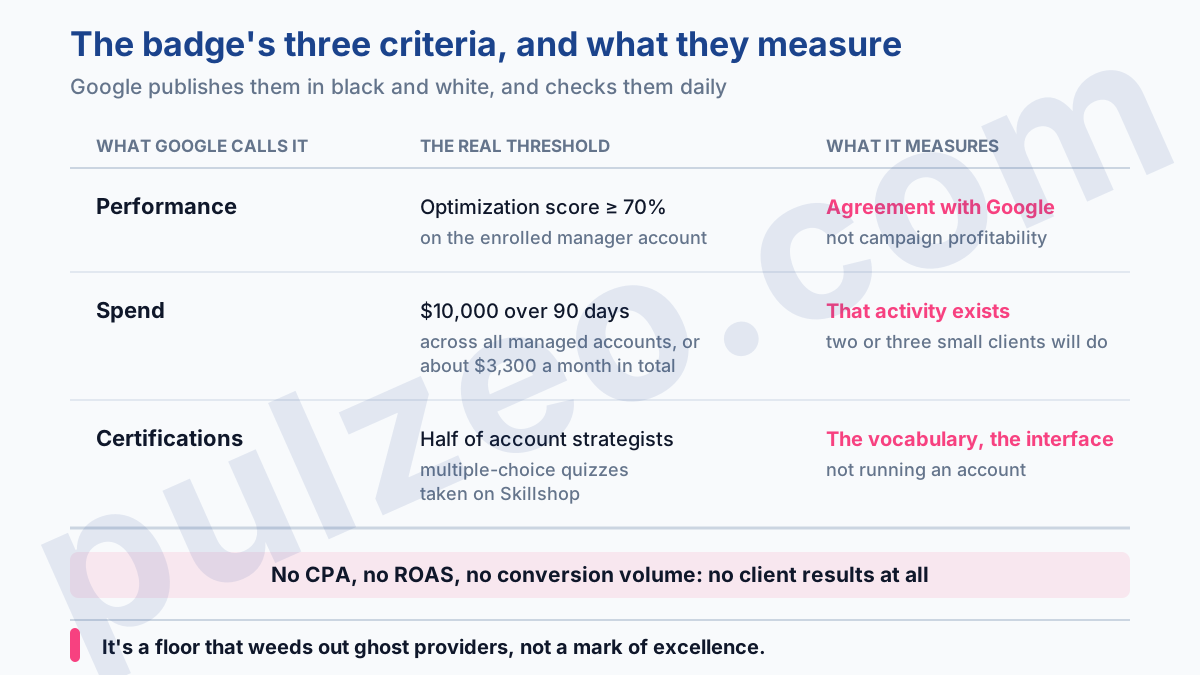
The Partners program sorts its requirements into three categories: performance, spend and certifications. Here they are with their real thresholds.
- Performance: an optimization score of at least 70% on the manager account enrolled in the program.
- Spend: at least $10,000 in ad spend over 90 days, combined across all managed accounts.
- Certifications: at least 50% of account strategists, meaning the people who manage client accounts day to day, plus one certification in each product area that spent at least $500 over the last 90 days.
Read the first line twice. The category Google calls "performance" doesn't contain a single results metric. No cost per acquisition, no return on ad spend, no conversion volume. It contains an optimization score.
Does optimization score measure performance?
No, it measures something else: how closely your account follows the recommendations Google sends you. It's a grade for agreeing with the ad platform's advice, not a grade for profitability.
The distinction is far from theoretical. These recommendations regularly include switching keywords to broad match, raising budgets, turning on Performance Max or adding audiences. Some of them are excellent. Others mainly serve to make you spend more, and a good account manager dismisses them with good reason.
Google makes no secret of it, and admits as much in the very sentence that sets the threshold.
"You're in control, with the ability to apply or dismiss recommendations."
Except there's a 70% floor, and that floor creates a very real tension. An agency that methodically turns down questionable recommendations watches its score drop. If it falls below the threshold, Google notifies it and gives it some time to get back into compliance.
I'm not saying badged agencies blindly click "Apply." Most of them make these calls very well, and 70% leaves some room. Still, a metric that rewards agreeing with the ad platform measures something other than the service delivered to the advertiser. Read it with that in mind.
Making those calls means knowing what each recommendation actually brings in, which the interface doesn't tell you. Pulzeo ranks each fix by estimated gain and effort required, rather than handing you a queue to approve in bulk.
The $10,000 spend threshold
It's the most misunderstood criterion, because people imagine it's tougher than it is. The threshold covers all managed accounts combined, not a single client, and it runs over three months.
Do the math: that's about $3,300 a month for the entire portfolio. An agency managing two or three small businesses with average budgets clears the bar without any particular effort. A freelancer with a single sizable client clears it too.
So this threshold says nothing about the provider's size, experience or specialization. It filters out outfits with no real activity on Google Ads, which is already useful, but that's where it stops.
As for certifications, they're multiple-choice quizzes taken on Skillshop, Google's training platform. They confirm you know the vocabulary and the interface. Nobody has ever claimed that passing a quiz makes someone a good account manager, and it pays to know what a Google Ads certification is really worth before judging a badge on this criterion.
What is Google Premier Partner status?
Let's go up a notch, because this is where the system gets truly revealing. Premier status is reserved for the top 3% of participants in a country, designated once a year, and Google publishes the factors it uses.
There are five of them: spend growth among existing clients, spend from newly acquired clients, client retention, diversification into products other than the Search Network, and the amount of annual spend managed.
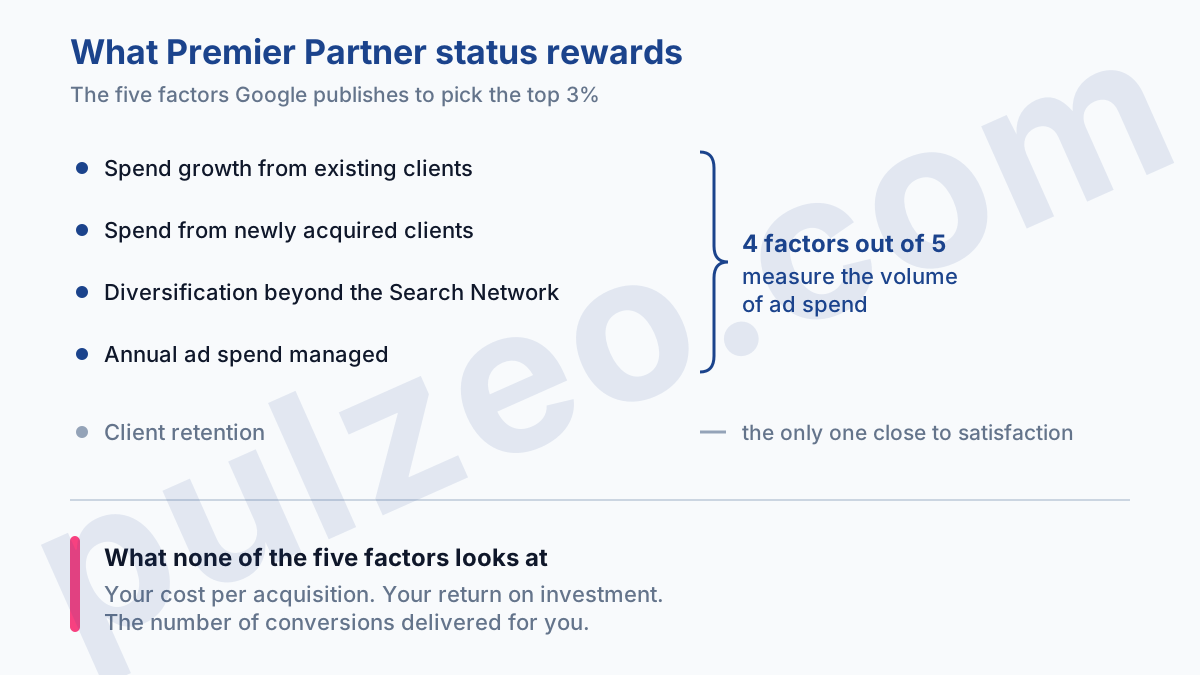
Let's count. Four of these five factors are calculated from your ad spend, in one form or another. The fifth, retention, is the only one that comes close to client satisfaction, and even then only indirectly.
The diversification criterion deserves a special mention, because it's especially telling. Google measures the share of your spend that goes somewhere other than the Search Network: YouTube, Display or Shopping.
So an agency whose clients are all profitable on the Search Network alone gets penalized on this factor. That makes perfect sense from Google's point of view, since its interest is to grow its inventory, but your budget has no reason to follow that logic.
How to check that a badge is genuine
Since we're talking about a logo displayed on a homepage, you might as well know how to check it. Google governs its use with precise guidelines, and two of them give you instant checks.
The badge must be clickable
A compliant badge is displayed through the HTML snippet Google provides, which automatically includes a link to the company's profile page in the Partners directory. Google is unambiguous about it: using only the marketing image doesn't comply with the guidelines.
The check takes one second. Click the badge. If nothing happens, you're looking at an image pasted into the page, so you don't know whether the status is real, or whether it's still valid. On the official profile, you'll see the current status and the product areas covered.
This detail matters because the requirements are checked every day, and an agency that drops below the thresholds loses its badge after a grace period. A static image, on the other hand, never updates itself.
The badge never covers SEO
Here's a guideline almost nobody knows, and it's telling. An agency that displays its badge on pages selling SEO services must state prominently that those services aren't verified or endorsed by Google.
Look at the websites of agencies that sell both paid search and SEO: the notice is extremely rare. Nothing dramatic in itself, but keep the principle in mind: the badge says nothing about their skills in SEO, social media or website design. It covers Google Ads, and only Google Ads.
Google actually goes further, and spells out in black and white the line that some agencies' marketing happily crosses. The badge, its guidelines say,
"cannot be used in any manner that implies a relationship or affiliation with Google."
Nor can it suggest that Google sponsors the company or endorses its products, services or the information it provides. In other words, reading it as "Google recommends this agency" isn't just a stretch. The program's own rules explicitly forbid it.
So, should you ignore the badge?
No, and that would be the mirror-image mistake. The badge isn't hot air, it's just misread.
What it actually guarantees is worth spelling out, because it isn't nothing. The agency really does manage Google Ads campaigns, today, for real clients. Part of its team has completed the official training. It has a manager account in good standing, with ongoing activity that's checked daily.
In other words, the badge weeds out ghost providers, the ones who add "Google Ads" to their list of services without ever having opened the interface. In a market where anyone can call themselves an expert, that filter has value.
It's a floor, and it should be read as one. It proves that activity exists, but says nothing about its quality.
What questions should you ask a Google Ads agency?
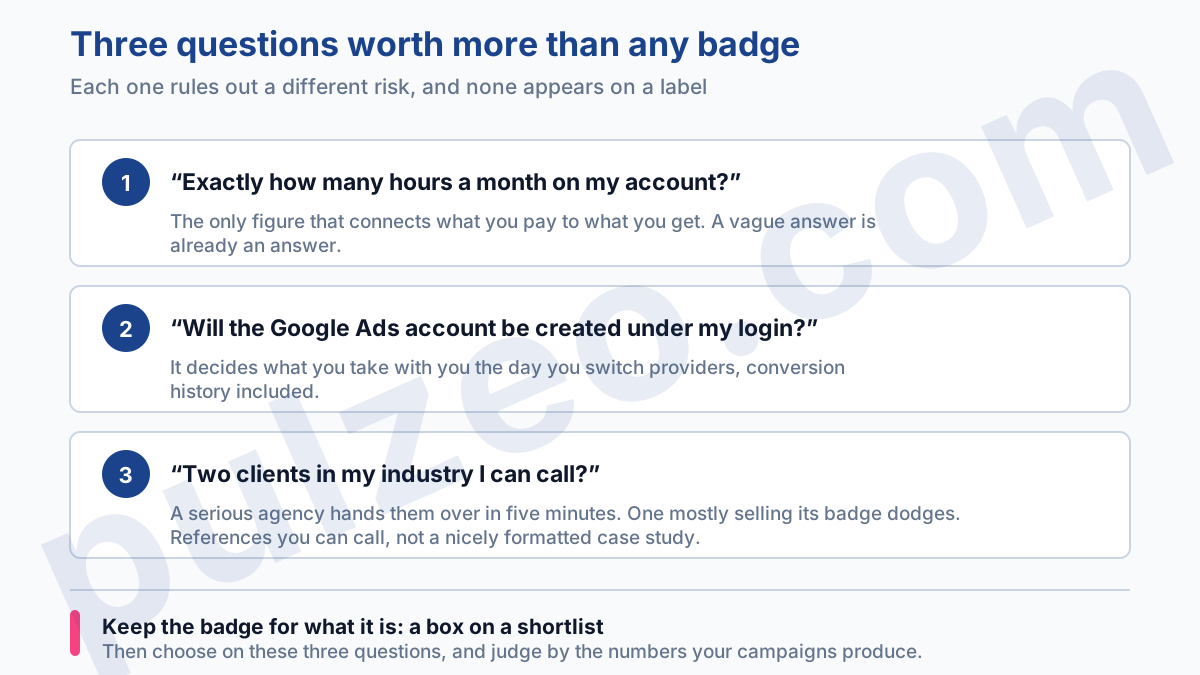
Three questions are worth more than any badge, and I ask them every time someone asks me to choose between two providers:
- exactly how many hours a month on my account;
- will the Google Ads account be created under my login;
- two clients in my industry I can call.
Each one rules out a different risk. The number of hours is the only figure that connects what you pay to what you get, and it doesn't appear on any label. Account ownership decides what you take with you the day you switch providers, conversion history included. As for the two references, a serious agency hands them over in five minutes, while one that's mostly selling its badge dodges the question.
The rest of the reasoning, including the budget at which an agency starts to pay for itself, I've laid out in the article on when handing off your account is worth it. The badge never factors into that calculation.
Then, once the contract is signed, no label will replace the only check that counts: what your campaigns produce, month after month. A badged provider whose cost per acquisition climbs for two quarters is still a provider whose cost per acquisition climbs. You still have to spot it without depending on someone's reporting schedule, and that's what Pulzeo does by monitoring your accounts continuously.
So keep the badge for what it is, a box to check on a shortlist. Then choose based on the three questions, and judge by the numbers. It takes more effort than a glance at a blue logo on a homepage, and it'll tell you what the badge never will.
Common questions
What are the requirements to become a Google Partner agency?
Google publishes three. The first is an optimization score of at least 70% on the manager account enrolled in the program. The second is at least $10,000 in ad spend over 90 days, combined across all managed accounts. The third requires at least half of the people who manage client accounts to be certified on Skillshop, with one certification for each product area that spent at least $500 over the period. Google checks these requirements daily.
Does the Google Partner badge guarantee results?
No, and Google doesn't claim it does. None of the three criteria looks at cost per acquisition, return on ad spend or the number of conversions delivered for clients. The criterion called "performance" is the optimization score, which measures how closely the account follows Google's recommendations, not how profitable the campaigns are. The badge is still a useful floor, filtering out providers with no activity or training, but it isn't a mark of excellence.
What's the difference between Google Partner and Premier Partner?
Premier status is reserved for the top 3% of participating companies in a given country, determined once a year. The factors Google uses are spend growth among existing clients, spend from new clients, client retention, diversification into products other than the Search Network, and the amount of annual spend managed. Four of these five factors are calculated from ad spend.
What should you ask an agency besides the badge?
Three things that, unlike a badge, the agency actually has to commit to. The time really spent on your account each month, in hours. Ownership of the Google Ads account, created under your own login with admin access in your name. And two client references in your industry that you can call, not a nicely formatted case study.
