
Is Google Ads certification worth it?

The Google Ads certification is free, you take it on Skillshop, it takes 80% correct answers in 75 minutes, and it's valid for one year. That's the part the top Google results already explain very well, often in three thousand words.
What none of them tell you is what it actually vouches for once it's in your pocket.
I typed the query into Google in France, my home market, and looked at what it suggested on its own. Between "free" and "price" sat "answers pdf". Then I measured the cluster in Keyword Planner, in August 2026: seven different French phrasings looking for the exam's answer key, about sixty searches a month that don't ask how to study, but where to find the answers.
That doesn't make the certification useless. It just means you need to know what you're reading when you see it on a profile, and what you can expect from it when you take it. That's what this article is about.
What is the Google Ads certification?
The Google Ads certification is a credential Google issues to anyone who passes one of its online assessments on Skillshop, its free training platform. It validates knowledge of an ad format, not the ability to manage a real account.
Google publishes the rules in black and white. Its official help page on certifications gives the four numbers that matter:
- 75 minutes to take the exam;
- 80% correct answers to pass;
- a new attempt allowed one day later if you fail;
- one year of validity, after which you have to retake the assessment.
All of it is free, from the first course to the downloadable certificate. The point bears repeating, because "price" is right there in that autocomplete, and paid offers come up for that search: what training companies charge for is their coaching, and Google issues the certificate itself without asking for a cent.
The nine Google Ads certifications and which one to take first
Let's start by correcting what you'll read everywhere, including on Skillshop itself. When I checked, the description on its French page still listed six areas: Search, Display, Video, Shopping, Apps and Measurement. The catalog, once you're signed in, contains nine.
The three missing from that list are recent, and their names tell you what Google has in mind: "AI-Powered Performance Ads", "Creative", and "Grow Offline Sales". Along the way, Shopping was renamed "AI-Powered Shopping Ads". Three of the nine certifications now have artificial intelligence in their name.
Alongside this catalog, Google has opened a second one, for professional certifications, which for now only contains Search. It's a separate exam, and I'll come back to it below, because that's where the real difference lies.
Start with Search, period. It's the format nearly every advertiser comes in through, and its curriculum covers the fundamentals you'll then find everywhere: account structure, keyword match types, Smart Bidding, conversion tracking. The other eight add nothing until that one is in the bag.
After that, the rule fits in one sentence: take the certification for the format you actually run. Getting certified in Shopping when you sell nothing online, or in Apps when you don't publish any, fills out a profile without teaching you anything you can use.
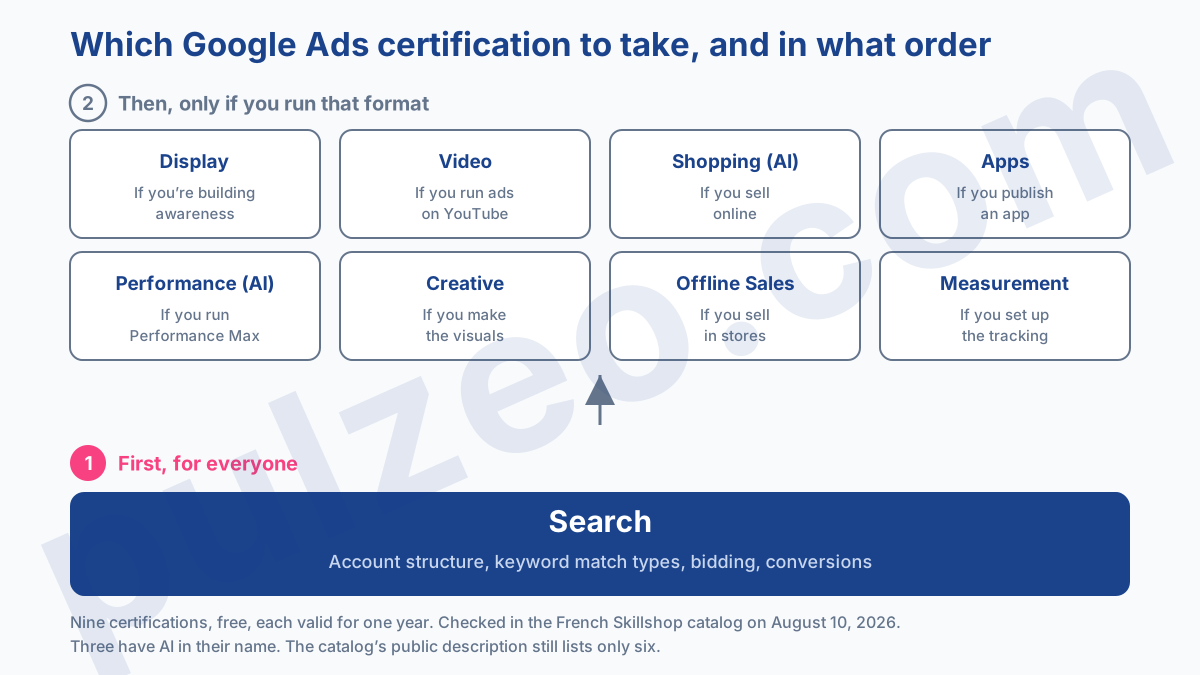
I've seen profiles that list nearly all of them, and it's a more ambiguous signal than it looks: either the person really runs every format, which is rare, or they're collecting. Nine certifications at about three hours apiece adds up to a week of work, and on a real account, all that's left of it is what you actually apply.
Worth knowing if you're looking at this from the agency side: the Measurement certification doesn't match any of the five product areas in the Partners program. So it counts toward your team's skills, but not toward the badge.
What the Google Ads certification proves, and what it doesn't
Here's the point every guide out there sidesteps, and it comes down to a procedural detail. The exam isn't proctored.
No need to guess: Google says so itself. Introducing its new professional certifications, Skillshop's help center states that they're virtually proctored "to ensure higher exam integrity", explicitly as opposed to the foundational certifications.
Professional certifications are virtually proctored to ensure higher exam integrity. Foundational certifications are not virtually proctored.
The consequence is inevitable. A multiple-choice quiz, taken alone in front of your screen with another tab open, measures the ability to find a right answer. The autocomplete test I mentioned earlier says the same thing another way: part of the audience for this query shows up looking for the answer key.
This proctored track deserves a closer look, because it sheds light on everything else. Google describes it as meant for "Google Ads users who spend more time implementing and managing campaigns", as opposed to the foundational certifications, aimed at strategists. In other words, Google itself has identified the gap this article is about, and it has started building a different exam to fill it.
Where does it stand today? It exists, in a catalog separate from the nine foundational certifications, and for now it only contains Search. I checked on August 10, 2026, on a French Skillshop account. Google announced in 2024 that it would come with a fee, without naming a price; I haven't seen any confirmation since, so treat that point as open.
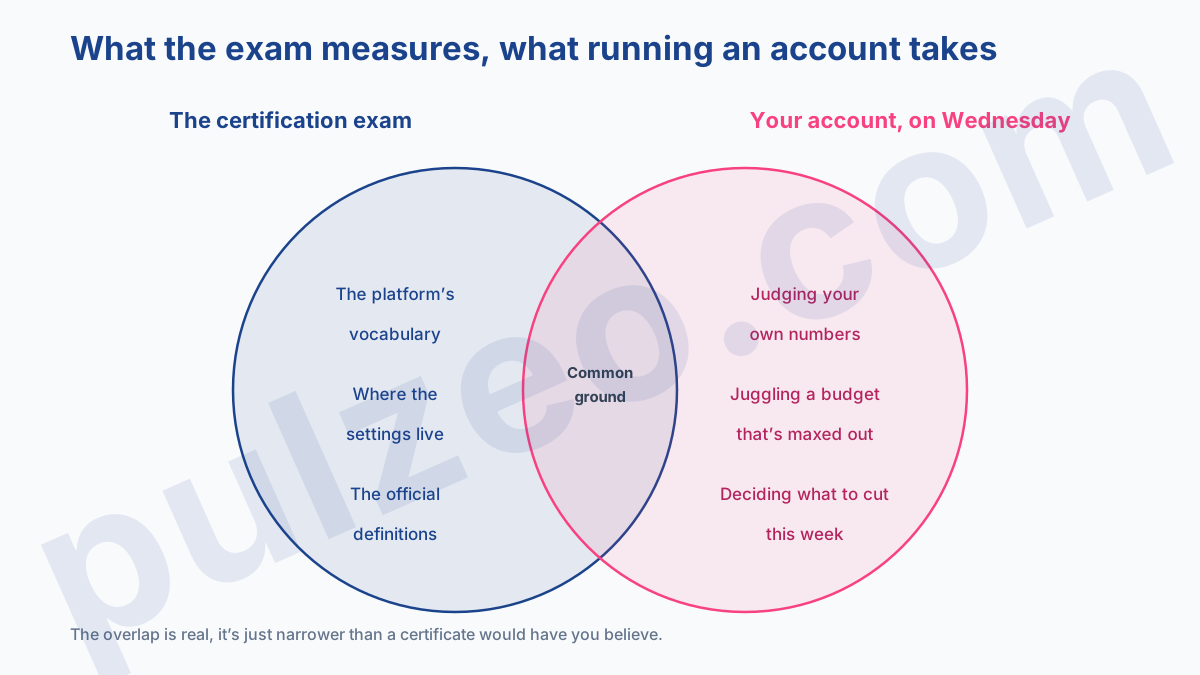
What the certification proves is still real, as long as you describe it accurately. It shows that you know the platform's vocabulary, that you know where the settings live, and that you've put a few hours into the subject. For a beginner, that's no small thing: it's exactly the foundation missing in someone who opened an account on a whim.
What it leaves out fits in one question: would this person know what to do with YOUR account, next Wednesday, with a cost per acquisition that went from $23 to $31? The exam never asks it, because it doesn't have your data in front of it.
That's precisely the gap Zeo, Pulzeo's assistant, is there to fill: it answers by reading your campaigns, your search terms and your change history.
What is the Google Ads certification worth on a resume?
Its value depends entirely on who's reading it, and the two typical readers don't use it the same way at all. So let's take them one at a time.
On the hiring side
For a junior candidate, the certification works for you. It says you took the subject seriously before anyone paid you to, and it gives you the vocabulary to hold your own in a technical interview without floundering. On an application for an internship or a first job, it's a real differentiator next to a resume that has nothing.
For an experienced candidate, it barely carries any weight anymore. A recruiter looking for five years in the trade looks at budgets managed, industries, results, and asks open-ended questions. The certification becomes just another checked box, and it can even backfire when it's the only thing filling the skills section.
On the client side
An advertiser choosing a provider is in a more uncomfortable position: they can't judge technical skill, so they look for a signal. A "Google certified" label plays that role perfectly, which is exactly why it shows up on nearly every agency and freelancer homepage.
Except that a signal anyone can get for free in 75 minutes doesn't set anyone apart anymore. If you're on that side of the table, these are the questions that actually weed people out:
- ask to see a real account, managed today;
- have them explain the structure they chose, and why that one;
- ask what was cut last month, and on what basis.
A provider who has done the work answers them in three minutes, and the certificate never comes up in the answer. We laid out this checklist in the article on when a Google Ads agency is worth it.
How long is the Google Ads certification valid?
One year, with no automatic renewal. Google is clear: to keep it, you have to retake and pass the assessment. And that's where the real problem with this certification lies, far more than in how hard it is.
Nothing happens on the day it expires. The certificate disappears from your Skillshop account, but the line on your LinkedIn profile stays, the logo in the agency website's footer stays, the label in the sales brochure stays. Nobody comes to take them down.
The result: some of the "Google Ads certified" labels displayed online point to an exam taken two or three years ago, on an interface that has changed since.
Since 2024, Demand Gen has taken over from Discovery campaigns, AI Max has arrived on Search, and two very common settings, automatically created assets and the campaign-level broad match setting, switch over to AI Max automatically as of September 2026. We've laid out AI Max's real timeline, which almost everyone gets wrong. An exam curriculum from 2023 describes a different platform.
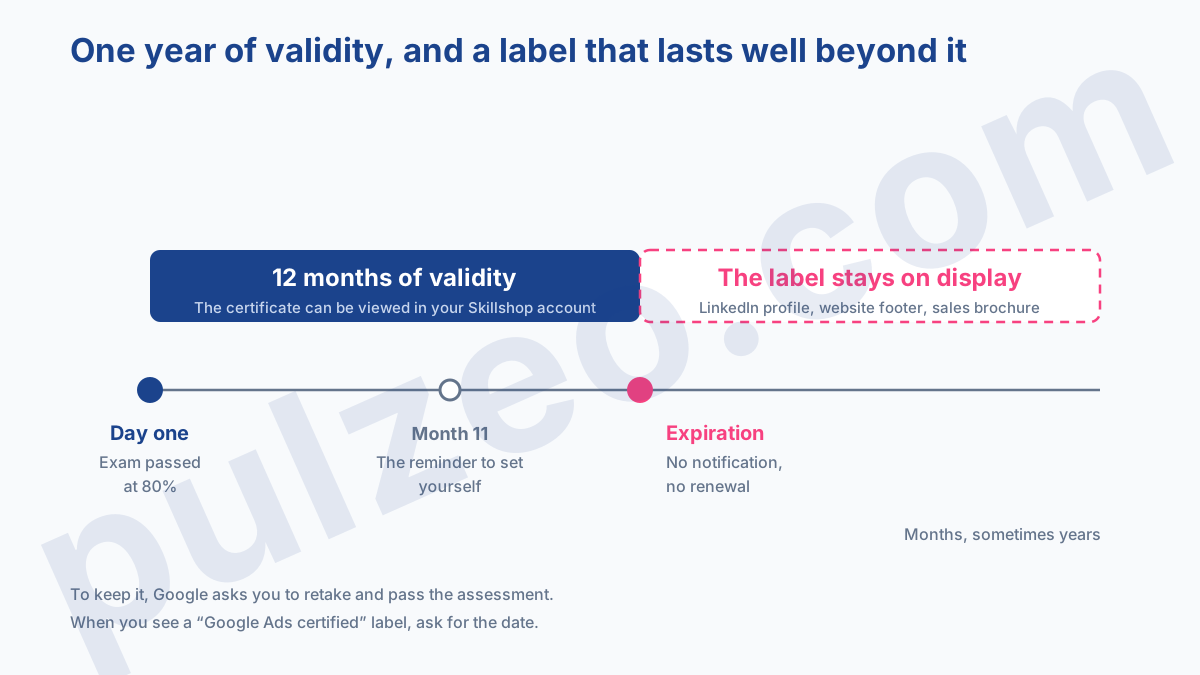
Two habits follow from this, depending on which side you're on. If you see the label on someone else's profile, ask for the date: it's a polite question, and it takes five seconds.
And if you're certified yourself, set a reminder at eleven months. Retaking the assessment costs 75 minutes once a year, and incidentally it's the best time of year to find out what Google has changed without telling you.
Can you verify a Google Ads certification?
Yes, but only if the holder helps you. There's no directory where you can look someone up by name.
The certificate lives in "My Profile", under Skillshop's "Awards" section. From there, Google explains that you can select it and then print it, or copy and share the URL of the page that appears. The profile itself can be made public or private, your choice.
What's missing is a reverse lookup. There's no way to start from a name and find someone's active certifications, the way you'd look up a contractor's license number. So the process always starts with the certified person, never with you.
So here's a concrete habit if you're hiring or choosing a provider: ask for the link, not a screenshot. A Skillshop URL shows the page as Google serves it today, whereas a screenshot has no date, and an expired certification looks exactly like a valid one in it.
That's the big difference from the agency badge, which you can verify without asking anyone for anything. Which brings us to the most common confusion on the subject.
Google Ads certification vs. Google Partner badge: the difference
People often mix them up, and they're two separate things. The certification is individual: it belongs to one person, you take it alone, and it's free. The Google Partner badge is awarded to a company, and it depends on three requirements Google checks daily, only one of which concerns certifications.
That one is worth knowing: Google requires at least half of the people who manage client accounts to be certified. A 50% threshold, which means a badged agency can easily hand you over to someone who isn't.
The other two criteria, optimization score and spend volume, actually say more about the agency than that one does. We've taken apart what the Google Partner badge really measures in a dedicated article.
Should you get the Google Ads certification?
Yes, take it. This article wasn't trying to talk you out of it, it was trying to tell you what you'll get in exchange for your 75 minutes.
It's free, Google keeps its curriculum up to date, and it's the fastest path to a structured vocabulary when you're starting out. As for the value of Google Ads training in general, free or paid, that deserves its own math. But get your expectations straight before you begin: you're going to learn how the platform is organized, not how to run your account.
No certification gives you that second part, and that's to be expected. It depends on your margins, your seasonality, your competitors and the numbers that move every week in your account. That's what Pulzeo reads for you, continuously, to tell you what deserves your attention today rather than what was on the exam syllabus.
The certificate proves you've learned the rules of the game. Only your account knows how your own game is going.
Common questions
Is the Google Ads certification free?
Yes, entirely. The courses and assessments live on Skillshop, Google's training platform, and all you need to get in is a Google account. There's no sign-up fee and no exam fee, and if you fail, Google says you can retake the assessment one day later. Be wary of companies that charge for the certification itself: what they're selling you is prep, not the certificate, which Google issues for free.
Do you have to retake the Google Ads certification every year?
Yes. A Google Ads certification expires after one year and there's no automatic renewal: Google asks you to retake and pass the assessment. It's the most common trap, because nothing takes the certification off a LinkedIn profile or an agency website the day it expires. So a certificate on display isn't necessarily a valid one.
Is the Google Ads certification hard to get?
No, and Google doesn't claim otherwise. It's an unproctored 75-minute multiple-choice quiz where you need 80% to pass, with a new attempt allowed one day later if you fail. Someone who has already run campaigns often passes it on the first try after a quick review. Difficulty isn't what gives it its value.
Which Google Ads certification should you take first?
Search, in nearly every case. It's the format almost every advertiser starts with, and its curriculum covers the fundamentals you'll find everywhere: account structure, keyword match types, Smart Bidding, conversion tracking. Take the others when you actually use the format in question, not to collect badges.
