
Is Google Ads training worth paying for?

Google Ads training costs anywhere from €0 to €2,000 on the French market, where I work, and the question everyone asks before paying is simple: is it worth it? The honest answer, the one you won't find on the pages selling these courses, comes in two parts.
The best Google Ads training is free, official, and kept up to date by Google. And what you'll be missing after that isn't one more course, it's guidance on your own account, at the moment the question comes up.
Here are the real prices, what the free training actually covers, and the only two cases where paying for a Google Ads training course makes sense.
A word on course names, because they muddy any comparison between catalogs. A PPC course, or paid search training, usually means the same thing as Google Ads training, and so does AdWords training, which simply uses the platform's old name. Some providers advertise search engine marketing without naming Google at all, even though ninety percent of their program is about Google Ads, simply because that's where the market is.
What Google Ads training costs, from free to publicly funded
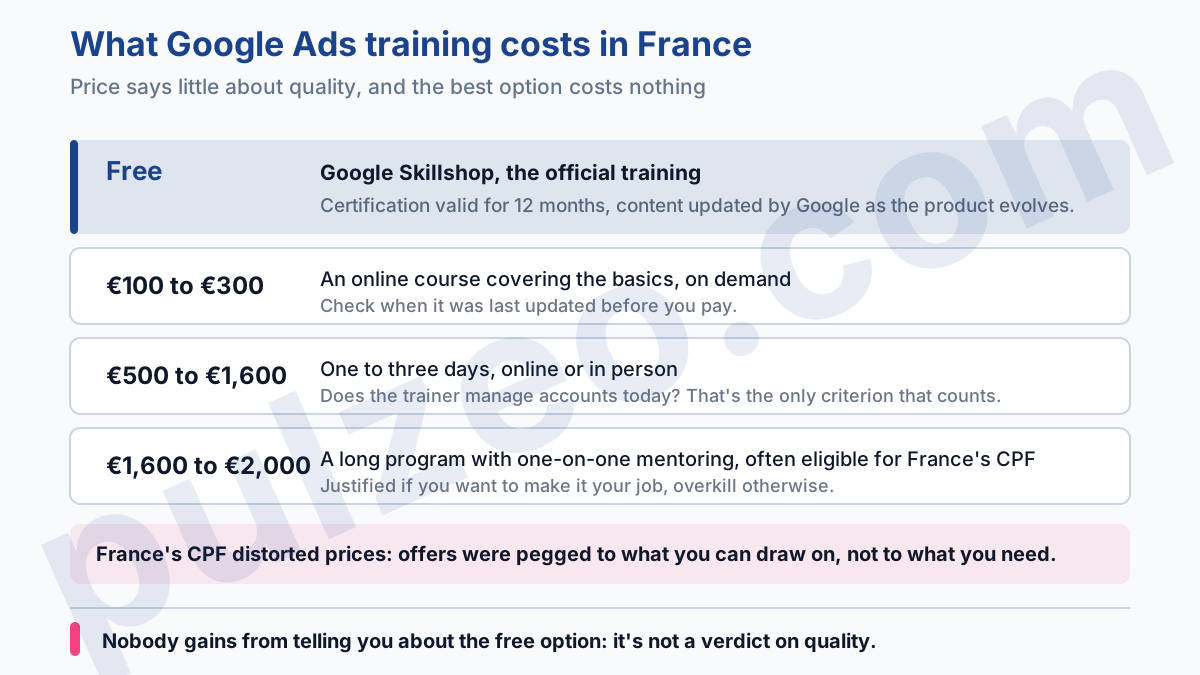
The market covers a wide range, and price tells you very little about quality. Here are the ballpark figures you'll find among French training providers:
- €0 for Google Skillshop, Google's official training;
- €100 to €300 for an online course covering the basics, available on demand;
- about €500 to €1,600 for a one- to three-day course, online or in person;
- €1,600 to €2,000 for a long program with one-on-one mentoring, often eligible for the CPF, France's publicly funded training account.
The CPF is precisely what distorted prices. Because this French training account picks up the bill, a crop of offers of very uneven quality sprang up, pegged mainly to the amount you can draw on rather than to what you actually need. A high price there guarantees neither a trainer who manages accounts today nor up-to-date content.
Free Google Ads training on Skillshop
Google publishes its own training, Google Skillshop, and it's a surprising blind spot: most comparisons barely mention it, or write it off as not enough. Yet it's free, it awards an official certification valid for 12 months, and it covers every format: Search, Shopping, Display, Video and Performance Max.
Above all, it has an edge no recorded paid course can match: Google updates its content as the product evolves. A video shot eighteen months ago teaches a platform that no longer quite exists.
So why do you see it recommended so rarely? Because nobody stands to gain from selling it. A provider that lives off its courses, or a comparison site paid a commission on every sign-up, has no reason to put Google's free option forward. The silence around Skillshop isn't a verdict on quality, it's a conflict of interest.
That leaves the question of what this certification is really worth once you've earned it. The same certifications serve another purpose, too: they count toward the criteria for the agency badge, and what that badge really measures is worth knowing before you choose a provider.
The best-maintained training on the market is free, official, and almost nobody has a reason to tell you about it.
Where to start without spending a dime
If you're starting from scratch, here's the path I'd recommend to a friend, and it costs nothing. Create your Skillshop account and take the Search certification first, the one that covers Search Network campaigns, the entry point for nearly every advertiser.
The exam is a multiple-choice quiz: you need 80% correct answers to pass, and if you fail, you can try again after 24 hours. Other certifications exist for each format (Display, Video, Shopping, Performance Max, Measurement), but only take them if you actually use those formats. Getting certified in Shopping when you don't sell online is pointless.
Once you have Search in the bag, stop taking courses and open a real account. Three constraints to impose on yourself, and they matter more than anything in the course:
- a budget you're prepared to lose entirely, without it changing anything about your month;
- a single campaign, so the cause of any swing stays identifiable;
- a conversion goal defined before the first dollar is spent, not after. You'll learn more in three weeks of running real ads than in three more video modules. The certification has to be renewed every year, but your account teaches you continuously.
How long Google Ads training takes
Even free training has a cost, and it isn't where you'd expect it. Skillshop asks for a few hours of coursework and a 75-minute exam, which is modest. The real cost comes afterward, when you move on to a live account.
It's those first weeks of fumbling around: a badly set-up campaign left running two days too long, a broad match keyword that scoops up anything, an automated bid strategy launched without enough conversions to learn from. Each of these mistakes is paid for in real ad spend, long after the training invoice has been settled.
That's your tuition at the school of hard knocks, and no provider puts a number on it because none of them bills for it: it's your own ad budget, spent learning as you go. On a small budget, it often exceeds the price of the course itself.
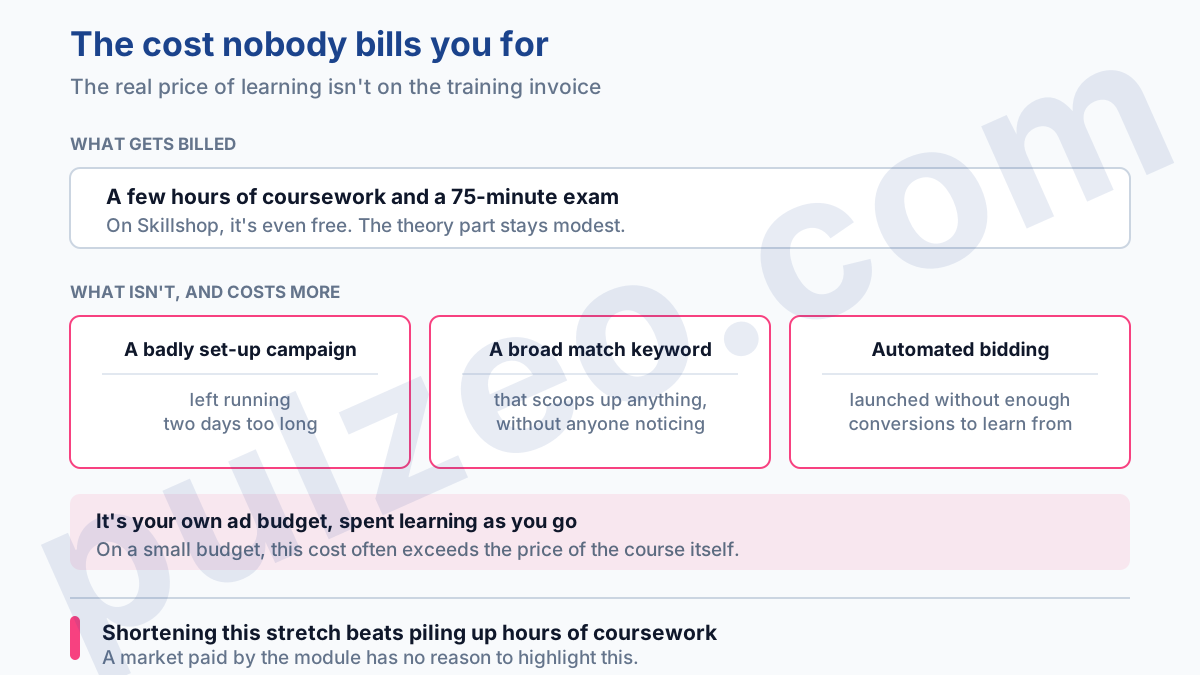
Which leads to a counterintuitive conclusion. What's expensive about learning Google Ads is the stretch when you're applying the theory badly on a real account. Shortening that stretch is worth far more than piling up hours of coursework, and it's an angle the training market, paid by the module, has no incentive to highlight.
Keeping Google Ads training up to date
Google Ads changes constantly, and fast. Take AI Max: Google first announced the end of Dynamic Search Ads for September 2026, then pushed the switch back to February 2027 and reopened DSA campaign creation in June.
Announced in April, corrected in June. Any course recorded in between is teaching the wrong timeline today, and its author probably doesn't even know it.
A few months earlier, the minimum audience size for remarketing had dropped to 100 users, and Google removed per-asset performance labels from its ad reports. A course that hasn't been redone since will happily teach you features that no longer exist.
That's the Achilles' heel of the video format, the one sold to you at a premium precisely because it's "at your own pace." At your own pace often means frozen on the day it was recorded. Always check when a module was last updated before you pay, and be wary of screenshots of a Google Ads interface you don't recognize.
This is also where a tool connected to your account has the edge over a course: Zeo, Pulzeo's assistant, works from the current state of your account and today's Google Ads, not from a screenshot frozen two years ago.
Why training isn't enough to run your account
I've seen several business owners in France pay €1,800 for a course, come out of it with a notebook full of notes, then reopen their account on Monday morning with no idea where to start. The problem wasn't the course, which was often decent. It was the gap between learning and doing, the moment when you have to apply a general rule to a specific situation that wasn't on any slide.
Here's the fundamental limit, and it holds for the best course as much as the worst. Training teaches you Google Ads in general. It doesn't know your industry, your seasonality, your margins, or why your CPA moved last Tuesday.
Yet that's exactly where the decisions that cost you or pay off get made. Knowing what a Target CPA is counts as general knowledge. Knowing whether yours is so low it's choking delivery on your own campaigns depends on context no course can anticipate.
Once you've got the basics down, the real need shifts. It's being able to ask a precise question about your account and get an answer grounded in your actual data.
"Why did my cost per acquisition go up this week?" "Which keywords should I add?" Those are exactly the questions Zeo answers, drawing on your account's real numbers rather than generalities, like a colleague who's already been briefed.
So when is a paid course worth it?
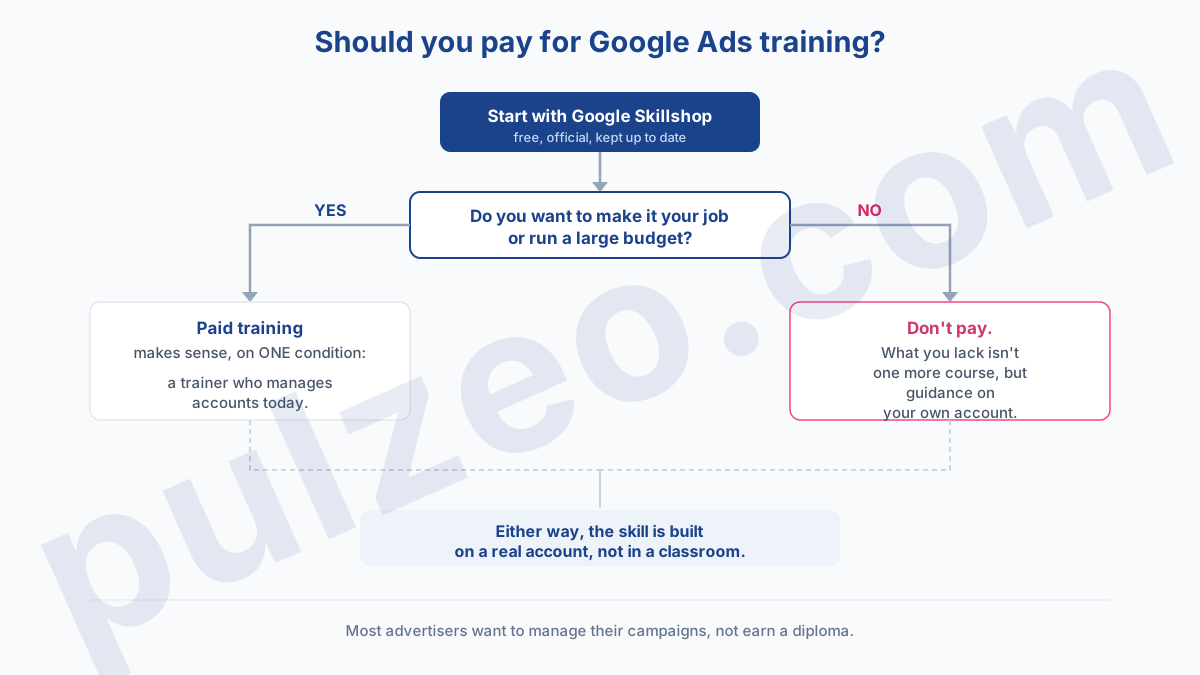
The question isn't whether to learn: obviously, you need to understand what you're doing. The question is whether to pay for it, and the answer depends entirely on your goal.
Yes, if you want to make it your job
If your goal is to become a consultant, manage client accounts, or run a sizable budget in-house, real paid training is justified. On one firm condition: it has to be taught by a trainer who manages accounts today, not by someone who stopped practicing five years ago. Ask about it explicitly before you pay; it's the only criterion that truly counts.
In that case, one-on-one mentoring, feedback on your own campaigns and access to a practitioner are worth the price. That's what the free format doesn't provide.
No, if you just want to manage your campaigns
If you're a tradesperson, a shop owner or a small business owner who wants to run your own ads without devoting your life to it, a €2,000 course is almost always overkill. Skillshop gives you the basics, free and up to date. The rest you learn by doing, on your account, not in a classroom.
What you'll be missing at that point isn't more theory, it's a safety net: something that warns you when a campaign starts burning through budget and tells you what to look at, while you get on with your real job.
Learning by managing your own account
The truth is, you don't really learn Google Ads in a course. You learn it by managing an account, seeing what works, fixing what doesn't. The course supplies the vocabulary; the skill comes from hands-on experience.
The trouble with learning on the job is that you're on your own, and a mistake costs real budget. That's where Pulzeo takes over from the training you'd rather not pay for: instead of memorizing what you should be watching, you let Zeo review your accounts, flag anomalies and suggest an action plan ranked by impact.
You then learn by watching recommendations land on your own account, with the explanation right beside them. It's a much faster way to build reflexes than a theory course, because it deals with your own cases.
The promise differs from a course's, and that's deliberate. A course aims for independence down the road; hands-on support aims to make you effective this week. For most advertisers, who are after results rather than a diploma, the second path gets there faster.
So start with Skillshop: it's free and well made. Launch a real account, even a modest one. And for everything the course couldn't anticipate, because it depends on your own numbers, lean on a tool that reads them continuously. Training teaches you Google Ads. Your account teaches you yours.
Common questions
Is Google Ads training required to launch campaigns?
No, nothing requires it. You can create an account and launch a campaign without any training. But launching without understanding anything gets expensive: a beginner can easily waste their first weeks of budget on default settings that don't fit. At a minimum, understand how an account is structured and how conversion tracking works, which Google's free training already covers.
Is Google Skillshop enough to get started?
For an advertiser who wants to manage their own campaigns, yes, in the vast majority of cases. Skillshop is Google's official training, free, with a certification valid for 12 months, and it covers Search, Shopping, Display, Video and Performance Max. Google keeps its content up to date, which no recorded video course can promise. It doesn't replace practice on your own account, but no training does.
How much does Google Ads training cost?
From €0 to €2,000 on the French market. Google Skillshop is free. Paid courses run from about €500 for a single day to €2,000 for a long program with one-on-one mentoring, often eligible for the CPF, France's publicly funded training account. In between, expect €100 to €300 for an online course covering the basics.
How long does it take to get up to speed on Google Ads?
Allow a few hours of coursework and a 75-minute exam for the Skillshop Search certification, then three to four weeks of running real ads on a small budget before your instincts become reliable. The theory is short. It's the hands-on stretch that takes time, because you have to wait for your campaigns to build up enough data for your decisions to rest on something other than gut feeling.
