
How to find clients in France: 10 free and paid ways

What it costs to find clients in France depends on how you go about it. In the French data I've been publishing for three weeks, it ranges from €3 for a restaurant cover to €2,220 for a real estate transaction, and the gap has nothing to do with talent or luck.
The trouble, when you look up how to go about it, is that guides line up thirty methods without ever saying what each one costs or how long it takes. Here are the ten that actually exist, ranked from free to paid, with a figure or a timeframe for each.
Can you find clients for free?
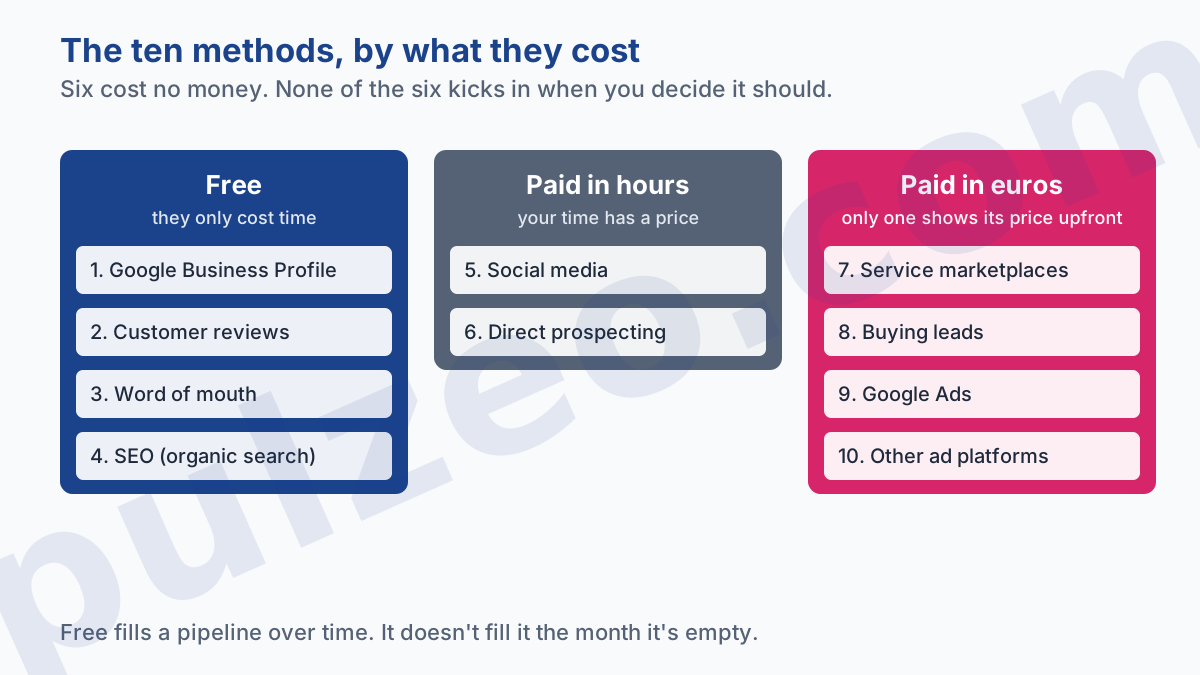
Yes, and that's actually where you should start. Six of the ten methods below won't cost you a cent: four are genuinely free, two are paid for only in hours.
But free doesn't mean there's no catch. They all cost time, and above all, none of them comes on demand. You don't get to decide when they deliver, or how much.
Timing, by the way, is the second thing guides never give you, and it matters as much as price. A verified Business Profile pays off within a few days, SEO within several months, word of mouth within years. An ad campaign, on the other hand, starts running within the hour after it's approved.
So free channels fill a pipeline over time. They don't fill it in the month it's empty.
That's where the last four change the game, and it's what justifies paying.
1. Google Business Profile
Free, and by far the best return on effort if you have a physical address. It puts you in the local pack on nearby searches, shows your hours, photos, directions and reviews, and Google answers with a map before it even shows a single ad.
For a local business, it's what captures most "near me" searches, and it only costs you the time to keep it up to date.
It also pays off once you move to advertising, because it's what feeds the address and phone number shown under your ads. I walk through that setup in the guide on linking your Business Profile to Google Ads.
2. Customer reviews
Free as well, and they break the tie where everything else fails. Two tradespeople side by side in the local pack, one at 4.8 from sixty reviews, the other at 3.9 from seven: the first one gets the calls.
The only thing it costs is the discipline to ask for them. A happy customer doesn't think of it; an unhappy one takes care of it unprompted: if you don't ask, your rating mostly reflects your misses.
3. Word of mouth and referrals
The most profitable channel there is, and the hardest of all to summon on demand. You don't steer it, you just watch it happen.
That's why a business that has never needed to look for clients is left helpless the day the pipeline runs dry. It has no tap to turn on: its stock of relationships ran out without warning, and nothing refills it on demand.
4. SEO (organic search)
Free on the surface, and that's where it gets expensive. Writing, structuring a site, earning links: it all takes a considerable amount of time, and nobody can tell you when it'll pay off.
Google does give a ballpark, but look how wide it is: "some changes might take effect in a few hours, others could take several months," and it advises waiting "a few weeks" before judging. From a few hours to several months: that's all the search engine commits to. I laid out the full math in the article on SEO vs. paid search.
Remember the mechanics: SEO is an investment whose return comes later and with no guarantee, advertising an expense whose return comes right away and stops when it does. The two complement each other; neither replaces the other.
5. Social media, with no budget
Free in the sense that posting costs nothing, time-consuming in the sense that you have to post nonstop to stay visible. And organic reach has collapsed on every platform.
For a visual trade like cooking, hairdressing, interior design or renovation, it's still a real channel because the work can be shown. A before-and-after of a job beats all the ads in the world, and it only costs the photo.
For an accountant or a locksmith, the effort rarely pays off: nobody follows a locksmith on social media; you look one up at 11 at night when you've locked yourself out. Run the same math as for prospecting, in hours spent, and compare it to the number of clients who actually came in that way.
6. Direct prospecting
Calls, emails, door-to-door, professional networks. It doesn't cost money, it costs hours, and that's where you need to run the math nobody runs.
Count the time you actually spend, apply your hourly rate to it, and divide by the number of clients signed. A tradesperson at €45 an hour who spends a full day landing one job has just paid €360 for that client. The cost is real; it's simply paid in unbilled hours rather than in euros leaving the account.
7. Service marketplaces
The first truly paid channel on the list, and the most opaque. Several models coexist: a monthly subscription, a price per contact, or a commission on the value of the job.
The rate cards published by the French platforms themselves range from about €20 a month with no commission up to €50 for just a prospect's contact details, with a commission on top in some models. And the same contact is often sold to three to five professionals at once, which puts you in a price war before you've even picked up the phone.
8. Buying leads
Same logic, more direct: you buy a qualified contact, one at a time. The French rate cards I collected run from €45 to €180 depending on the sector, with an advertised average of around €79.
One detail is worth noting, and it holds for this whole section: these figures are published by the people who sell the leads. They're the only ones available for France, and they come from the party with an interest in making them look reasonable. Take them for what they are: a ballpark produced by an interested party.
Another thing to know: a purchased lead isn't a client. The conversion rate usually assumed is around one in five, which multiplies the real cost by five.
If you'd rather generate your own leads than buy them, the method is in how to make Google Ads lead generation work, along with the trap waiting for both approaches: counting contacts instead of clients.
9. Google Ads
It's the most expensive option on the list, and the only one whose price you can know for your trade and your city before you spend a single cent.
What a customer costs, by trade
For three weeks now, I've been pulling real bids by sector and working out what a customer ends up costing.
Let's start with the click, since that's what you're buying. It runs from €1 for a tiler to €15.61 for a locksmith, with €1.46 for a garage and €13.46 on a moving quote request. A factor of fifteen between the two ends, for trades that all do the same thing: send someone to a website.
But the click tells you nothing until it's turned into a customer. That's where the gaps really widen.
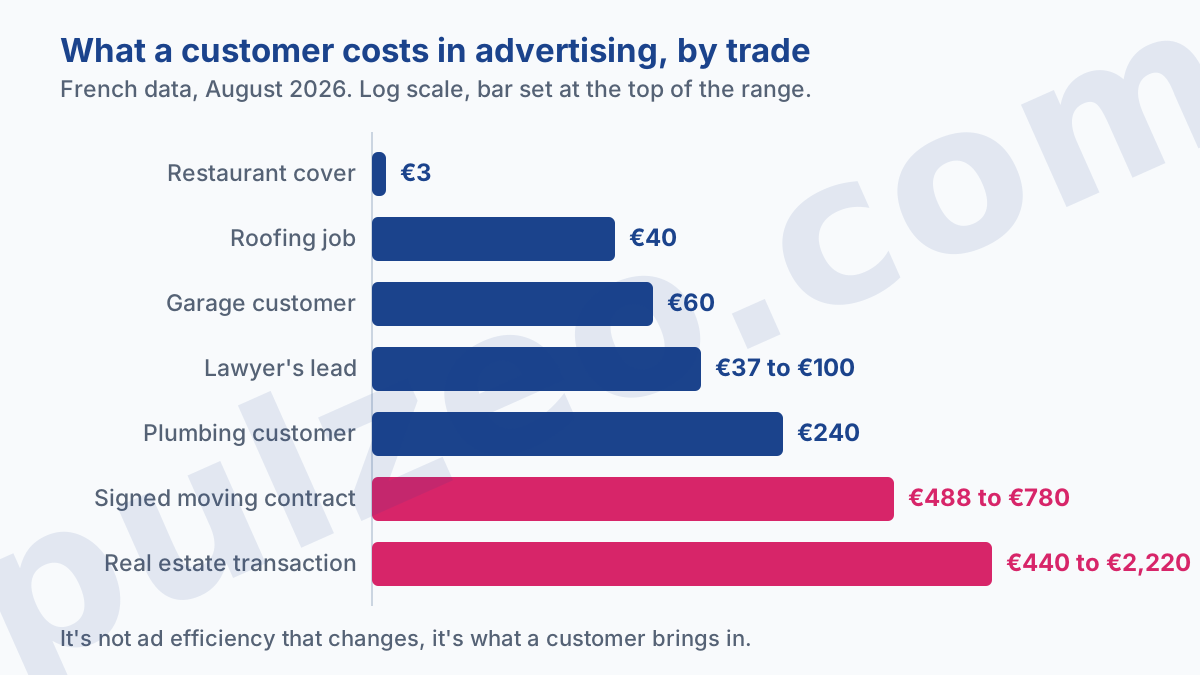
A restaurant cover comes to around €3. A roofing job around €40. A garage customer €60. A lawyer's lead €37 to €100, a plumbing customer €240. A signed moving contract €488 to €780. A real estate transaction €440 to €2,220.
A factor of more than seven hundred between the two extremes. This isn't about advertising efficiency. It all comes down to what a customer is worth: nobody buys a €30 click to sell a lunch special.
Why you can know the price in advance
This is what really sets this channel apart from the other nine. Google publishes its estimated bids in Keyword Planner, for free, before any campaign.
A platform tells you its own rate. Google tells you what YOUR trade costs in YOUR city, before you've spent a single cent.
Do keep in mind what that estimate actually is, though: the amount to bid to aim for the top of the page, not the price you'll pay. Your actual cost will come in lower. That's the data Pulzeo pulls for you, trade by trade, with the volumes and bids for your own keywords.
The rest of the math, starting budget and break-even point, is detailed in how much Google Ads costs.
10. Other ad platforms
Google isn't alone, even if it handles the bulk of search in France. Three complementary options are worth knowing about.
- Microsoft Advertising, which sells the ads on Bing, Yahoo, DuckDuckGo and Qwant: about a tenth of French searches, with bids often lower because there's less competition. As for Ecosia, it now draws on three providers: Bing, Google, and EUSP, the European index it built with Qwant, which for now is only available in France.
- Meta, for businesses where people discover a need they weren't looking for: interior design, coaching, training, restaurants.
- LinkedIn, for B2B only, and the most expensive of the three: published benchmarks put the click well above what you pay on search, which only makes sense if a client brings you several thousand euros.
The last two don't replace search when the customer already knows what they want. A locksmith whose customer types "emergency locksmith" at 11 at night has nothing to gain on LinkedIn; on Bing, on the other hand, that same customer exists and costs less.
So, where should you start?
Three steps, in this order, without skipping any:
- set up everything that's free: your Business Profile, reviews, a decent website;
- work out what a client brings you in margin, not in revenue;
- then test a single paid channel at a time, over a month, measuring as you go.
The first step comes before everything else because an ad account that sends people to a dirty storefront wastes every click it buys. You'd be paying to bring people to a profile with no photos and a dated website.
The second is the one almost nobody has done in the accounts I take over. Without that number, no acquisition cost means anything: €240 per customer is a bargain for a plumber installing a boiler, and a disaster for a restaurant owner.
The third takes patience. One month, a budget you're prepared to lose, and a single question at the end: how many clients, for how much spent? Without that answer, the next month gets decided on gut feeling.
That last point sinks more accounts than any other: the spend shows up right away, the return is measured weeks later, and without proper tracking you cut the campaign that was working. That's exactly what Pulzeo monitors and reports to you every week, so the decision to cut rests on a number.
Common questions
How much does a client cost in France?
There's no useful average: the figure depends on your trade far more than on your talent. In the French data I've been publishing for three weeks, a restaurant cover acquired through advertising costs around €3, a garage customer €60, a lawyer's lead €37 to €100, and a real estate transaction €440 to €2,220. Always compare that cost to what a client brings you, never to what a peer in another trade pays.
Can you really find clients for free?
Yes, and that's where to start: a Google Business Profile, reviews, word of mouth and SEO don't cost a cent. But none of them comes on demand: they take time, sometimes months, and you control neither the timing nor the volume. Free channels fill a pipeline; they don't fill it when you need it.
Which method brings in clients the fastest?
Advertising, with no serious rival. A campaign starts running within the hour after it's approved, while SEO takes months and word of mouth doesn't kick in on command. It's also the most expensive, and that's exactly the trade-off: you pay to choose the timing.
How do you know if an acquisition channel is profitable?
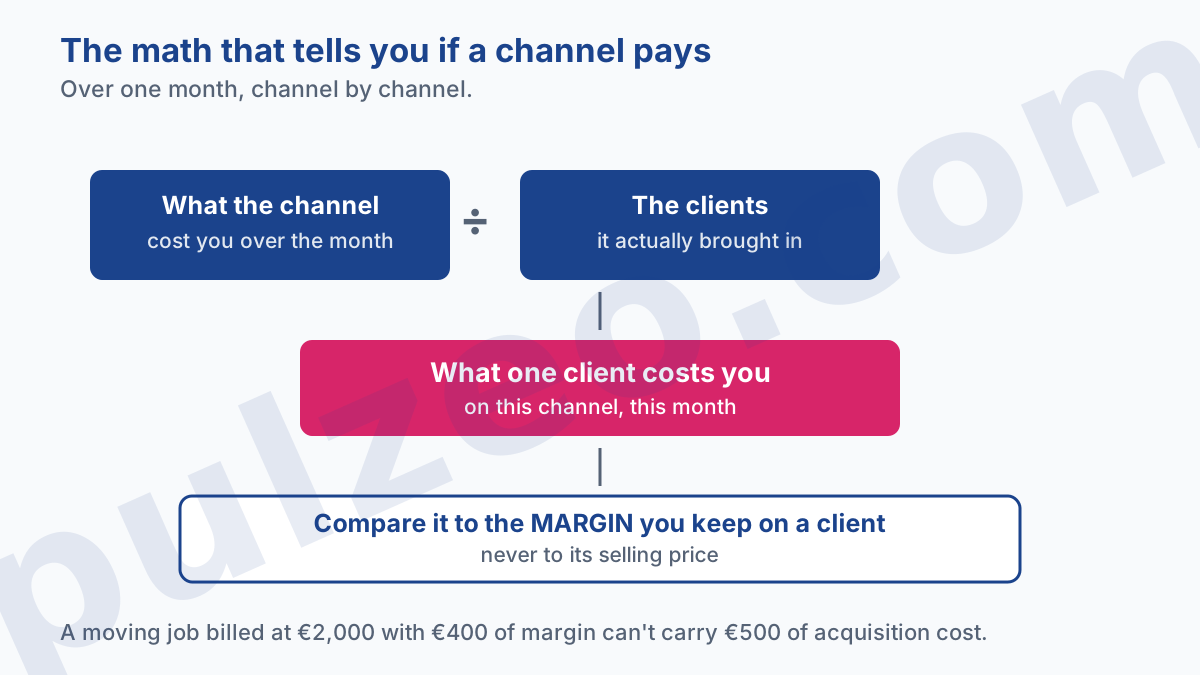
Divide what the channel costs you over a month by the number of clients it actually brought you, then compare that figure to the margin you keep on a client, not to its selling price. A moving job billed at €2,000 that leaves €400 of margin can't carry a €500 acquisition cost. A €60 garage customer who comes back every year can.
