
Google Ads for plumbers in France: cost per client in 2026

In France, a plumber has to bid between €4.80 and €25 depending on the city to aim for the top of the page, with peaks above €45 inside Paris proper. It's the first number to have in mind before getting into Google Ads for plumbers, and it's also the one that explains why two people in the same trade can have opposite experiences of the channel.
These amounts are Keyword Planner's bid estimates for the French market, pulled in August 2026 for emergency plumbing searches. They'll get stale, like any price. What won't get stale is the method for going from the price of a click to the price of a client, and that's what decides whether you should go for it or not.
How much a click costs in emergency plumbing
Here are the trade's most searched queries in France, translated, with their monthly volume and the bid Google estimates you need to show at the top of the page. Be clear on what that figure means: it's what you have to bid, not what you'll pay, since the price actually charged is almost always lower.
| Keyword (translated) | Searches / month | Estimated bid |
|---|---|---|
| emergency plumber | 5,400 | €11.27 |
| plumbing repair | 2,900 | €7.16 |
| emergency plumber paris | 880 | €25.32 |
| emergency plumber montpellier | 720 | €7.17 |
| emergency plumber toulouse | 390 | €5.28 |
| emergency plumber lyon | 320 | €4.80 |
| emergency plumber bordeaux | 260 | €16.63 |
| emergency plumber lille | 210 | €12.41 |
| emergency plumber marseille | 170 | €13.23 |
| emergency plumber nice | 110 | €22.11 |
The median comes out around €12. Hold on to that number: everything else follows from it.
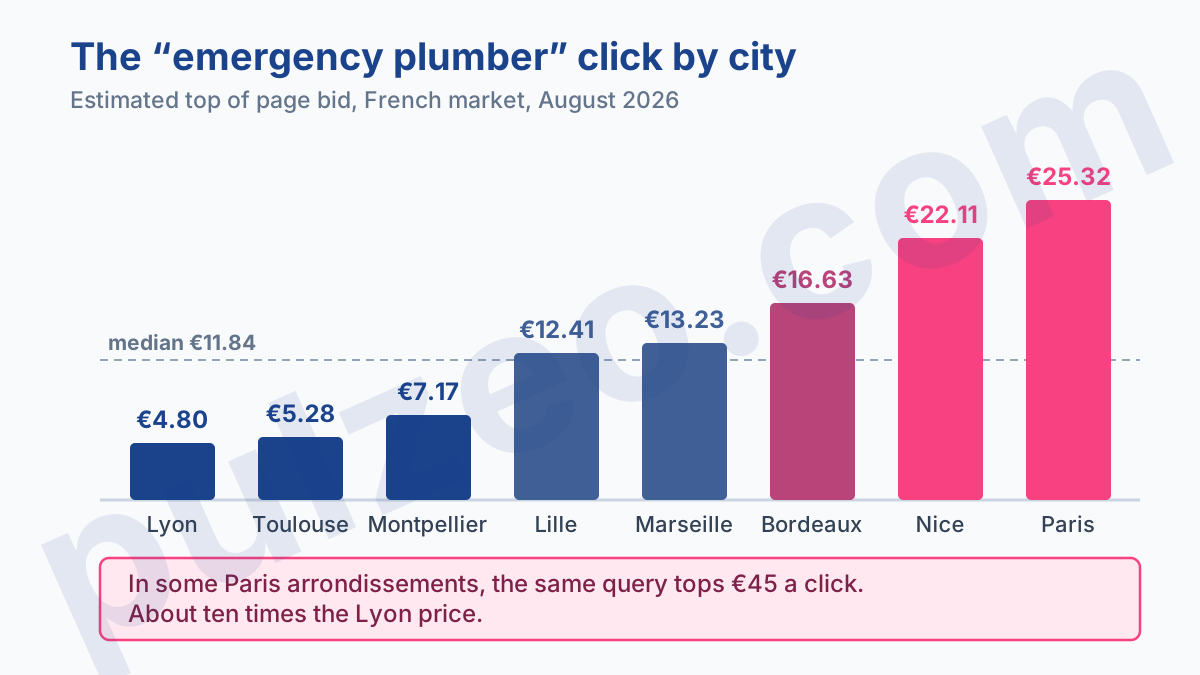
Now look at both columns together. National volume is concentrated on two generic queries, but the city queries are where bids take off. And the gap between Lyon and Nice, for the same trade and the same wording, reaches a factor of five.
What a client costs, not a click
The price of a click tells you nothing on its own. What counts is the number of clicks it takes to land a job, and you work that out in two steps, which I'll go through in order.
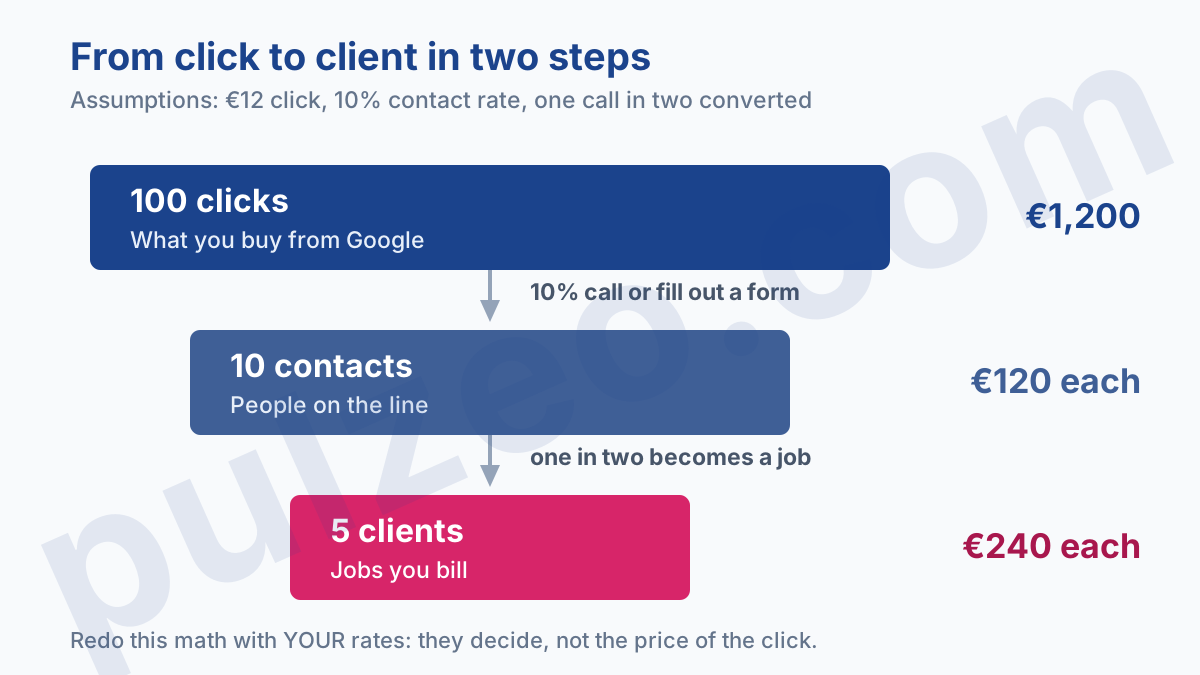
Step one, from click to contact. Out of a hundred clicks, how many call you or fill out the form? I'm not going to make up an industry average for you: nobody publishes a serious one. Work with a range instead. At 5%, a contact costs you twenty clicks, so about €240 at the median price. At 10%, it costs you ten, so €120. At 15%, around €80.
Emergency work tends to sit at the top of that range, because the intent is immediate: someone whose bathroom is flooding doesn't shop around for three quotes. But that advantage holds on one condition, how fast you answer, and I'll come back to it below.
Step two, from contact to job. Not every call turns into work: wrong area, you're not available, the price gets turned down. If one call in two turns into a job, which is a reasonable assumption for emergency work, your acquisition cost doubles. A €120 contact becomes a €240 client.
This is exactly the general mechanism I laid out in the article on choosing between SEO and paid search, applied this time to a plumber's numbers.
There's one prerequisite left, and without it this whole calculation falls apart: you still have to count the calls. That's what sets emergency work apart, since the conversion is almost never a form but a phone call made within a minute. An account that only tracks form submissions will show three conversions a month when it actually produced twenty.
I've seen tradespeople shut down perfectly profitable campaigns for that reason alone. Turn on call tracking for calls from your ads and from your website, add a call asset, and set a minimum call length beyond which a call counts as a conversion, thirty or sixty seconds depending on your business. Without that, you're flying blind.
At what margin Google Ads becomes profitable
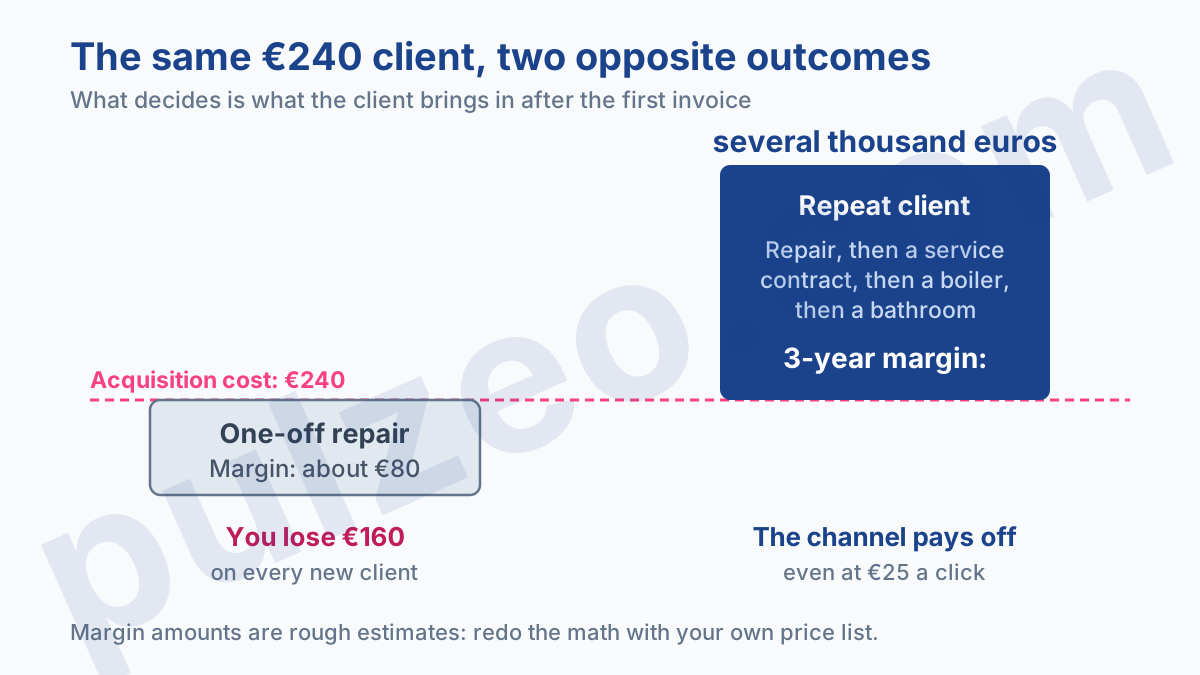
Here's the threshold, and it's higher than people think: at €240 per acquisition, a one-off job doesn't pay.
Run the math with your own price list. Unclogging a drain or replacing a seal, billed at €150 to €200, leaves you a margin below what that client cost you. You're working at a loss, and you find out at the end of month three, when seasonality can no longer serve as an excuse.
What turns that calculation around is the client's value over time. The same contact who cost you €240 becomes profitable if they sign an annual maintenance contract, call you back for their boiler, or if the job leads to a four-figure bathroom remodel.
The right indicator isn't the margin on the first job. It's what that client brings in over three years.
In practice, that changes what you're buying. A plumber whose business is made up of one-off emergencies, with no repeat customers and no big projects, has good reasons to stick with their Google Business Profile and word of mouth. One who installs, maintains, and renovates can pay €25 a click without flinching, because they know what's behind it.
What makes the bill vary in this trade
Three factors weigh far more than your choice of keywords, and they're specific to emergency work.
The city, which outweighs everything else
It's the clearest lesson from the numbers I pulled. The "emergency plumber" click goes for €4.80 in Lyon, €12.41 in Lille, €22.11 in Nice, and €25.32 in Paris. Zoom in to the arrondissement level and the gap becomes dizzying: some Paris queries go over €45 a click.
The practical consequence is immediate. A budget that's more than enough in a low-competition area only covers a few clicks a day in a crowded one, and a campaign built on advice written for another city produces results that make no sense. Always check your own estimates before you build a plan, never those from a generic article, this one included.
Urgency, which decides your hours
A leak doesn't give notice. It's one of the few trades where half of the high-intent searches come in at night, on Sundays, and on public holidays, which raises a question few tradespeople really settle: do you pick up at 3 a.m.?
If the answer is no, turn your ads off in those time slots. Paying €20 for a click that ends in voicemail is the fastest way to empty a budget with nothing to show for it, and you leave an unhappy customer behind you on top of that. If the answer is yes, those slots are actually the least contested of the week.
A sector Google watches closely
In-home repair has a reputation for fraud that has left its mark on the advertising rules. Google goes as far as banning locksmith ads outright in several European countries, and plumbing ads in the Netherlands, as the local services policy spells out.
In France, there's no restriction of that kind: you run ads normally, with no advanced verification required first.
The flip side of that openness is the bids you're seeing, and heavy exposure to junk queries. That's exactly the kind of weekly monitoring Pulzeo automates for tradespeople who don't have time to do it.
Which keywords should plumbers exclude?
In a trade at €12 a click, one junk query costs as much as a meal out. Here are the categories that keep showing up in tradespeople's Search terms reports, and that you're better off excluding as soon as the account opens:
- jobs and training: "plumber jobs", "plumber salary", "how to become a plumber", "CAP plomberie" (the French plumbing trade certificate);
- DIY: "unclog a toilet yourself", "how to change a seal", "leaky faucet tutorial";
- pure price hunting, if that's not where you position yourself: "cheap plumber", "plumber hourly rate";
- supplies: "water heater price", "thermostatic faucet", which bring in people who came to buy equipment;
- cities outside your service area, which location targeting alone doesn't always keep out.
That last category often surprises people. Location targeting is about where the searcher is, not the words they type: someone in your city may well be looking for a plumber for their parents' house three hundred kilometers away. Exclude the names of the cities you don't serve.
Go through that report every week in the first month, then every two weeks. The full method, including the broad match trap, is in the article on negative keywords.
What your ad and your page need to show
At €12 a click, what happens after the click matters as much as the targeting. And emergency work has its own rules, because the person on the other end isn't comparison shopping: they've got water on the floor.
On the ad side, four assets really make a difference in this trade:
- the call asset, so the number can be tapped without going through the website;
- the location asset, which reassures people that you're genuinely close by;
- sitelinks to your repair pages by type of problem: leak, water heater, pipes;
- callouts that spell out your real commitments: on site within an hour, free quote, seven days a week.
On the landing page side, never send people to your homepage. A page dedicated to emergency repairs has to answer three questions in under five seconds: do you come to my area, how soon, and what's the minimum it will cost.
So put the number big and at the top, tappable on mobile. Name the cities and postal codes you cover explicitly, because that's the caller's first worry. Give a response time and a trip fee, even a rough one: hiding the price doesn't get you more calls, it gets you calls from people who'll hang up.
One last detail that's expensive to ignore: on the emergency repair accounts I look at, traffic is overwhelmingly mobile, which makes sense since a breakdown is rarely discovered in front of a computer. A page that's slow to load loses the call before it's even earned it.
A realistic starting budget
Don't start from an amount, start from a number of clients. It's the only way to get a budget that means something.
Take a plumber in a mid-priced area, at €12 a click, who's aiming for five new clients a month. With a 10% contact rate and one call in two converted, that takes ten contacts, which means a hundred clicks, or €1,200 a month. In Paris, the same goal takes double that, or more. In Lyon, it drops below €600.
This reasoning is specific to emergency work, where clicks are scarce and expensive. In a trade where a click costs less than a euro, the arithmetic flips and the constraint changes completely: what Google Ads costs a restaurant shows it with the same calculation.
Set aside a cushion for the first month. Automated bidding needs volume before it settles, and the first weeks always cost more per contact than the ones that follow. The general budget math, with the thresholds that decide whether a campaign learns or not, is laid out in the article on the real budget of a Google Ads campaign, and our plans are on the pricing page.
One last piece of advice, the one I give every tradesperson starting out: begin with a single city and two or three immediate-intent queries. Within a month you'll know what a client is worth to you, with your real numbers. Those are the only ones that count.
Common questions
How much does a Google Ads click cost for a plumber in France?
On the emergency searches I pulled in August 2026, the estimated top-of-page bid runs between €4.80 and €25, with a median around €12 and peaks above €45 in some Paris arrondissements. The gap has little to do with the keyword you pick: it comes down to the city. The same emergency plumber search costs five times more in Paris than in Lyon.
What monthly budget should a plumber starting on Google Ads plan for?
Think in terms of contacts, never a round budget. At €12 a click and 10% of clicks turning into a form or a call, a contact costs you about €120. If you're aiming for ten contacts a month and converting half of them, budget €1,200 a month. In an expensive area, double it. That math is what gives you a realistic budget, not an amount picked in advance.
Are one-off emergency jobs profitable on Google Ads?
Rarely, if you look at them job by job. A €120 contact and one call in two turning into a job put the acquisition cost around €240, which is more than the margin on unclogging a drain or replacing a seal. What makes the channel profitable is the client's value over time: a maintenance contract, a boiler, a remodel. A plumber who only ever bills isolated jobs will struggle.
Should you run your ads at night and on weekends?
In emergency repair, that's the heart of the matter, since emergencies don't keep business hours. But only run at night if someone really picks up: paying €20 for a click that lands on voicemail at 3 a.m. is the fastest way to burn through a budget. Set your ad schedule to the hours you're actually on call, not the opening hours you advertise.
