
Why is my Google Ads CPA going up?

You open the account on a Monday morning, and the CPA is up 30%. Nothing changed on your end, no alarm went off, and yet the cost per acquisition climbed while you weren't looking. A Google Ads CPA that blows up is almost never a sudden accident. It's a slow leak, the kind of water leak behind a wall you only notice once the plaster swells. And by the time you spot it, the month's budget is already gone.
It's the mistake I see most often on the accounts I take over: nobody was watching that slow climb, because a CPA at $31 instead of $23 doesn't look like a breakdown. Just a bad week. Here's how to tell a real deterioration from plain noise, where to look for the cause, and above all what to do once you've found it.
How do you know your CPA really went up?
Before you rush to fix anything, ask yourself one question: did your CPA really go up for good, or is this noise? A CPA moves on its own from one day to the next, especially at low volume. On an account doing ten conversions a week, a CPA going from $25 to $32 on a Monday means nothing. Two fewer conversions that day, and the ratio takes off by itself.
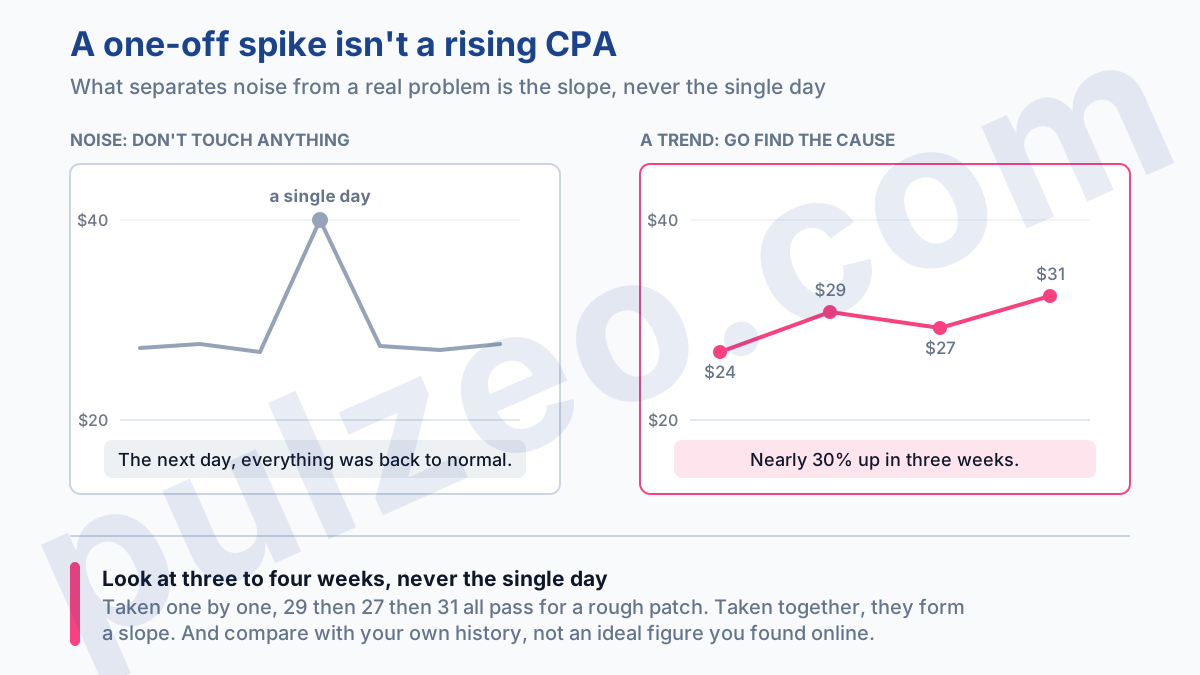
The rule I apply: I look at the trend over three to four weeks, never the day. A real problem is a slope climbing steadily, not an isolated spike that falls back the next day. And always compare against your own history, the average CPA of previous months in the same season, not an ideal figure from nowhere.
An example. An account ran at a $24 CPA for six months. One week it goes to $29, then $27, then $31. Taken one by one, each figure seems fine, and you tell yourself it's a rough patch.
Taken together, it's a slope of nearly 30% in three weeks, and that's when you go looking. Conversely, a single day at $40 in the middle of a perfectly stable month doesn't warrant touching anything. That's noise, not a signal.
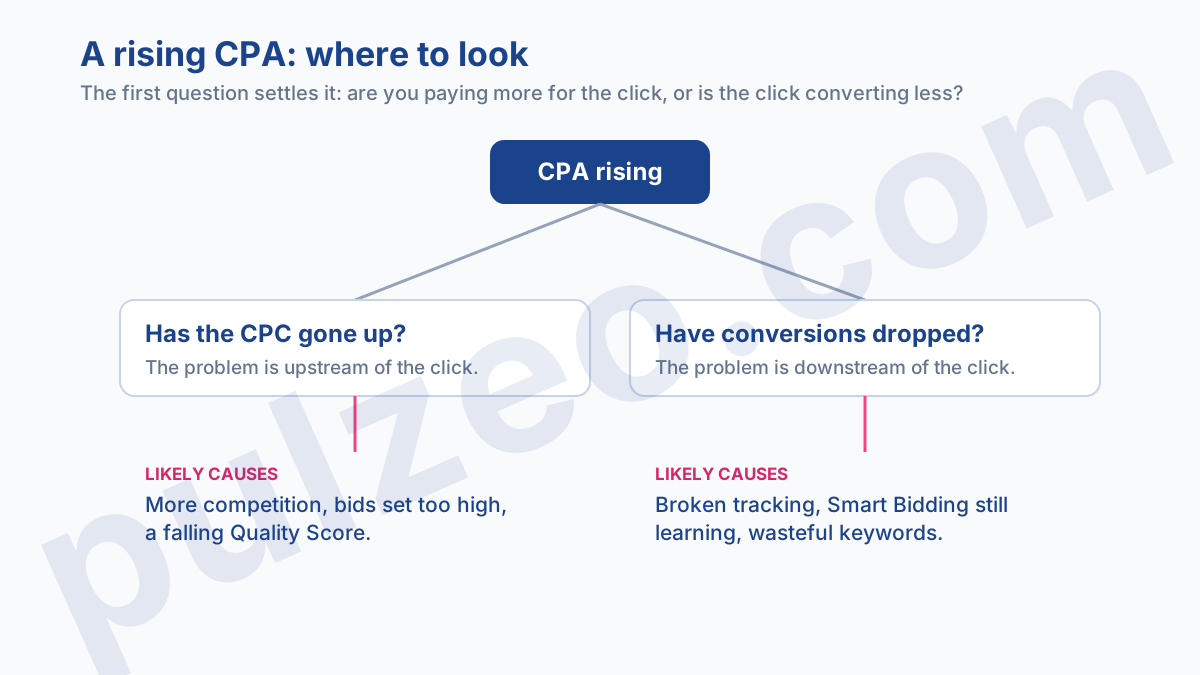
Once the rise is confirmed, the whole diagnosis comes down to one question. Either you're paying more for the click than before, or the click converts less well. Upstream, or downstream. Answer that, and you've already ruled out half the possible causes.
1. Competitors raised their bids
This is the most common upstream case, and the most unfair, because none of it is your doing. The market moves. A competitor launches an aggressive campaign on your keywords, bids go up, your CPC follows, and your CPA goes up with it.
You changed nothing, but the ground shifted under your feet. It often happens in waves, as the big shopping seasons approach, when everyone puts budget back in at the same time.
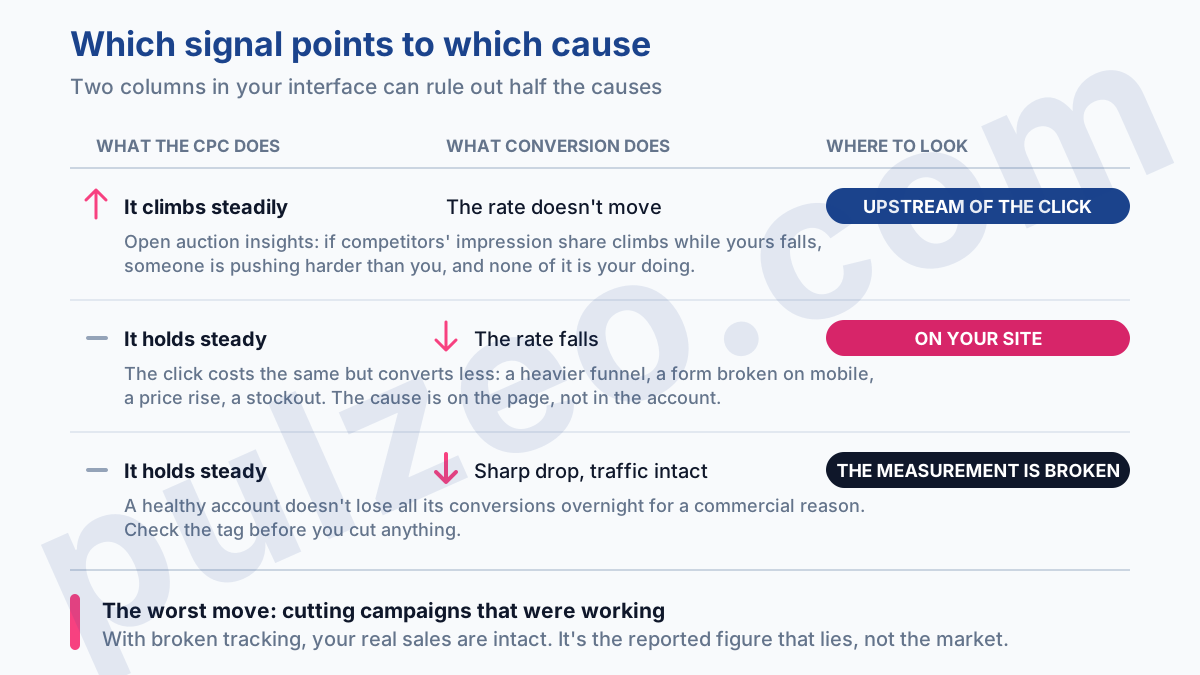
To settle it, open auction insights in the interface. If your competitors' impression share climbs while yours falls, you have your answer: somebody is pushing harder than you. It's data Google gives you for free, and that almost nobody looks at before panicking.
What points upstream: an average CPC rising steadily over two to three weeks while your conversion rate doesn't move. If the CPC climbs but the conversion rate holds, the problem really is upstream of the click, not on your site.
2. Your conversion tracking broke
The most insidious case, and it's downstream. A tag that stopped firing, a primary conversion accidentally taken out of the "Conversions" column, a site change that broke the dataLayer, a consent banner blocking the tag.
Google keeps counting clicks and spend, but the conversions stop coming in. The result: your reported CPA blows up while your actual sales may be perfectly intact.
And that's where the trap snaps shut. You see a red figure, you panic, and you cut campaigns that were actually working fine. I've watched accounts wreck themselves that way in an afternoon. Before any decision, this point deserves a check of its own, which I've set out in the guide on badly configured conversions.
What gives a broken tag away: a sharp, clean drop in the number of conversions on one specific action, with no matching drop in traffic. A healthy account doesn't lose 100% of its conversions overnight for a commercial reason.
3. Smart Bidding is learning on bad data
If you've recently edited your conversions (adding one, removing one, changing a value) or switched bid strategies, the algorithm goes back into learning.
It's a bit like an apprentice whose rules you change halfway through: for one to two weeks they feel their way, and the CPA is volatile, often higher. That's normal, it's the price of the transition. But you need to know it, so you don't panic and break everything in the middle, which restarts the clock.
The spike is easy to date: it follows closely on a configuration change. If the two coincide, don't judge anything yet, let the learning settle first. Exactly how long depends on your business, and the real length of the learning period is counted in conversion cycles, not in days.
4. Wasteful keywords are dragging the average up
Often it isn't the whole account that's unwell. It's two or three keywords, or rather two or three search terms, spending heavily for zero conversions and inflating the average. The overall CPA hides those leaks, because it drowns the good and the bad in a single figure.
On broad match that isn't watched closely, you regularly find completely off-topic terms swallowing a serious share of the budget without ever converting. It's infuriating, but it's also good news: of all the causes, it's the quickest to fix.
The right move here is to look at CPA by keyword rather than the account average alone. A term that has spent a meaningful budget without converting anything is an immediate candidate for pausing or exclusion through a negative keyword. To compare your CPA with the highest CPA your margin can afford, our CPA calculator does it in one click.
5. Your landing page converts less than it used to
A downstream cause, often forgotten because it doesn't come from Google Ads at all. The click arrives, the measurement works, but fewer visitors buy: the site's conversion rate has fallen. A redesign that added friction to the funnel, a form failing on mobile, a price rise, a stockout on your best seller.
The CPA rises as a direct result: you pay the same for the click, but it takes more clicks for a sale. The trap is that you look for the cause in the account when it's on the site.
The sign that points there: a conversion rate falling while the CPC holds steady. If the click costs the same but converts less, look at the landing page before touching bids, and ask yourself what changed on the site just before the CPA took off.
Once you've found the cause, how do you bring the CPA down?
Detecting it is half the battle. The other half depends on which side the problem is hiding on, and that's where the upstream or downstream question finally pays off.
When the problem is upstream
If it's upstream, your goal is to pay less for the click. The long-term fix is Quality Score: more relevant ads and a landing page aligned with the query bring the CPC down for the same position. In the shorter term, three quick moves:
- adjust bids where the CPC is running away;
- exclude the areas or audiences that cost a lot without converting;
- tighten targeting that has gone too wide.
When the problem is downstream
If it's downstream, the priority changes completely. You repair the tracking first, always, because correcting a bid on wrong data leads nowhere. If it's the learning period, you touch nothing and let the algorithm finish. If it's wasteful keywords, you go through the search terms report with a fine-tooth comb and exclude without a second thought.
One mistake keeps coming up, whichever side it's on: slashing the target CPA to force the result. That doesn't lower your costs, it throttles delivery, volume collapses, and you end up with a flattering CPA on three conversions a week, a volume too small to mean anything. The CPA is only one symptom among others.
To put it back in context, a full account audit, layer by layer, will always beat a blind fix based on a single number.
Why a rising CPA gets spotted too late
All these causes have one thing in common: they can be caught early, provided you watch the right signals regularly. The snag is that nobody has time to audit every account by hand, every week. You put it off, you glance at the overall CPA once a month, and by the time it has doubled, the leak has been running for three weeks.
That's exactly what Pulzeo automates. Zeo, the built-in assistant, watches your accounts continuously and alerts you when a CPA starts running away, pointing at the likely cause, upstream or downstream, instead of putting one more red figure under your nose. You no longer discover the problem at the end of the month. You deal with it while it still costs almost nothing.
A CPA under control isn't an account you watch by hand every day. It's an account that tells you itself when something is off.
Common questions
What's a good CPA on Google Ads?
There's no universal good CPA, and be wary of anyone who gives you one. A good CPA is simply lower than what a customer is worth to you: if a customer is worth $200 in margin, a $60 CPA is excellent and a $180 CPA puts you at risk. Always compare your CPA to your customer value, never to a figure you found online.
Why did my CPA jump all at once?
Almost always for one of two reasons: the click costs you more (competition, bidding) or the click converts less (broken tracking, a learning period, wasteful keywords). A sudden, sharp spike with no gradual climb usually points to a measurement problem: check your conversion tracking before touching anything else.
What's the difference between CPA and target CPA?
Your CPA is the real cost per acquisition, the one you observe. Target CPA is the goal you hand Smart Bidding so it can adjust bids. Setting a target CPA far below your actual CPA doesn't lower your costs by magic: it strangles delivery.
How do you bring a CPA down quickly?
The fastest win almost always comes from search terms: cutting the queries that spend without converting frees budget immediately. Improving Quality Score and tuning bids come next. Slashing the target CPA isn't a solution, it's a way to cut delivery.
