Four pieces of news in October, and the one that matters most for your campaigns is channel prioritization, which changes how your daily budget is split between Google Search, its partners and the Display Network. It also carries the month's only firm deadline, February 2027.
Here's the month, from most pressing to most distant:
- channel prioritization and budget allocation are coming to Search, Shopping, Performance Max and Demand Gen;
- ads in AI Mode are opening up to ten new countries, the UK still to come;
- versions 26 and 26.1 of the Google Ads API announce new recommendations and new targeting;
- Demand Gen gets a metric that puts a number on what your first-party data brings in.
Google lets you rank your channels by priority
On October 14, Google introduced two optional settings: channel prioritization and budget allocation. According to the help page that covers them, they've been rolling out progressively since October 15, for Search, Shopping, Performance Max and Demand Gen campaigns.
The idea fits in two levels. Each channel in a campaign is set to high priority or low priority. Google spends on the high-priority channels first, within your target CPA or target ROAS if you have one, then moves on to the others. With a target, the rest of the budget goes to low-priority channels when they can convert at that level.
By default, everything is high priority: if you do nothing, nothing moves. One nuance the help page spells out: the ranking only matters when budget limits the campaign. A target CPA or target ROAS campaign that isn't short on budget aims for its target across all channels, and priority changes nothing there; only the allocation applies.
For a low-priority channel, you can set a maximum percentage of the daily budget. Google describes it as a best-effort limit, which makes it a goal rather than a guaranteed cap. I'd treat it as a safety rail, and I'd still check the split by network after two weeks.
Which channels you can adjust depends on the campaign type. In Search, it's Google Search, Search partners and the Display Network; in Shopping, Search and its partners. Demand Gen supports prioritization, not budget allocation. The setting can be applied at the account, shared budget or campaign level, but Google Ads Editor doesn't support it yet; the API got it at the end of October, more on that below.
Why is this good news? Because Search partners used to be all or nothing. A channel you consider less profitable can now stay active, served second, instead of being switched off out of caution. I still recommend unchecking both boxes on a new account, as in the complete Google Ads guide for 2026; low priority opens a middle path for anyone who wants to test without risking everything.
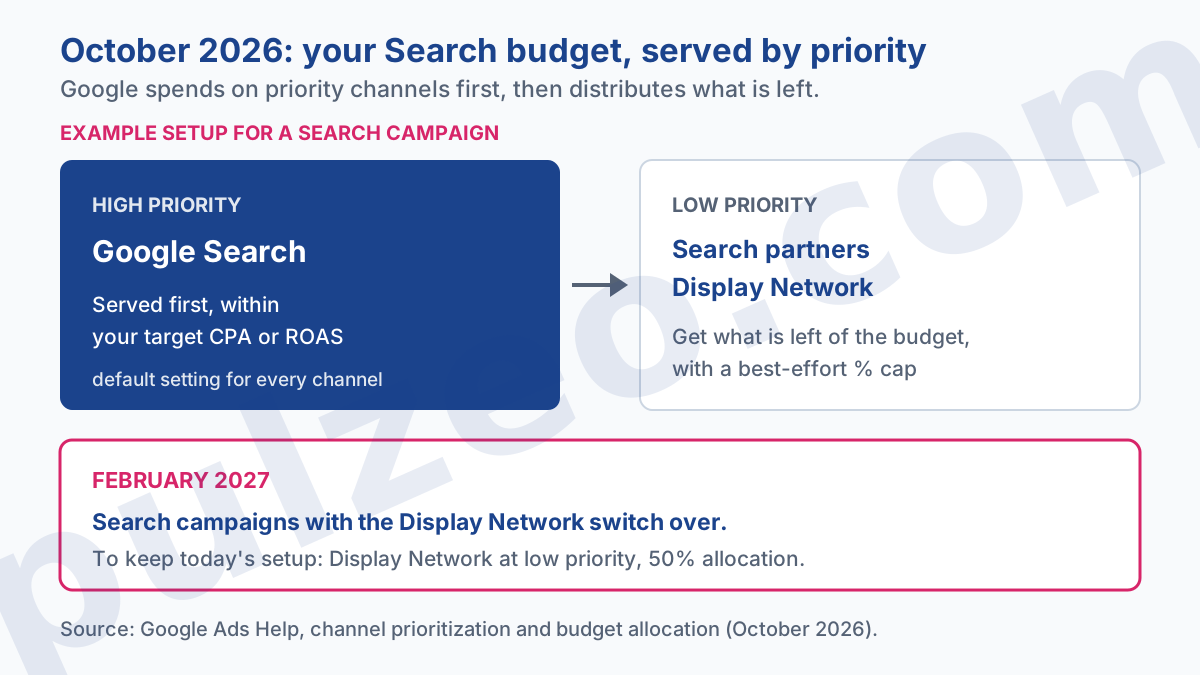
The February 2027 deadline
This is the date to note. Starting in February 2027, all Search campaigns that serve on the Display Network will automatically switch to this system, and Google warns that your spend across channels may shift. To keep today's behavior, the official advice is to set the Display Network to low priority, with a 50% daily budget allocation.
Starting in February 2027, a Search campaign that serves on the Display Network changes how it works, whether you've touched the setting or not.
One detail is worth flagging. With this switch, the Display Network will stop serving altogether on Search campaigns that use the Target Impression Share bid strategy. An account that relied on those impressions will lose them with no other warning than that line on the help page.
For most small businesses, the question is simpler: does your Search campaign still have the Display Network checked? If so, decide now whether to keep it at low priority or turn it off, rather than letting February decide for you.
Ads in AI Mode reach ten more countries
On October 28, Google expanded ads in AI Mode to Australia, Canada, India, Kenya, Malaysia, New Zealand, Nigeria, Pakistan, the Philippines and Singapore. Brazil, Mexico and the United Kingdom are planned for Q4 2026. No European Union country is named.
Two details from the post are worth keeping. The ads are clearly labeled as sponsored. And in the U.S., they can now appear in follow-up questions, when the user carries the conversation on.
The headline figure comes from Google's AI Mode report (U.S., May 2026): queries there are on average three times longer than a traditional search. An advertiser who sells in Canada or Australia is affected right now: their ads can appear in those answers. In the UK, it's planned before the end of the year.
What versions 26 and 26.1 of the Google Ads API announce
The API had a busy month too. The release notes list two this month: v26, a major version, on October 14, then v26.1 on the 28th.
On the recommendations side, v26 adds one that suggests raising a Search campaign's budget when its daily budget is too low. It complements September's target recommendations, which I covered in the article on target bidding since August 17.
Before applying it, check that the campaign converts at an acceptable cost: a bigger budget doesn't fix a campaign that loses money, and the useful threshold can be calculated, as I explain in the article on the minimum budget.
v26.1 adds a recommendation to optimize a campaign for new customer acquisition, and household income exclusions in Performance Max. It also exposes the channel priority settings described above, which suggests they'll soon reach the tools that work through the API.
Two additions in v26 round out the picture. A new conversion category covers message or chat exchanges that signal interest in the offer, and the minimum daily budget for a Demand Gen campaign can now be read in the API, currency by currency.
Demand Gen puts a number on what your data brings in
On October 13, October's Demand Gen drop confirmed that the "Data Strength Uplift" metric, announced in September, is launching in Google Ads. It's meant to show, in the interface, the conversions gained thanks to your first-party data setup. Data Manager is expanding to Display & Video 360 and Google Analytics, where enhanced conversions are also due soon.
The figure put forward: over 20% more conversions on average in Demand Gen campaigns for advertisers who use Google Tag Gateway. The footnote dates it June 3 to June 17, 2026, Google data, global. Two weeks of measurement, by the ad platform, on its own advertisers: I read it as a ballpark.
The underlying reasoning still holds. A Demand Gen campaign learns from your conversions, and a conversion your tag doesn't see doesn't exist for it. If you're still unsure about this campaign type, start with what Demand Gen is really for before plugging in yet another measurement tool.