Google Ads for masons in France: cost per client in 2026

Across ten masonry queries pulled in France, the bid to reach the top of the page runs from €0.76 at the low end to €3.72 at the high end, as medians. That's on par with carpenters, and a good starting point if you run Google Ads for masons in France.
The most surprising number in the data is elsewhere. The word “mason” alone tops out at €1.74, while “mason Marseille” climbs to €7.23. The shortest search is the cheapest, and that isn't a bargain: it's a warning.
How much does a Google Ads click cost a mason?
Pulled on November 7, 2026 from Keyword Planner, location France, Search Network with partners. The queries are French, translated here. Volume is the monthly average over a year. The two amounts form the Top of page bid range Google estimates, meaning what you have to offer and not what you'll pay.
| Keyword (translated) | Searches / month | Low bid | High bid |
|---|---|---|---|
| masonry | 27,100 | €0.64 | €3.06 |
| mason | 14,800 | €0.58 | €1.74 |
| mason near me | 9,900 | €0.71 | €3.63 |
| masonry company | 6,600 | €0.96 | €4.19 |
| masonry contractor | 4,400 | €0.86 | €3.74 |
| masonry work | 1,900 | €0.85 | €3.69 |
| mason tradesman | 1,600 | €0.70 | €2.65 |
| load-bearing wall opening | 1,600 | €0.43 | €4.90 |
| masonry renovation | 590 | €0.80 | €3.89 |
| mason quote | 590 | €1.53 | €6.19 |
The median high bid comes to €3.72, the median low bid to €0.76. Your actual click will usually land between the two, with no guarantee, and only your account will tell you where, after two or three weeks of running ads.
Two lines deserve a second look. “mason quote” only gets 590 searches a month but it's the most expensive in the table, €6.19: whoever types it already has a project in mind and is comparing prices. “load-bearing wall opening”, at €4.90, says the same thing another way. The more a search names a specific job, the more it's worth, because it's closer to the signature.
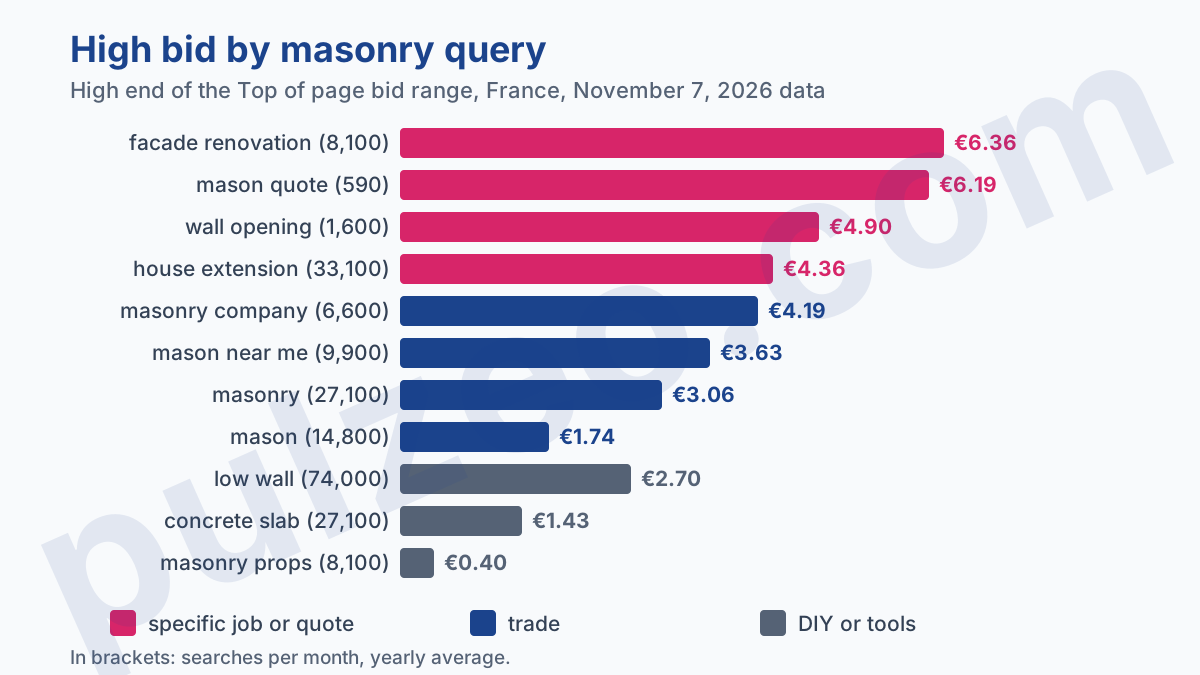
Big projects follow the same logic. “house extension” is searched 33,100 times a month at €4.36, “facade renovation” 8,100 times at €6.36, where you run into specialist facade contractors. On the other hand, “concrete slab” (27,100 searches, €1.43) and “low wall” (74,000, €2.70) stay cheap, and for good reason: a good share of those people want to do it themselves.
These numbers are national. Before building a plan, pull your own for your area: Pulzeo's keyword research shows the volume and cost per click range Google gives for the city or department you choose.
To compare this trade with the others, all measured again on the same day, check the price of a Google Ads click, trade by trade.
Finding mason clients: what a signed job costs
The price of a click alone says little. You have to set it against the number of clicks it takes to sign a job, and for a mason the path always goes through a quote, often through a site visit. Since no reliable industry average is published, I'll give you the calculation with stated assumptions.
First case, small jobs: a low wall, a patio, an opening in a wall. Let's take a €3.70 click, at the median, and one quote request for every ten clicks. Each request costs €37. At one quote in three signed, the job costs you €111.
Second case, structural work: an extension, a garage, an added storey. The click goes up, say €4.40, roughly the high bid for “house extension” (€4.36). But above all the homeowner compares more, takes their time, sometimes waits for a building permit. With the same one quote request for every ten clicks and one quote in five signed, the job costs €220.
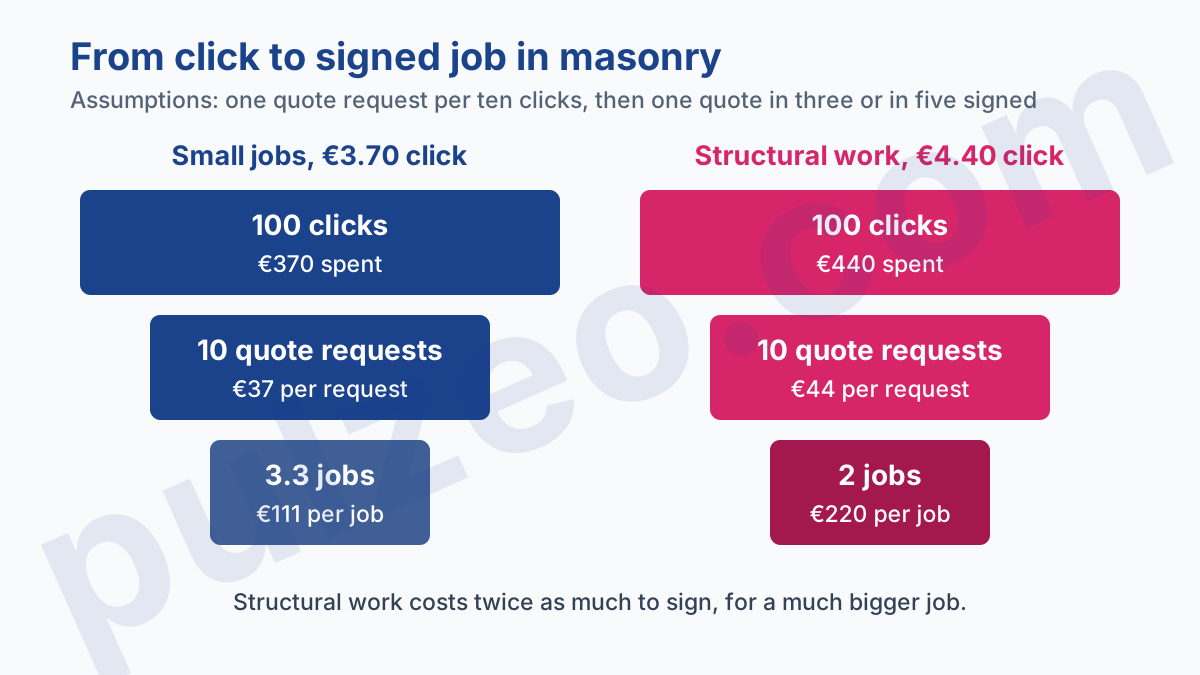
The mechanics of the calculation are common to every trade, I go through them in the article on choosing between organic and paid search. Replace my assumptions with your numbers as soon as you have them: your own signing rate is worth more than any example.
One tracking rule follows. Count the call and the quote request as conversions, then note in your quoting software which requests become jobs, and where they came from. On structural work signed three months after the click, it's the only way to know what Google Ads brought you.
When Google Ads becomes profitable for a mason
The short answer: as soon as a job's margin exceeds what it cost to win. At €111 per small job and €220 per large one, under these assumptions, most masonry work clears that bar. The real choice is which type of job you want to fill your schedule with.
Small masonry jobs
“small masonry jobs” is searched 260 times a month at €2.23, “looking for a mason for small jobs” 390 times at €2.06. The click is reasonable and the job gets signed quickly. The risk is the order size: a redone door sill doesn't leave the same margin as a forty square metre patio.
So set a minimum job size, and say so in the ad if your schedule is already full of small call-outs. Someone after a simple bit of sealing won't click, and won't cost you anything.
House extensions and structural work
The volume is there (33,100 searches for “house extension”, 3,600 for “home enlargement”), but you run into builders, sellers of kit extensions and quote platforms. A tradesperson doesn't win that spot by outbidding them on the generic query.
In structural work, a mason doesn't win by paying for the most expensive click in the region. They win by paying for the clicks in their own town and by showing the jobs they've already done there.
My advice if you do both: two separate campaigns, one for small jobs, the other for structural work, with two budgets. Otherwise the bidding algorithm puts the money where conversions come fastest, meaning on small jobs, and your structural work never gets served.
“Prix macon”, Macon, freemasons: which keywords should a mason exclude?
This is the trap specific to this trade, and I haven't seen it in any other episode of this series. Many French users type “macon” without the cedilla under the c, which is also the name of a town, Macon. In Keyword Planner, “macon” and the town's accented spelling each get 74,000 searches a month, five times more than the correctly spelled French word for mason.
And Google says it in black and white in its definition of close variants: your keywords can be matched to searches that differ only by accents, and the feature can't be turned off. Google's French help page even cites the French words for mason and masonry, for another kind of close variant, words sharing the same stem. Your keyword for mason can therefore make you pay for searches about the town.
Just look at what autocomplete suggests after “prix macon” to see how mixed it is: fuel prices in Macon, the motorway toll, the price of a bottle of Macon-Villages, membership of the freemasons. The families to exclude from the day you open the account:
- the town of Macon and its area, with “71”, “71000”, “saone et loire”, “carburant” (fuel), “autoroute” (motorway), “hotel”, “train”;
- wine and freemasonry, with “village”, “vin” (wine), “franc”;
- tools, “masonry props” (8,100 searches at €0.40), “trowel”, “mason's straightedge”;
- jobs and training, “mason salary” (1,000), “masonry vocational certificate” (880), “mason training” (590);
- insurance, “mason decennial insurance”, typed by your peers looking for an insurer, at a €18.94 high bid, the most expensive bid in the whole data set.
Above all, don't exclude “macon” itself: a negative keyword blocks every search that contains it, and “devis macon” (mason quote) or “macon travaux” (mason works) are typed by real clients. The context words do the sorting. For exactly how exclusions work, the Google help page remains the reference.
Then keep an eye on the search terms report during the first month. Pulzeo's Optimizations tab spots the search terms to exclude in your real queries, which saves you reading them one by one. The full method, with the broad match trap, is in the article on negative keywords, and the details on close variants in the one on match types.
Masonry work: what drives the click price
The city weighs heavily in this trade, much more than for carpenters, and the season has to be read job by job.
Mason near me, or a mason in your city
Adding the name of a big city multiplies the high bid for “mason” by two to more than four. “mason Marseille” climbs to €7.23, “mason Annecy” to €6.46, “mason Bordeaux” to €5.74, “mason Lyon” to €5.12. Paris is the exception, at €2.77, and Lille sits at €3.56.
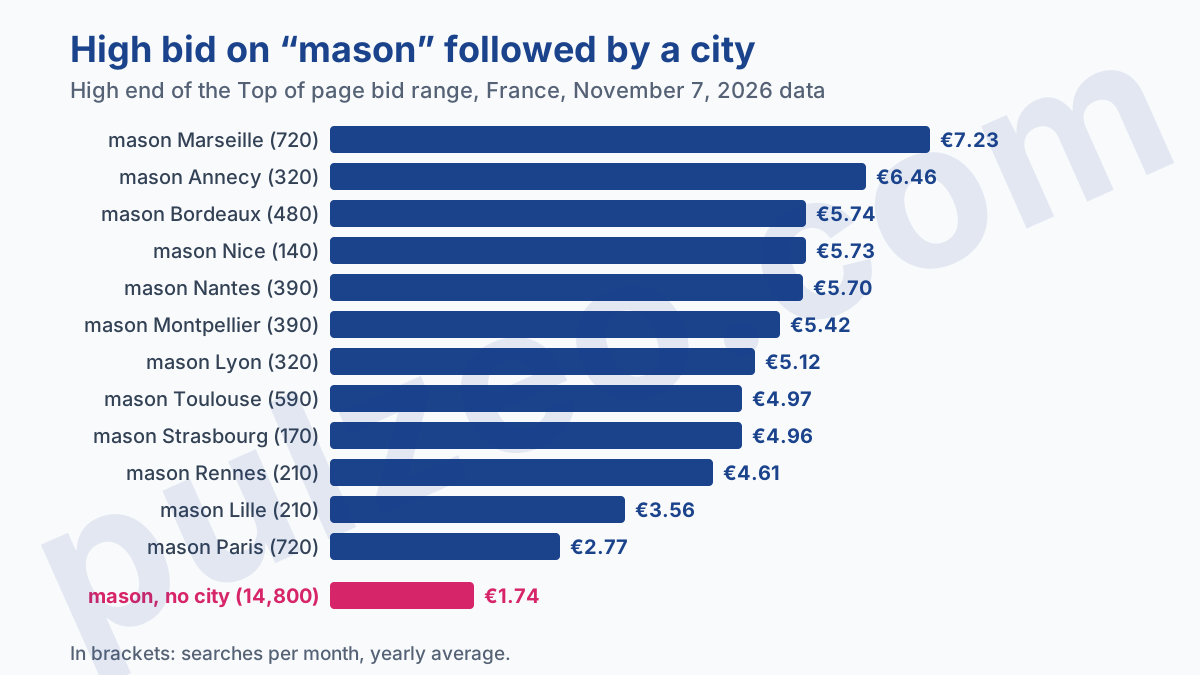
My explanation: the city name removes all ambiguity. Whoever types “mason Bordeaux” wants a tradesperson in Bordeaux, and advertisers know it. The word for mason alone mixes the town of Macon, apprentices and DIYers, and nobody wants to pay much for a click that uncertain. The most profitable mason advertising is therefore the one with a clear intent, even if its click costs more.
Another signal: “mason near me” went from 3,600 searches in October 2025 to 14,800 in September 2026. A single year isn't enough to say whether the trend will last, but searching by proximity, typical of phones, is gaining ground. Set your ad area to a short radius around your job sites.
The masonry seasons
The query “mason” holds at 18,100 searches most months, and drops in December (12,100), in June (12,100) and above all in August (9,900). Behind that seemingly flat line, each type of job has its own calendar.
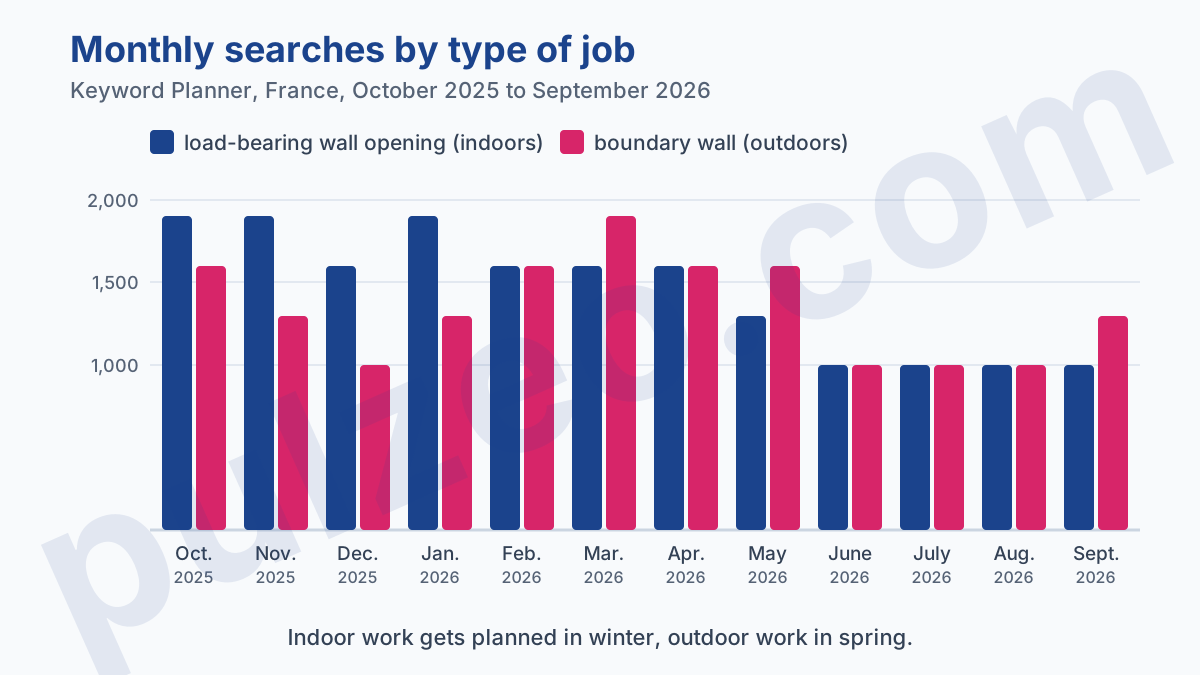
“load-bearing wall opening” peaks at 1,900 searches from October to January and falls to 1,000 from June to September: indoor work gets planned in winter. “boundary wall” does the opposite, at its highest in March at 1,900. If you do both, rotate your ads with the seasons, indoors in winter, outdoors in spring, instead of running the same message all year.
Mason decennial insurance: what the landing page should show
A mason sells work that has to last for decades, and the client knows it. For a construction business in France, ten-year liability insurance (known as the decennial guarantee) is mandatory, and since July 1, 2016 the insurance certificate has to be attached to quotes and invoices (article L. 243-2 of the French Insurance Code). Show it before the quote even goes out: it's the argument your competitors leave at the bottom of a file.
The page your ads lead to has to reassure on durability as much as on price:
- the decennial insurance certificate as a download, with the insurer's name;
- photos of finished jobs, with the town and the year, never stock images;
- your phone number at the top of the page, tappable on mobile;
- your service area, town by town, and the average delay before a visit.
With high bids from €2.77 to €7.23 depending on the city, a masonry contractor that sends visitors to a generic home page pays a lot for people who leave without finding what they were looking for.
What Google Ads budget should a mason plan for?
Start from the number of jobs you want to sign each month.
For four small jobs a month, with a €3.70 click, one quote request for every ten clicks and one quote in three signed, you need twelve requests, or 120 clicks and €444 a month. For two structural jobs, with a €4.40 click and one quote in five signed, you need ten, or 100 clicks and €440.
In a big city where the high bid goes over €6, count on at least €600 to €720 for the same goals, and up to €720 to €870 if your actual click gets close to Marseille's €7.23.
Plan a margin for winter if you do indoor work, for spring if you do outdoor work, and two to three months before judging structural work. To compare with other building trades, see what a client costs a carpenter, at an almost identical click, and the roofer's numbers, a trade that lives by the storms.
If you also dig pools, pool builders pay a click in the same range but live through a much sharper season: see what a client costs a pool builder.
If you also do facade renovation, compare with what a client costs a house painter: the same facade clients, but a market split in two between interior and exterior work.
My advice to start: your town and the neighbouring ones, two separate campaigns, the town of Macon and its look-alikes excluded from day one, and a page that shows your decennial insurance and your jobs. If you want a tool to watch the account while you're on site, Pulzeo's plans are on the pricing page.
Common questions
How much should a mason in France bid on Google Ads?
Across ten masonry queries pulled on November 7, 2026 from Keyword Planner, location France, the Top of page bid range has a median low end of €0.76 and a median high end of €3.72. The word “mason” alone tops out at €1.74, “mason quote” climbs to €6.19, and “mason” followed by a big city runs from €2.77 in Paris to €7.23 in Marseille.
Why does the word mason cost less than mason followed by a city?
Because the French word for mason, typed alone, is a fuzzy search: without its cedilla, it is spelled exactly like the town of Macon, and it also draws DIYers, apprentices and tool buyers. Advertisers bid little on it. “mason Marseille” or “mason Bordeaux” leave no doubt about the intent, and the high bid there goes over €5, against €1.74 for the word alone on November 7, 2026.
What monthly budget should a mason in France start with on Google Ads?
Start from the number of jobs you want. For small jobs, with a €3.70 click, one quote request for every ten clicks and one quote in three signed, four jobs a month take about 120 clicks, or €444. For structural work, with a €4.40 click and one quote in five signed, two jobs a month take 100 clicks, or €440.
Should a mason exclude the word macon without a cedilla in Google Ads?
No. Many of your future clients type “macon” without the cedilla, and excluding it would cut off part of the demand. Exclude instead the words that point to the town of Macon or another meaning: “71”, “carburant” (fuel), “autoroute” (motorway), “hotel”, “village”, “franc”, along with tool words such as props or trowel.