What is impression share in Google Ads

Your campaign spends its whole budget, conversions are coming in, and you wonder whether there is still room to grow. Impression share in Google Ads answers that question: it tells you how much of the demand you actually see, and more importantly why you miss the rest. Two columns come with it, the share lost to budget and the share lost to rank, and they are the ones that decide what to do.
Most of the accounts I take over show the first column and ignore the other two. That's a shame: on its own, it says almost nothing. Read next to its two neighbors, it tells you in ten seconds whether to add budget, rework your bids or leave everything alone.
What is impression share in Google Ads?
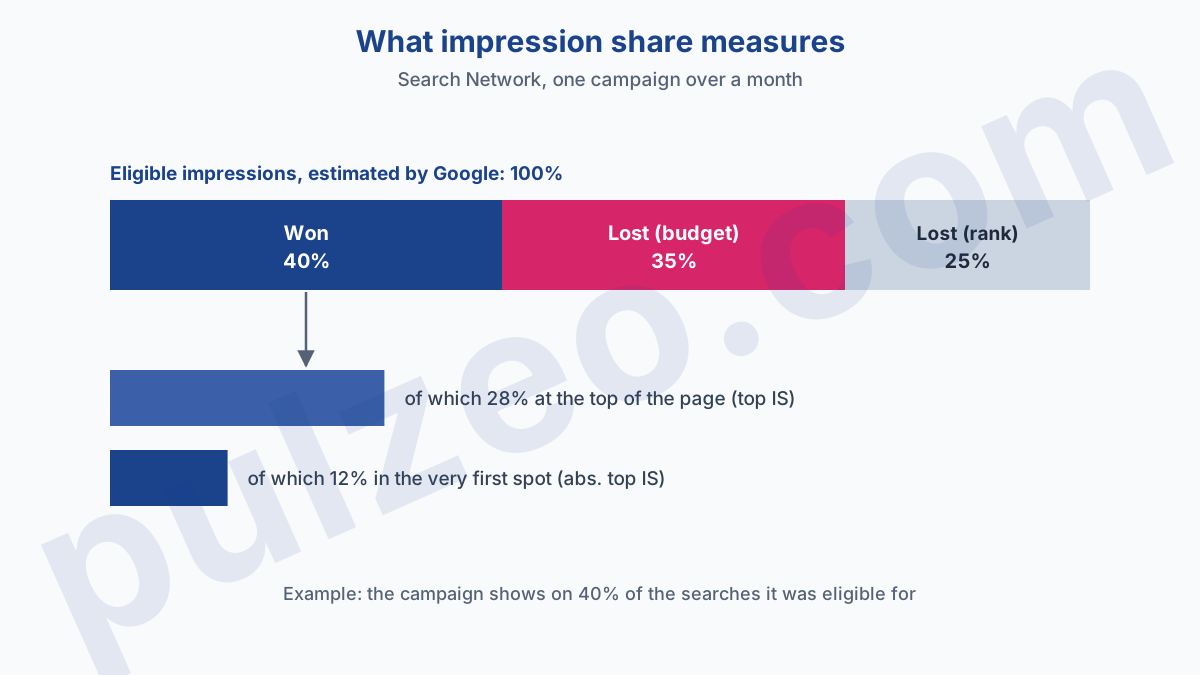
Impression share is the percentage of times your ad showed, out of all the times it could have shown. Google lists it among the competitive metrics, and the Search Network version appears in the interface as "Search impr. share", often shortened to Search impression share or simply IS.
The denominator is an estimate made by Google. According to Google Ads help, eligible impressions are calculated from your targeting settings, your ads' approval status and their quality. So you can't recalculate it yourself: you are reading Google's judgment of the demand you could have reached.
The family has several columns. On the Search Network, these are the ones that actually matter:
- Search impression share, the overall share;
- Search lost IS (budget);
- Search lost IS (rank);
- Search top IS and Search absolute top IS, which tell you whether you were at the top of the page;
- Search exact match IS, which only counts searches that exactly match your keywords.
A few limits to know before reading your numbers. Search partners are not counted. A Performance Max campaign mixes Shopping and Search impressions into a single share. And all of these metrics are updated within one to two days: yesterday's share is still incomplete.
How to calculate impression share
The formula fits on one line: impression share = impressions received ÷ eligible impressions. A campaign that received 3,400 impressions out of 8,500 eligible shows 40%.
Google does the math for you, but turning the formula around is far more useful. Divide your impressions by your share and you get an estimate of total demand: 3,400 ÷ 0.40 = 8,500 eligible searches over the period. That's the number you need when a client asks "how many people search for this, and how many do I reach".
Keep the display limits in mind. According to the Google Ads API documentation, impression share is reported between 10 and 100%: below 10%, the interface shows "< 10%" and the API returns 0.0999. The lost share columns cap at 90%, shown as "> 90%". At those edge values, the division only gives you an order of magnitude.
One reading trap follows directly from the formula. The share is a ratio, and its denominator moves with your settings. Add broad match keywords, and eligible impressions swell: your share drops even though you reach more people. Tighten your geographic area, and it rises while your impressions shrink.
A rising impression share isn't good news until you've looked at the number of impressions next to it.
Lost impression share: budget or rank
Everything you don't win falls into two boxes, and reading impression share starts there. Google separates the share lost to budget from the share lost to rank, and the two call for opposite remedies.
Search lost IS (budget)
Search lost IS (budget) measures the searches where your ad was eligible but didn't show because the campaign had used up what it could spend. Typically, the day's budget is gone by 3 p.m. and the campaign goes quiet until the next morning.
This data only exists at campaign level, since the campaign is what holds the budget. There's no point looking for it in the ad groups tab: it isn't there, and that's by design.
A high share lost to budget isn't necessarily a problem. If your cost per acquisition is already at the edge of profitability, those missed impressions would cost you more than they bring in. If, on the other hand, every conversion leaves you a healthy margin, that's money you leave on the table every afternoon.
Search lost IS (rank)
Search lost IS (rank) measures the auctions where you were present but not ranked high enough to show. According to Google's help on Ad Rank, that ranking takes into account your bid and your ad quality at auction time: expected click-through rate, ad relevance, landing page experience.
This is where the most expensive mistake happens. A campaign that loses 60% to rank and 2% to budget isn't short of money: adding budget will give it almost nothing, because it already can't spend what it has on the auctions it loses. It needs a better bid, more relevant ads or a landing page closer to the search.
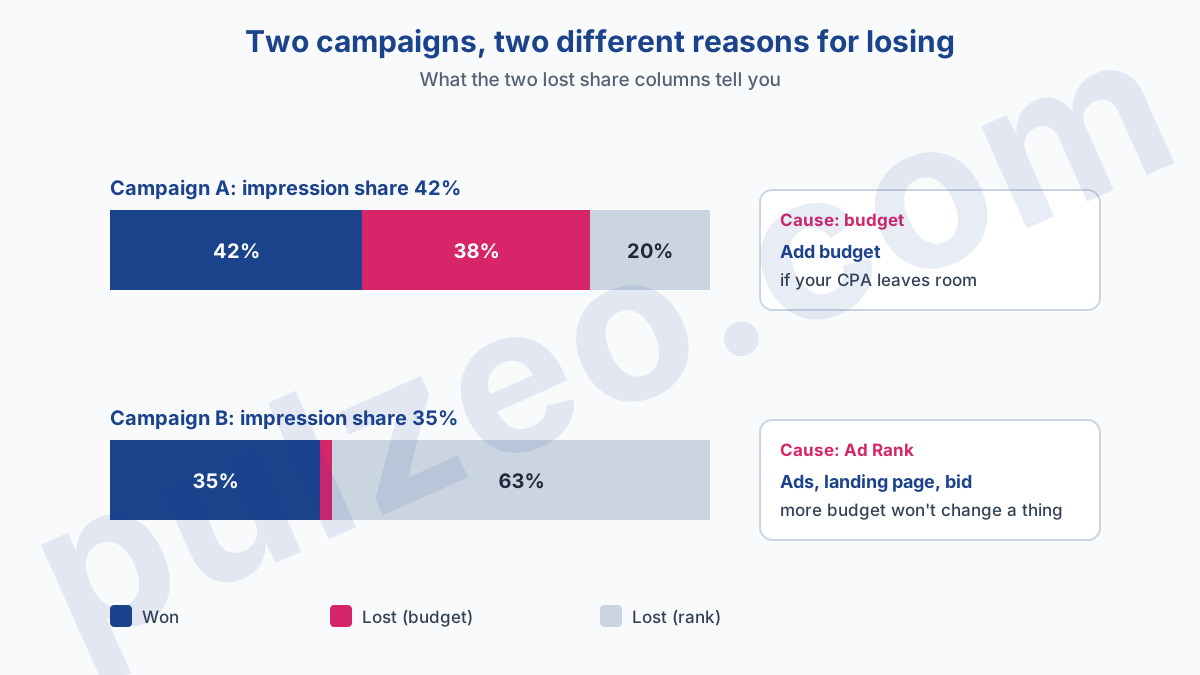
Put the two columns side by side for each campaign, and the decision almost reads itself. That's what Zeo, Pulzeo's assistant does: for each campaign it analyzes, it receives the share lost to budget and the share lost to rank, and uses them to say which of the two levers to pull.
What is a good impression share in Google Ads?
There is no universal good share, and I'm wary of anyone who gives you one. Google doesn't publish any target, and for good reason: the right level depends on what one more impression is worth to you.
The only case where I set a threshold is a campaign on your own brand. Someone types your name, they are looking for you: every missed impression is an opportunity handed to a competitor bidding on your brand. Below 90% on a brand campaign, I always look for the cause.
On generic searches, it's the opposite. The last points of impression share come from the most contested auctions, at the hours and on the searches where everyone is fighting. Buying them gets more and more expensive, and in my experience those visitors don't convert any better than the others. A share of 40 to 60% on a profitable generic campaign suits me just fine.
So the right benchmark is the question the share raises. Would the impressions I miss be profitable if I bought them? If your cost per acquisition leaves room, yes, go get them. If not, your impression share is already at the right level, even if it looks low.
How to improve impression share in Google Ads
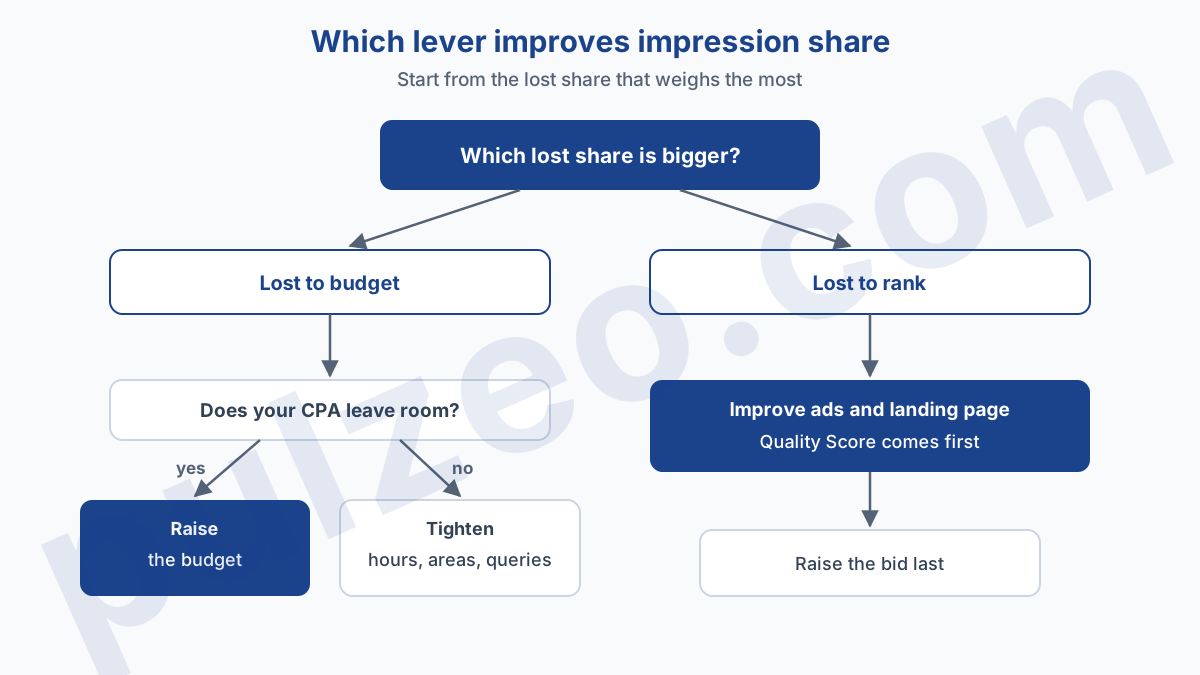
The lever depends on which column weighs the most. Always start with the dominant cause, otherwise you spend your energy on the wrong problem.
When budget dominates, three settings win back impressions without changing your strategy:
- raise the daily budget, provided your cost per acquisition leaves room;
- remove the hours, days or areas that spend without converting, to focus the budget on what pays off;
- exclude off-topic searches with negative keywords, since they eat budget without ever bringing anything in.
The last two have a side effect worth knowing: they reduce eligible impressions. Your share goes up, but part of the increase comes from a shrinking denominator. That's intended, you no longer pay for searches you didn't care about, but don't present that number as a conquest.
When rank dominates, the work is on quality before the bid. Ads that echo the words of the search, a landing page that answers what the person was looking for, ad groups tight enough for the ad to match the keyword. All of that improves your Quality Score, and therefore your ranking at an equal bid.
Raising the bid remains an option, but it's the most expensive one. I keep it for keywords I know convert, once quality can't improve any further.
Target impression share in Google Ads: when to use it
Target impression share is an automated bidding strategy, limited to the Search Network. You give it a location, anywhere on the page, top of the page or absolute top of the page, and the percentage of searches where you want to appear there. Google then adjusts your bids to hit the goal.
The setting that matters most is the maximum CPC bid limit. The Google Ads API documentation describes it as the highest bid the system is allowed to set, and the API makes it mandatory. Without a well thought out limit, a 95% target in the absolute top position on a contested search can make you pay for clicks at a price that has nothing to do with their value anymore.
This strategy buys visibility, not conversions. So it belongs on a brand campaign, where the goal is precisely to be there for every search, and almost nowhere else. For campaigns looking for sales or leads, a conversion-based strategy will do better, because it picks the auctions that pay off.
Tracking impression share without giving up your Mondays
Impression share moves slowly and reads poorly day by day. The right rhythm is a weekly look, campaign by campaign, with the two lost share columns next to it. It's also a number that speaks to an agency's clients, as long as you explain it: "you're visible on 45% of searches, and what's missing is a budget question" is a sentence any business owner understands right away.
Pulzeo retrieves impression share and its two lost share columns every night, for every campaign. Client reports can show impression share next to conversions, and the dashboard shows the path from impressions to clicks to conversions, so you can see at which stage the account gets stuck.
For the rest of the metrics, and which ones deserve a place in your reports, the guide to the Google Ads KPIs to track sorts them out.
Common questions
What exactly does Google Ads impression share measure?
It's the number of impressions your ads received, divided by the number of impressions they were eligible to receive. Google estimates those eligible impressions from your targeting settings, your ads' approval status and their quality. An impression share of 40% means your ads showed on 4 out of 10 eligible searches.
Should you aim for 100% impression share?
Almost never. The last impressions come from the most contested auctions, so they are the most expensive, and in my experience they don't convert any better than the rest. The exception is a campaign on your own brand name, where a low share lets competitors answer people who were looking for you.
Why doesn't Search lost IS (budget) show up for my ad groups?
Because Google only calculates it at campaign level: the campaign is what holds the budget. Ad groups and keywords show impression share and the share lost to rank, but the share lost to budget can only be read on the campaign row. If the campaign ran out of budget during the period, even the share lost to rank disappears from the ad groups tab.
Why does my impression share show "< 10%"?
Google doesn't report a precise value below 10%. Impression share is reported between 10 and 100%, and the lost share columns between 0 and 90%, shown as "> 90%" above that. A "< 10%" points to a campaign very far from its demand, often targeting that is too broad for its budget.