Google Ads vs Facebook Ads, which is better for your business

Google Ads vs Facebook Ads: the question almost always comes up when you have a budget and no plan yet. The short answer, and I give it every time: if people already type your service into Google, start with Google Ads. If nobody searches for it yet, because your product is new, visual or bought on impulse, start with Meta Ads. The rest of this article helps you check which case you're in, and avoid the trap that makes people misjudge both.
Because the real danger isn't picking the wrong platform. It's comparing them with their own numbers, which don't count sales the same way.
What is the difference between Google Ads and Facebook Ads?
Google Ads answers demand that already exists, Facebook Ads creates it.
On Google, your ad shows up because someone just typed "emergency plumber leak" or "women's trail running shoes". The person has a need, they've put it into words, and you pay to be there at the moment they search. On Facebook and Instagram, nobody is searching for anything: the person is scrolling their feed, and your ad has to stop them, spark the desire, then convince them to click.
That difference changes everything else. Targeting, first: on Google, you choose keywords, on Meta audiences (age, location, interests, similarity to your customers).
Creative next: a Google ad is mostly text answering a query, a Facebook Ads campaign lives or dies on its image or video. And buying delay, finally: the person searching is often ready to buy, the person discovering you first has to want it.
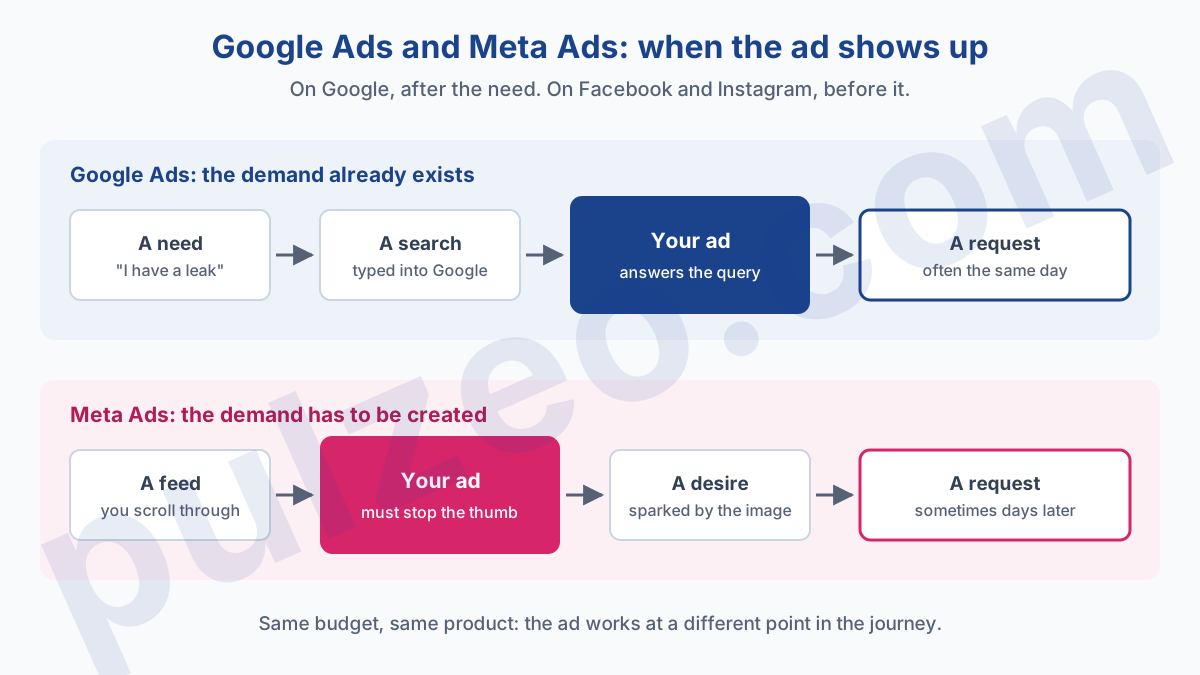
An image I use often: Google Ads is the shop window on the street where people looking for a bakery walk past. Meta Ads is the flyer slipped into the mailbox of someone who wasn't hungry. Both sell bread, but not at the same time of day.
How to know if your customers search for you on Google
The test takes ten minutes and settles the question better than any comparison chart. Open Keyword Planner in Google Ads (it's free, it only requires an account), type the three or four ways a customer would describe your service, and look at the monthly search volumes in your area.
If the search exists
You find queries with volume, and above all queries that reveal purchase intent: "quote", "price", "near me", a trade followed by a city. In that case, Google Ads comes first. These people are already looking for you, and every day without an ad is a day a competitor takes the call.
That's the case for most tradespeople, professional services, emergency repair services and stores selling a product people already know by name. For a plumber, staying off Google Ads when the search exists is like leaving the phone off the hook on Monday morning.
If nobody searches yet
Volumes are zero or close to it, or the only queries that come up have nothing to do with what you sell. Your product may be too new to have a name in people's heads, or it's bought on impulse, by seeing the object rather than searching for it. There, Google Ads has almost nothing to capture, and Meta Ads becomes the right starting point.
A case I see often: a maker of handmade jewelry. Nobody types the brand name, and "bracelet" on its own draws millions of searches that aren't for them. A beautiful photo in the Instagram feed, in front of the right people, sells better than any keyword.
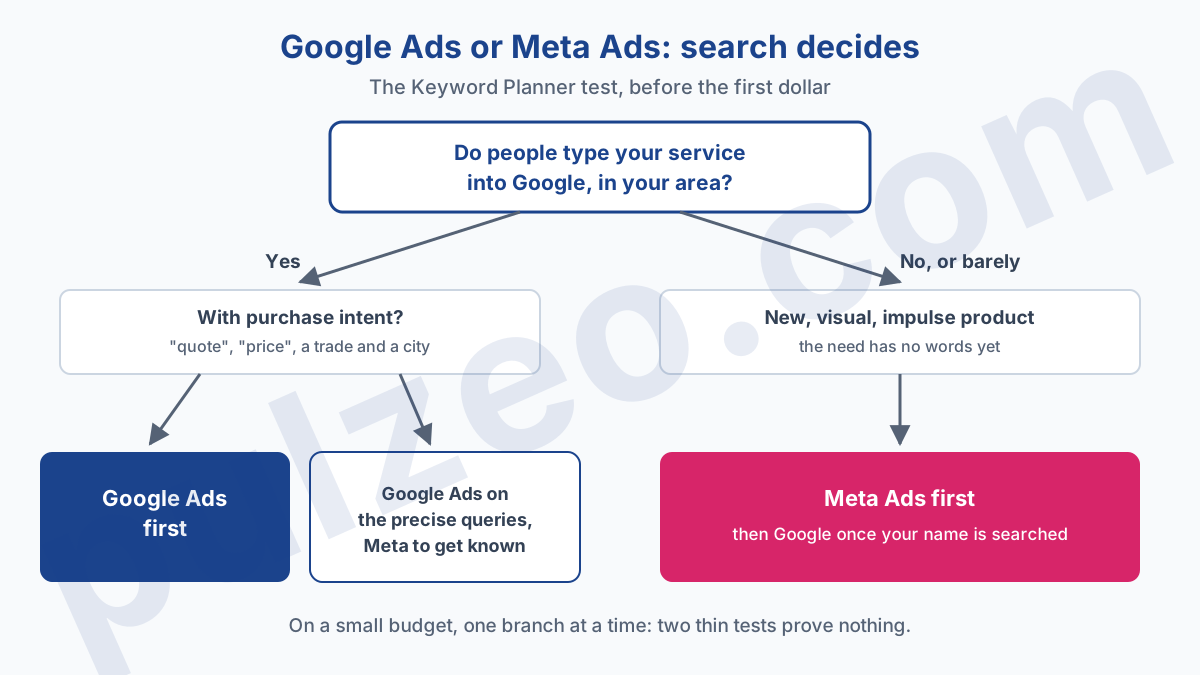
Google Ads vs Meta Ads for a small business
On a small budget, pick a single platform to start, and keep it long enough for it to teach you something. Splitting $500 a month between the two means getting two tests too thin to conclude anything, instead of one test that answers.
Here's how I decide by type of business, once the search test is done:
- Emergency or local service (locksmith, repairs, vet): Google Ads, no hesitation. The need is immediate, and it goes through a search.
- Profession people compare before choosing (lawyer, accountant, tradesperson working on quotes): Google Ads first, then Meta later to remind people who visited your site of your name.
- Online store selling a visual product (fashion, home decor, gifts): Meta Ads first, Google Shopping as soon as people search for your products by name.
- New product or event (launch, trade show, opening): Meta Ads, since the demand has yet to be created.
This breakdown has its exceptions, and that's normal. A restaurant can live off Google Ads ("restaurant open sunday") just as well as off Meta (a photo of a dish that makes people hungry on a Thursday at 6 p.m.). The search test remains the referee.
Facebook Ads cost: is it really cheaper than Google?
Per click, Meta Ads is often cheaper. But a cheaper click isn't a cheaper customer, and that's exactly the gap you need to measure.
Both networks run on auctions, with similar logic. On Meta's side, the help page on ad auctions describes a "total value" that combines three factors: your bid, the estimated action rates (the likelihood the person does what you want) and ad quality.
An ad judged relevant can therefore beat a higher bid. On Google's side, Ad Rank also takes into account your bid and the quality of your ad at auction time. The Quality Score shown in the account is only a diagnostic indicator of it.
Let's take an illustrative example, on the same budget of $600 a month. On Google Ads, a click costs $2.40: 250 visits, 4% of which become a quote request, so 10 requests at $60 each. On Meta Ads, a click costs $0.60: 1,000 visits, but from visitors who weren't looking for anything, and only 0.8% requests, so 8 requests at $75.
The Meta click is four times cheaper, and the request still ends up more expensive. The reverse happens too, on a visual product where the photo does all the work. That's precisely why you compare cost per request or per sale, never the Facebook Ads cost per click against Google's CPC. For the Google side, real CPCs by industry are detailed in what a Google Ads click costs.
Why both platforms claim the same sale
This is the trap nobody mentions in comparison articles, and it skews almost every decision. Each network counts sales by its own rules, and those rules don't look alike.
At Meta, the help page "About attribution models and settings" says it plainly: depending on the ad set setting, a sale can be attributed up to seven days after a click, but also one day after a simple impression, with no click at all. At Google, the "Conversions" column excludes those view-through conversions, which go into a separate column, and the default window runs 30 days after the click.
In practice, here's what happens. Tuesday evening, a customer sees your ad on Instagram without clicking. Wednesday morning, she types your name into Google, clicks your ad and orders. Meta counts the sale (an impression the day before), Google does too (a click right before the purchase). In your register, one sale. In your two reports added together, two.
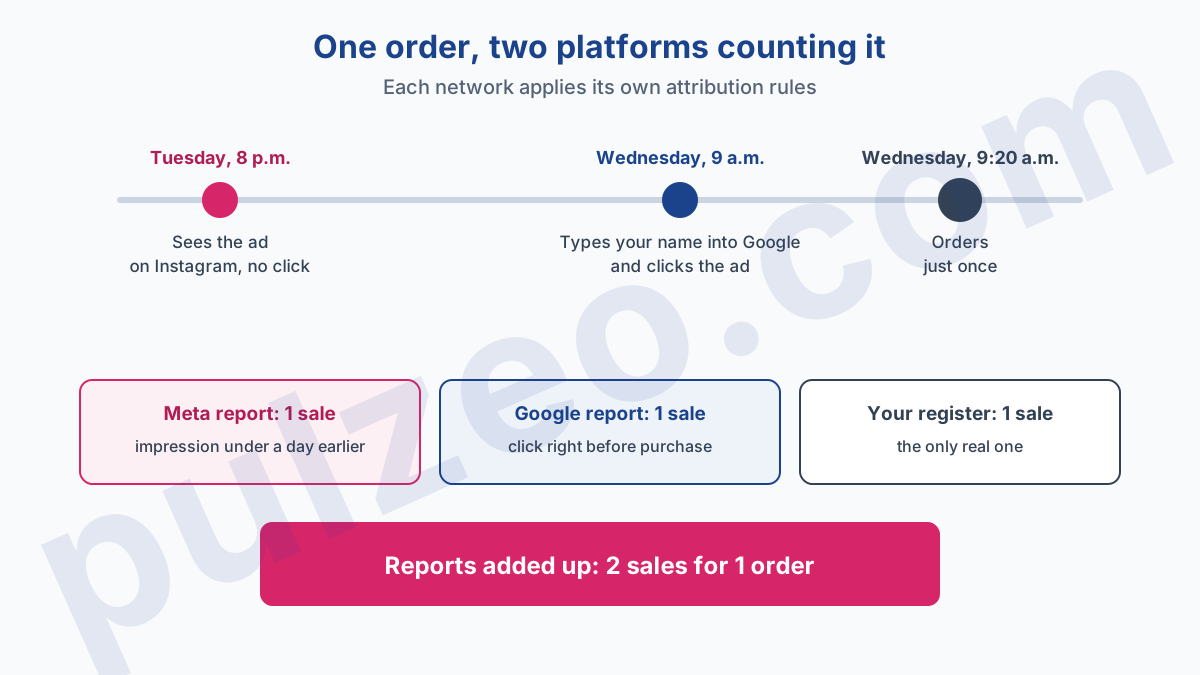
Meta acknowledges this for its own settings, too:
"Each attribution model uses different counting mechanisms." Meta Business Help
The fix comes down to three moves, and I put them in place before judging anything:
- a single referee for both networks (Google Analytics, your sales tool, or simply your order book);
- the question "how did you hear about us?" in the contact form, which catches what no tool sees;
- a monthly review, comparing the sum of claimed sales with the number of real sales.
If the two platforms together claim 140 sales for 100 orders, you know how much each one flatters itself.
On the Google Ads side, measurement starts out more accurate when tracking is set up properly from day one: Pulzeo installs the tags in your Google Tag Manager and creates the conversion action of your choice, form or sale, without a developer. The settings that skew that tracking are covered in the guide to misconfigured conversions.
Should you run Google Ads and Facebook Ads at the same time?
Yes, when the budget allows and a first platform is already running properly. The two complement each other well, provided you give them distinct roles.
The pattern that works most often: Google Ads captures the people searching, Meta Ads makes the brand known to people who aren't searching yet and reminds visitors who left without buying of your offer. The day your name starts being typed into Google, it's often Meta that planted the seed.
A useful nuance: Google has its own "feed" formats too. Demand Gen campaigns serve on YouTube, Discover, Gmail and the Display Network, with audience targeting close to Meta's. If you're already comfortable in Google Ads, it's a way to try discovery logic without opening a second tool. I cover how to use them in the article on Demand Gen.
Where to start on a small budget
Run the search test, pick a platform, and give it a month with a clear goal: a cost per request or per sale your margin can pay for. Not a number of clicks, not a number of likes.
During that month, the main risk is a campaign that spends without producing anything and that you discover at the monthly review. On Google Ads, Pulzeo's alerts flag a campaign that burns its budget without converting, with the figure that triggers it, before the month is lost. On Meta, Pulzeo does nothing: it only works on Google Ads, and it's better to know that before you choose.
Once the month is over, look at the cost per customer measured by your own referee, not by the network. If it holds, scale up. If it doesn't, the second platform deserves its own test, with the same rules.
And if you're still unsure about the budget to commit, the minimum threshold for a Google Ads test to mean anything can be calculated before you spend the first dollar. For day-to-day management, the Pulzeo for businesses page shows what the tool takes care of.
Common questions
Are Facebook Ads cheaper than Google Ads?
Per click, often yes. Per customer, nothing guarantees it: a Facebook click comes from someone scrolling their feed, a Google click from someone looking for your service. Compare the cost per lead or per sale, measured over a month and by the same tool, never the CPC each platform displays.
How much budget do you need to test Facebook Ads or Google Ads?
Think in conversions, not dollars. Estimate what a customer would cost you, multiply by about thirty conversions, and see whether that budget holds over the test period. Below that, the test result is indistinguishable from chance, whatever the platform.
Can you run ads on Instagram with Facebook Ads?
Yes. Meta Ads Manager runs the same campaigns on Facebook, on Instagram and on other Meta placements. Saying Facebook Ads or Meta Ads amounts to the same thing: one tool, one auction, several apps.
Can Google Ads show ads in a feed, like Facebook?
Yes, with Demand Gen campaigns. According to Google's help, they serve on YouTube, Discover, Gmail and the Display Network. You target audiences rather than keywords, which brings their logic close to Meta's, with the same limits: they create interest, they don't capture a search.