How much do TikTok ads cost

You want to try TikTok ads and you are looking for a price. Bad news first: TikTok does not publish one. No rate card, no official cost per view, no price per click. What the platform does publish are budget floors and billing rules.
The good news is that those rules are enough to run the calculation that matters. The budget that matters is the one that gets you about 25 results in the first week, and you work it out from your own cost per result. I will show you how to get that number before you spend, using the figures TikTok documents itself.
TikTok ads pricing: what TikTok actually publishes
TikTok publishes three things: minimum budgets, billing methods and a rule of thumb on how long learning takes. It publishes no price per click, per view or per thousand impressions.
I went through the TikTok Ads help center before writing this. Its only dollar figures concern the minimum budget for a campaign and an ad group. TikTok for Business's sales page adds a recommended daily spend, and that is all.
The CPM figures you see online therefore come from agencies or blogs, each with its own sample, industry and time period. They do not line up with one another, and mostly they measure the account of whoever publishes them.
My view on this is firm: an average CPM found on the internet is useless for making a decision. You are not paying for impressions, you are buying sales or quote requests. The only TikTok ads cost that concerns you is your cost per result, and you measure it in your own account.
TikTok ads minimum budget
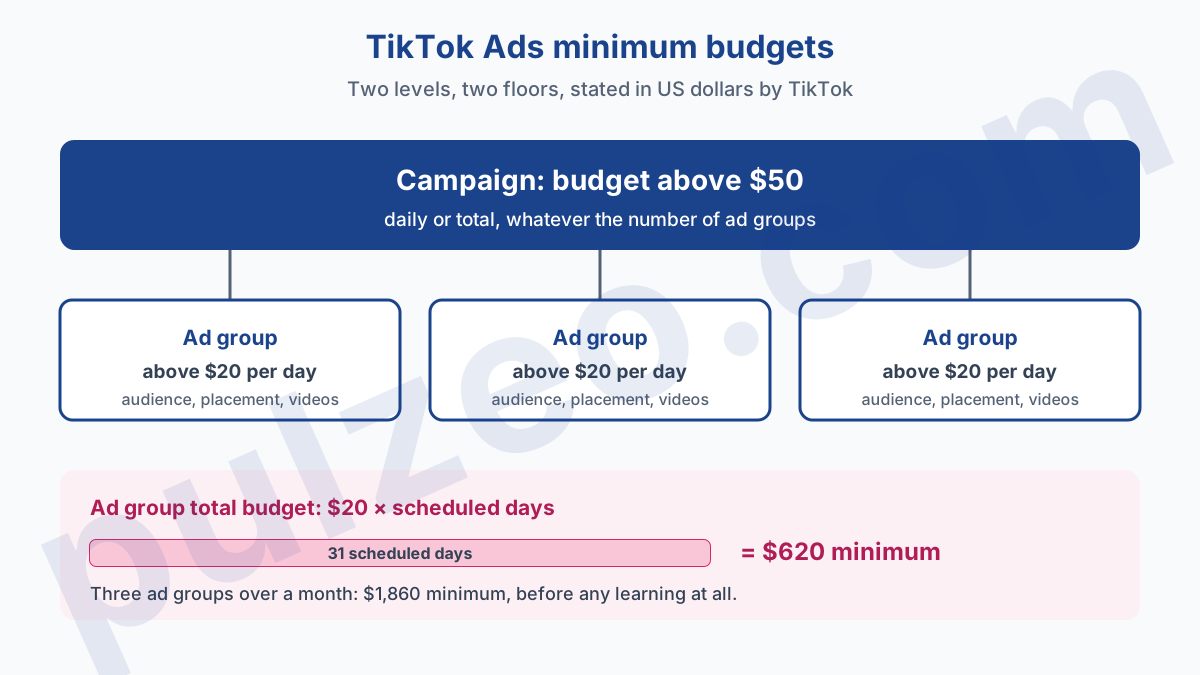
In Ads Manager, a campaign budget must exceed $50, and an ad group budget $20 per day. The documentation states these floors in US dollars and gives no equivalent in other currencies: on an account in another currency, go by the amount the interface shows when you create it.
A TikTok campaign has three levels, just like Google Ads: campaign, ad groups, ads. The campaign holds the objective, the ad group the audience and placement, the ad the video. Budget is set on the first two levels, and each has its own floor.
The campaign budget
At campaign level, the rule fits in one line of the help page on daily budgets: both the daily budget and the total budget must exceed $50. It does not matter how many ad groups the campaign contains.
TikTok adds a useful warning: the campaign budget should not be lower than the budget of one of its ad groups, as this can cause delivery issues. The ceiling at the top has to leave room for the ones below.
The ad group budget
At ad group level, the daily budget must exceed $20. The total budget is calculated: $20 multiplied by the number of scheduled days, past days included. TikTok's own example says it all, an ad group scheduled for 31 days needs at least $620.
This is where the floor surprises people. Three ad groups running for a month already come to $1,860 at the very least, before you have learned anything.
One detail TikTok's pages do not settle: one describes the daily budget as an average, another as a maximum. They agree on two points. The total budget is not exceeded by the end of the campaign, and an ad group that reaches its allocated budget stops delivering on its own.
How do TikTok ads work: bidding and billing
TikTok Ads runs on auctions, like Google Ads: every impression is contested between advertisers, and the price depends on competition for your audience. The help center offers only two bidding strategies.
The first, target cost per result, aims for a cost per action that you set. TikTok warns that the actual cost can land slightly above or below the target. The second, maximum results, spends the budget to get as many results as possible, with no cost ceiling.
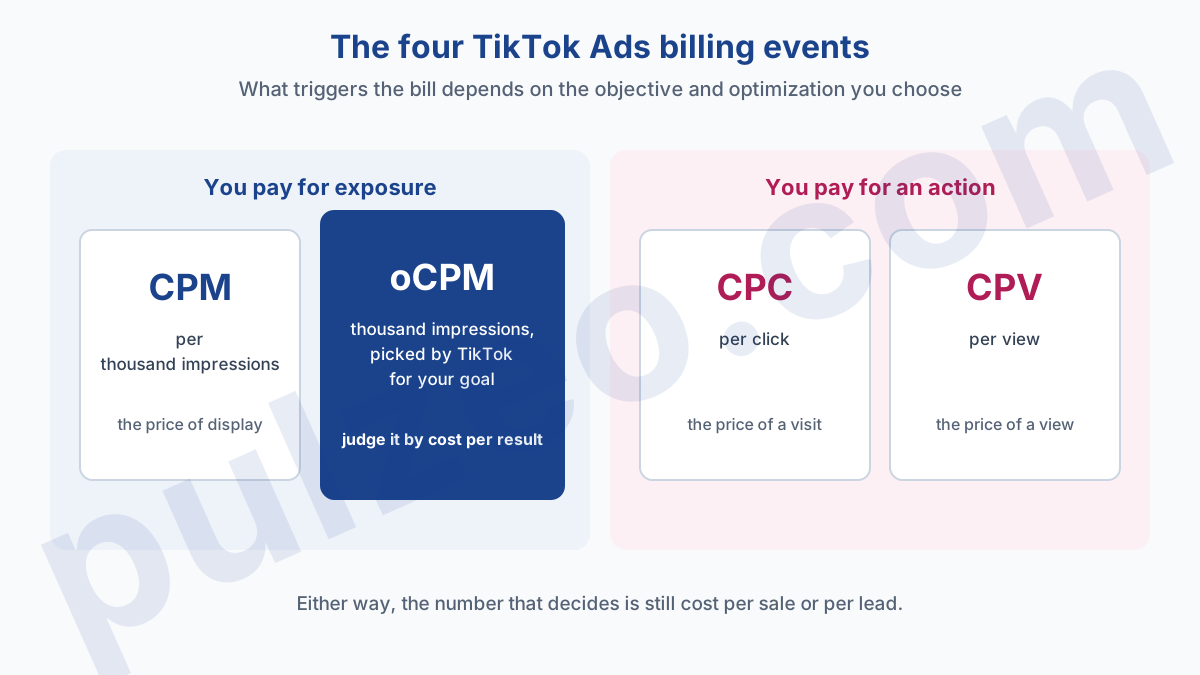
That leaves the question of what triggers the bill. TikTok lists four billing events, available depending on the objective and optimization:
- CPM, cost per thousand impressions;
- oCPM, the same CPM, optimized toward the goal you chose;
- CPC, cost per click;
- CPV, cost per view.
The classic trap is oCPM. You are billed per thousand impressions, but the system picks those impressions to get conversions. Your cost per thousand impressions can therefore rise while your cost per sale falls, and that is good news. Judging an optimized campaign on its CPM means judging it on the wrong number.
What budget do you need for TikTok ads?
The budget a TikTok campaign actually needs is calculated from learning. TikTok places the end of the most unstable period at around 25 results or 7 days: aim for the 25 results within the first week, so both markers line up, and multiply by your cost per result.
That benchmark comes from TikTok's page on the learning phase, the period during which the system looks for the right people for your goal. The sentence is cautious, and it is worth reading exactly as written:
"Typically, volatility starts to decline after about 25 campaign results or 7 days from when the campaign enters the learning phase." TikTok Ads help center, "Learning Phase" page.
Run the numbers with three different costs per result. At $12 a result, 25 results in a week take $300, or about $43 a day. At $30, you need $750 a week, about $107 a day. At $60, for example a quote request for an expensive service, it climbs to $1,500 a week, about $214 a day.
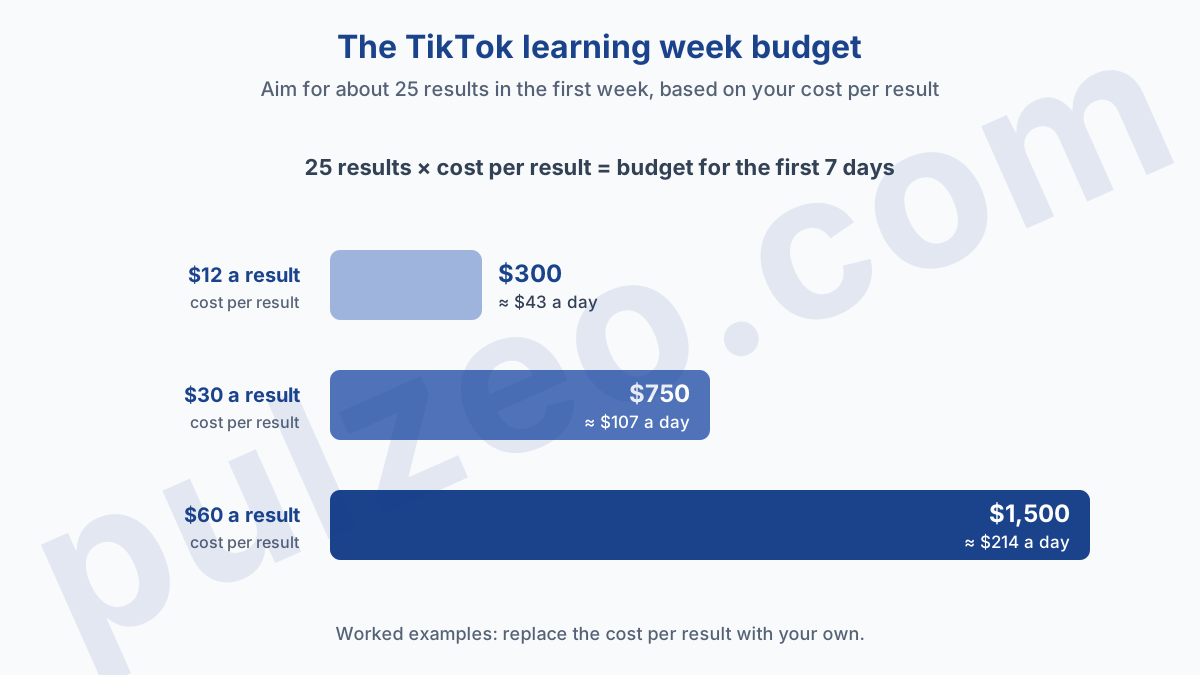
Brought down to a daily figure, all three budgets sit well above the official floors. That is the whole point of the calculation: the technical minimum lets you deliver, it does not let you learn. A campaign that gets six results in a week stays in the fog, and you will pay for that fog for longer.
TikTok says as much in its own way. On its sales page about budgeting, the platform recommends, for a web conversion campaign in North America and EMEA (Europe, Middle East and Africa), at least $30 per day per ad group, above its own floor of $20.
And where does your cost per result come from if you have never advertised on TikTok? Start from the one you already know on another ad platform, then build in some margin. If you run Google Ads, Pulzeo shows your cost per conversion and how it moved against the previous period on a single dashboard: that is the number to compare against.
The same logic holds on Google, where a budget too small to get enough conversions makes you pay without learning anything. One last rule, which TikTok lists among the practices to avoid: do not pause the campaign, and avoid mid-week edits that restart learning.
How to pay for a TikTok promotion
There are two ways to buy visibility on TikTok: Ads Manager, the advertisers' tool, and Promote, the promotion feature built into the app, which boosts a video you have already posted. They are not paid for the same way.
Promote accepts, according to the help center:
- credit or debit cards, and bank account details;
- gift cards and e-wallets;
- TikTok Coins;
- GMV Pay, which draws on TikTok Shop earnings;
- your Promote balance and your Ads Manager balance.
Two points from TikTok deserve attention before you pay. Additional mobile fees may apply to payment methods used in the app. And your Promote balance can no longer be withdrawn to your bank account once Promote is linked to Ads Manager.
As for refunds, unspent budget goes back to your Promote balance if the order is closed early or fails review. Coupons used to pay, on the other hand, may not be returned.
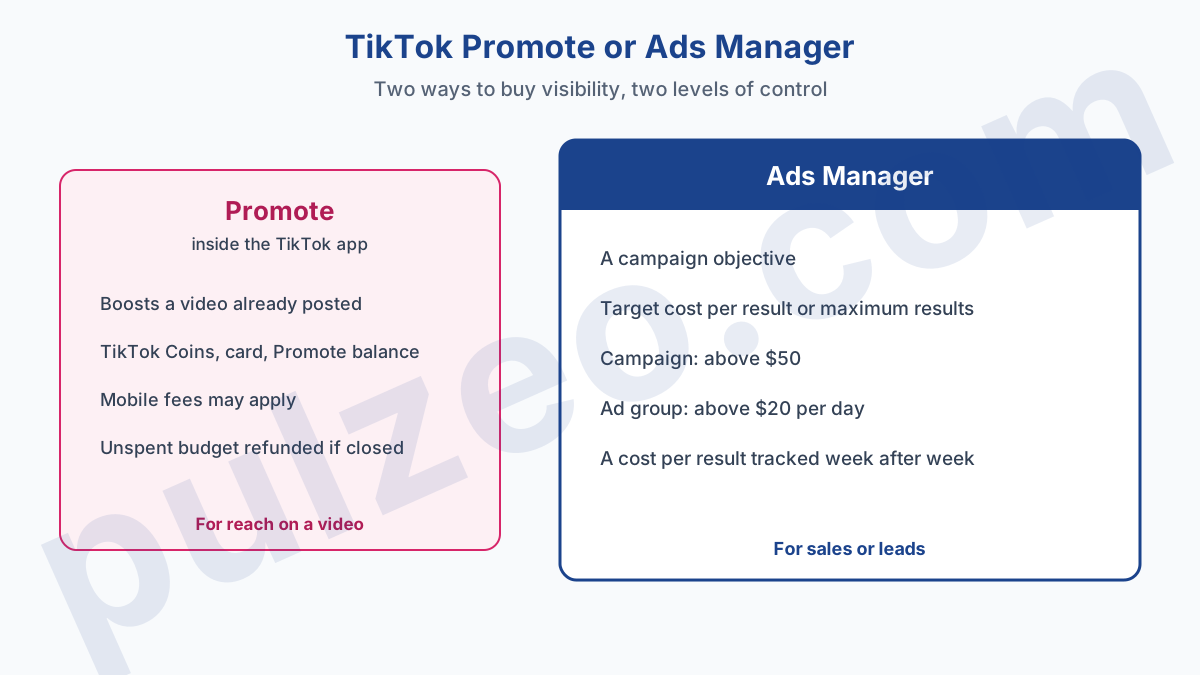
For a business that wants sales or leads, I recommend Ads Manager. You choose your objective and your bidding strategy, and you read a cost per result you can compare week to week. Promote remains handy for giving reach to a video that is already working.
TikTok ads or Google Ads: where to put your first budget
TikTok ads and Google Ads do not sell the same moment. On TikTok, you interrupt someone who was scrolling through videos and make them want something. On Google, you answer someone who has just typed what you sell.
That difference shows up in the cost per customer. A TikTok impression can be cheap, but the person had not asked for anything, and you often need a lot of them to get a sale. The same calculation comes back on every social ad platform: I covered it in detail in the Google Ads vs Facebook Ads comparison, and for video in the article on the cost of YouTube ads.
My starting rule is simple. If people already search for your service on Google, capture that demand first, it is the cheapest to convert. TikTok becomes interesting after that, to create demand that nobody is expressing yet, with a product that shows well on video.
The day you run both, compare them on the same measure: cost per sale or per lead, counted over the same period. For the Google Ads side, that is exactly what Pulzeo for businesses tracks: the cost per conversion of each campaign, and an alert when a campaign spends its budget without selling anything.
Common questions
What is the minimum budget to advertise on TikTok?
In TikTok Ads Manager, a campaign budget must exceed $50, and an ad group's daily budget must exceed $20. Those are technical floors. For web conversion campaigns, TikTok itself recommends at least $30 per day per ad group in North America and EMEA (Europe, Middle East and Africa), and the budget that actually works depends mostly on your cost per result.
Does TikTok charge per click or per impression?
Both exist. TikTok lists four billing events: CPM (per thousand impressions), oCPM (CPM optimized toward a goal), CPC (per click) and CPV (per view). Which one applies depends on the objective and optimization you choose for the campaign.
How long before you can judge a TikTok campaign?
At least a week. According to the TikTok Ads help center, volatility typically starts to decline after about 25 results or 7 days of learning. Judging earlier means reading noise, and pausing or editing the campaign restarts that learning.
Is unspent TikTok Promote budget refunded?
Yes, in two specific cases: if the order is closed early, or if it fails review. The remainder then goes back to your Promote balance. TikTok does note, however, that coupons used to pay for an order may not be returned.