How does white label Google Ads management work

White label Google Ads management works like this: an agency sells campaign management to an advertiser under its own name, and hands the actual work to a provider who stays invisible. The advertiser only talks to the agency, receives the agency's reports and pays the agency's invoices. The provider works inside the account through the access the agency gives them.
On paper, it is simple. In practice, three questions decide whether the arrangement holds: who does exactly what, who owns the account, and what Google allows an agency that resells a service it does not produce.
Almost every page explaining white label management is written by a provider that sells it. They talk about growth without hiring, rarely about account ownership, never about Google's policy. Yet that is where these arrangements crack, the day a client wants to leave.
What does white label mean in Google Ads?
White label describes a service produced by one company and sold by another, under the seller's name. In Google Ads, the service is campaign management: setup, settings, optimization, reporting.
Three parties share the work. The advertiser pays Google for clicks and the agency for management. The agency owns the relationship, the contract, the invoice and the stated strategy. The provider, a specialist agency or a freelancer, does the work in the account and prepares the material for the reports, without ever appearing.
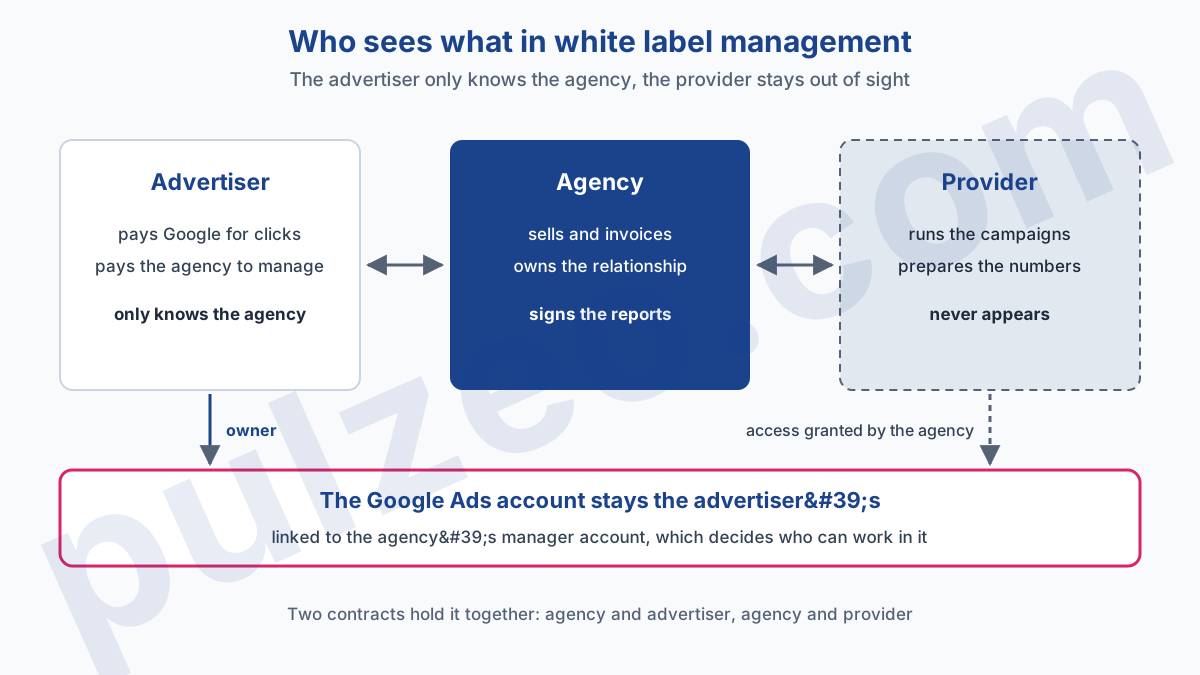
The most common setup is the branding or web design agency that does not do Google Ads, but whose clients ask for it. Rather than turning them down or hiring, it resells a specialist's skills. A busy Google Ads agency that hands part of its accounts to a freelancer follows the same principle.
Google Ads subcontracting: who does what?
In Google Ads subcontracting, the agency keeps everything that touches the client and the provider everything that touches the account. That line is worth putting in writing.
The agency sells, gathers the goals, presents the results and answers questions. The provider structures the campaigns, picks the keywords, writes the ads, sets the bids, watches the spend and prepares the month's numbers. Between the two flows information that is easily lost: a client launching a promotion, changing prices or closing a location tells the agency, and the provider finds out too late.
On access, the agency links the advertiser's account to its manager account (how that works is covered in the article on what a Google Ads manager account is used for). It then gives the provider user access, either to the manager account or to the client account alone. The second option is safer: each access can be removed account by account.
The contract between the agency and its subcontractor deserves more attention than the one between the agency and the client, because it governs what the client never sees. At a minimum, it should set:
- the exact scope of work and the response time to a client request;
- a ban on the provider soliciting or contacting the end client;
- who owns the ads, keyword lists and reports produced;
- the exit terms, including removing access and handing over files.
The exit clause is the one people forget, because they sign assuming everything will go well. For the contract between agency and client, the points to check are the same as for any agency, covered in what to check in a Google Ads agency contract.
Who owns the Google Ads account in a white label setup?
A Google Ads account has only one owner. According to Google's help page on client account ownership, an account created from a manager account belongs to that manager account, whereas an existing account that gets linked to it is not owned by it by default.
That detail changes everything in white label management. If the agency creates its client's account from its own manager account, it becomes the owner. If the client creates the account and links it afterwards, the client stays in control. The same page states that the client account always owns its data, and can remove ownership by unlinking the manager account.
My advice is firm:
The account should be created by the advertiser, in their name, with their payment method, then linked to the agency.
The advertiser pays for the clicks. Nothing justifies them having to ask permission to look at their own campaigns.
What the account keeps after unlinking
The break does less damage than people fear. According to Google's help page on unlinking, an unlinked account loses neither its campaign history nor access to Google Ads features. The account remains the advertiser's, and it can be linked to a new manager right away.
What stops when the agency leaves
What breaks are the things the account borrowed from the manager account. The same page lists three:
- remarketing lists fed by the agency's shared tag stop filling, and the ad groups targeting them stop serving;
- cross-account conversion tracking stops, except for earlier clicks, during their tracking window;
- if the agency was the payments manager on monthly invoicing, the account stops serving until new billing is set up.
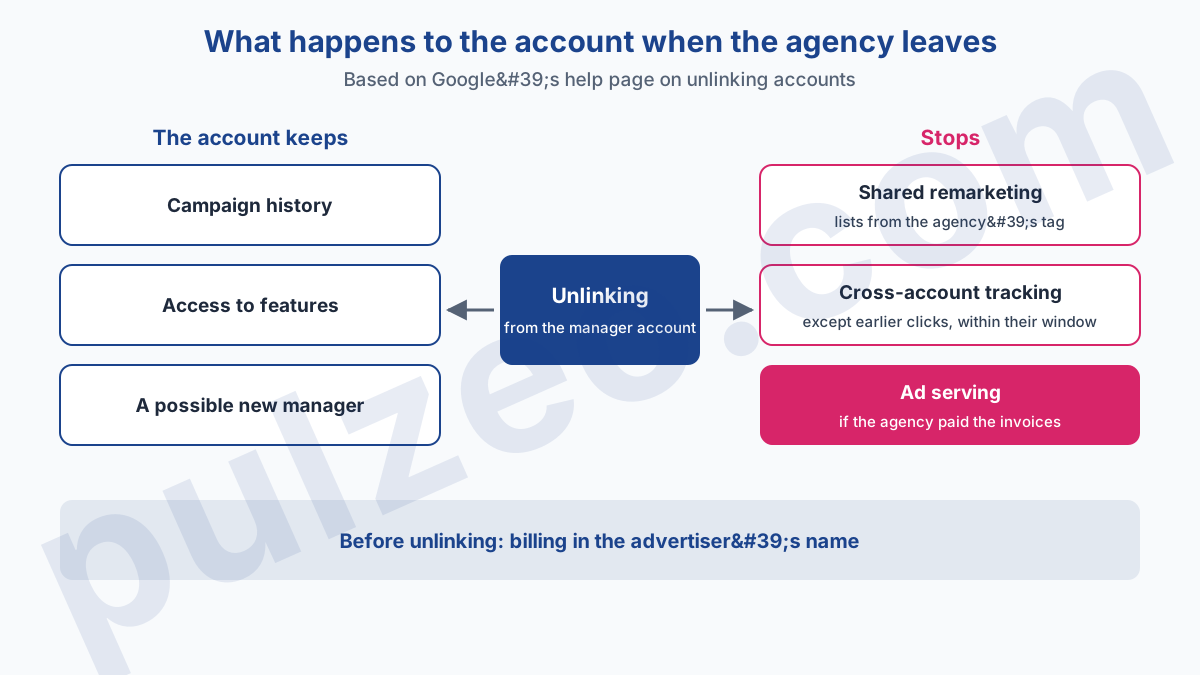
The third point is the most brutal: ads that stop dead on the day you leave. Before unlinking anything, set up billing in the advertiser's name.
Google Ads for agencies: Google's third-party rules
White label status exempts you from nothing. Google's Third-party policy applies to every third party that buys or manages Google ads on behalf of clients. An agency reselling management is one of them, whether or not it produces the work itself.
The same policy requires a separate account for each end advertiser: no single account in which the agency runs several clients' campaigns.
The costs the client must be able to see
When the contract includes a monthly report, Google requires it to show at least cost, clicks and impressions at the account level. Google's cost must appear at the exact amount Google billed, without the agency's fees. A more granular report, daily or by keyword, means providing Google Ads data at the same level of detail.
The client must be able to access these reports easily, by email, on a website or in their account. And the agency must give the client their Google Ads customer ID if they ask for it. In other words, the client may not know who touches their account, but they have a right to know what Google charges them.
Management fees and forbidden promises
The agency must tell its clients whether it charges management fees separate from Google Ads costs. It informs them in writing before the first sale, and the amount appears on invoices. When 80% or more of its clients spend less than $1,000 a month on Google Ads, it must also share Google's guide on working with third parties.
Then comes the list of forbidden promises, summed up by the policy in one sentence:
"Avoid making false, misleading, or unrealistic claims." (Google's Third-party policy)
The examples given are specific: claiming to be affiliated with Google, guaranteeing top placement, promising that ads will always show, offering unlimited clicks. In a white label setup, the temptation is real, because the person selling is not the person who knows what the account can deliver. Penalties range from losing privileges to account suspension, and Google may contact the agency's clients directly.
White label report: what the client should receive
The white label report is the visible part of the arrangement. It carries the agency's logo, colors and name, and nothing in it gives away the tool or provider that produced it. It is also the document the client reads when deciding whether to renew.
Its look is free, its foundation is not. Account cost, clicks and impressions, at the exact amount Google billed, come from the policy. Next comes what the client actually wants: their conversions, the cost of each one, how they moved over the month. And finally what the agency adds, the part that justifies its fee: what was done, why, and what comes next.
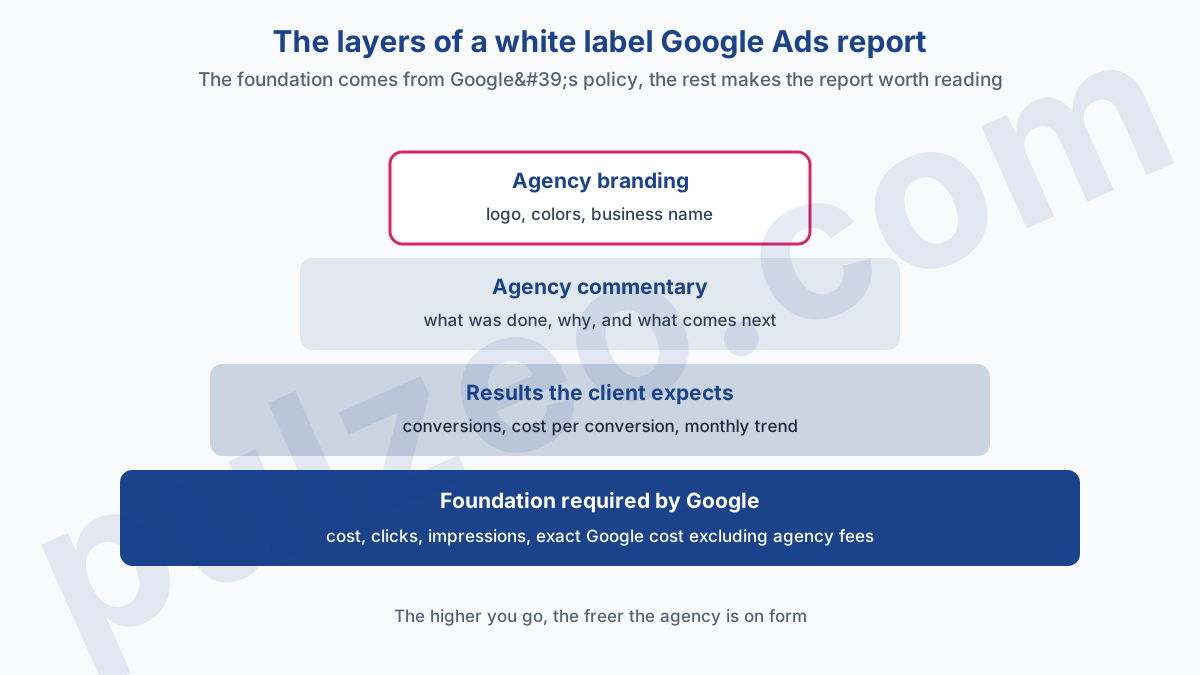
The classic trap is the opposite: a gorgeous report, packed with charts, that leaves out the cost Google billed or buries it in a total that mixes clicks and fees. It pleases at first glance and does not hold up against the rule. What makes a client report keep clients is covered in how to automate Google Ads client reports.
Producing these reports is the most repetitive task in the arrangement, and the one best handed to a tool. Pulzeo generates reports with your logo, colors and business name from the Business plan up, and sends them on a fixed schedule.
White label agency: pros and risks
For the agency, the appeal is obvious: selling a skill it does not have, without hiring or training, and absorbing a surge of clients without turning anyone away. For the provider, it means a volume of accounts with no sales effort.
The risks are mentioned less often. The first is the double margin: the advertiser pays two firms for one job, and their management costs more than if they dealt directly with whoever does it. The second is diluted responsibility. The agency answers to the client for work it does not control, and the provider works on an account whose client it only knows secondhand.
The third is the least comfortable. A client who discovers the arrangement, through a provider's name in the change history or a technical question the agency cannot answer, starts wondering what they paid for.
White label works as long as the agency brings something real on top of execution: knowledge of the client, strategy, the relationship. When it only passes messages along, it becomes an expensive middleman, and the client ends up seeing it.
White label service or software: when to keep management in-house
Before signing up for a white label service, ask yourself the real question: are you short on skills, or on time?
If skills are missing, subcontracting is the right answer. A specialist will do better than you at a trade you do not practice, and the extra cost is defensible.
If time is missing, it is often something else. Daily account monitoring, alerts to catch, reports to build every month are tasks people subcontract out of fatigue more than incompetence.
Start by measuring where that time goes. Google Ads itself offers automated rules and scheduled email reports, enough to lighten monitoring and sending without subcontracting anything.
It is also exactly what Pulzeo takes on for an agency that wants to keep its accounts: a portfolio view of every account, alerts when a metric worsens, and white label reports ready to send. The details are on the Pulzeo for agencies page.
Either way, hold the same standard: an account in the advertiser's name, readable costs, a subcontractor bound by a contract. The rest is a question of price.
Common questions
Can a Google Ads account belong to two agencies?
No. According to Google's help center, a client account can have only one owner. Other firms can be given access to the account without becoming owners, and that is how a subcontractor usually works under a white label arrangement.
What do you lose when you leave a Google Ads agency?
Not your history: according to Google's help center, an unlinked account keeps its campaign history. What stops are the things shared by the manager account: remarketing lists fed by its tag, cross-account conversion tracking and, if the agency was the payments manager on monthly invoicing, ad serving itself until new billing is set up.
Can an agency refuse to give you your Google Ads customer ID?
No. Google's Third-party policy requires agencies to give advertisers who ask for it their Google Ads customer ID. It is the bare minimum for the advertiser to check their account, take it back, or hand it to someone else.
What is a white label Google Ads report?
It is a performance report presented with the agency's logo, colors and name, with no trace of the tool or subcontractor that produced it. The agency chooses how it looks, but if it is monthly, Google requires it to show at least the account's cost, clicks and impressions.